

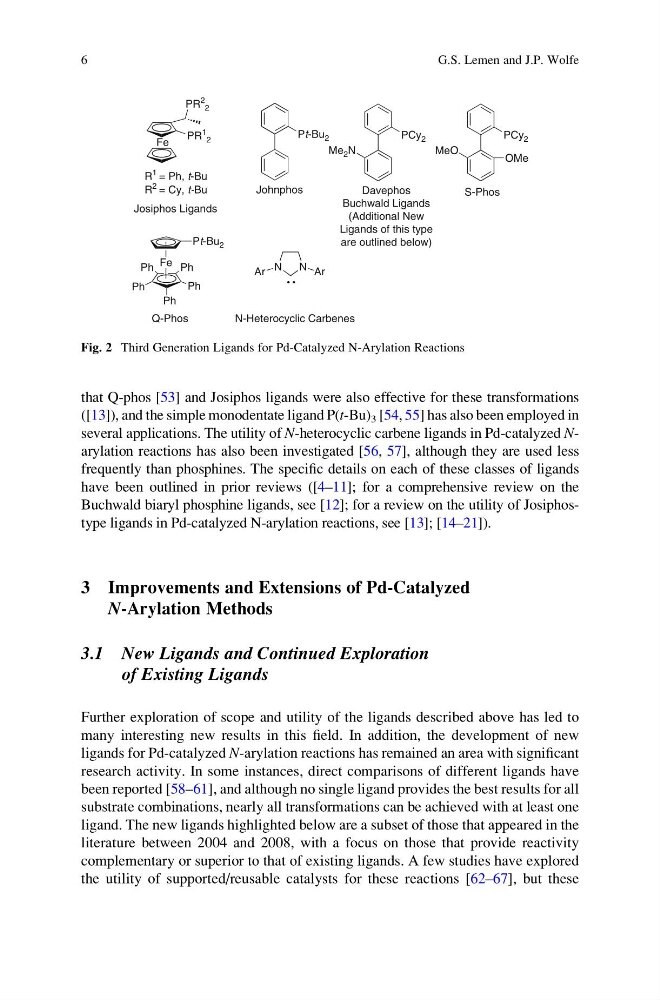
that Q-phos [53] and Josiphos ligands were also effective for these transformations
([13]), and the simple monodentate ligand P(t-Bu) 3 [54, 55] has also been employed in
several applications. The utility of N-heterocyclic carbene ligands in Pd-catalyzed Narylation reactions has also been investigated [56, 57], although they are used less
frequently than phosphines. The specific details on each of these classes of ligands
have been outlined in prior reviews ([4–11]; for a comprehensive review on the
Buchwald biaryl phosphine ligands, see [12]; for a review on the utility of Josiphostype ligands in Pd-catalyzed N-arylation reactions, see [13]; [14–21]).
3 Improvements and Extensions of Pd-Catalyzed
N-Arylation Methods
3.1 New Ligands and Continued Exploration
of Existing Ligands
Further exploration of scope and utility of the ligands described above has led to
many interesting new results in this field. In addition, the development of new
ligands for Pd-catalyzed N-arylation reactions has remained an area with significant
research activity. In some instances, direct comparisons of different ligands have
been reported [58–61], and although no single ligand provides the best results for all
substrate combinations, nearly all transformations can be achieved with at least one
ligand. The new ligands highlighted below are a subset of those that appeared in the
literature between 2004 and 2008, with a focus on those that provide reactivity
complementary or superior to that of existing ligands. A few studies have explored
the utility of supported/reusable catalysts for these reactions [62–67], but these
Fe
Fe
PR
1
2
PR
2
2
Josiphos Ligands
Pt-Bu 2
R
1 = Ph, t-Bu
R
2 = Cy, t-Bu
Johnphos
Q-Phos
Pt-Bu 2
Ph
Ph
Ph
Ph
Ph
N
N
Ar
Ar
N-Heterocyclic Carbenes
PCy 2
Davephos
Buchwald Ligands
(Additional New
Ligands of this type
are outlined below)
Me 2 N
PCy 2
MeO
S-Phos
OMe
Fig. 2 Third Generation Ligands for Pd-Catalyzed N-Arylation Reactions
6
G.S. Lemen and J.P. Wolfe
([13]), and the simple monodentate ligand P(t-Bu) 3 [54, 55] has also been employed in
several applications. The utility of N-heterocyclic carbene ligands in Pd-catalyzed Narylation reactions has also been investigated [56, 57], although they are used less
frequently than phosphines. The specific details on each of these classes of ligands
have been outlined in prior reviews ([4–11]; for a comprehensive review on the
Buchwald biaryl phosphine ligands, see [12]; for a review on the utility of Josiphostype ligands in Pd-catalyzed N-arylation reactions, see [13]; [14–21]).
3 Improvements and Extensions of Pd-Catalyzed
N-Arylation Methods
3.1 New Ligands and Continued Exploration
of Existing Ligands
Further exploration of scope and utility of the ligands described above has led to
many interesting new results in this field. In addition, the development of new
ligands for Pd-catalyzed N-arylation reactions has remained an area with significant
research activity. In some instances, direct comparisons of different ligands have
been reported [58–61], and although no single ligand provides the best results for all
substrate combinations, nearly all transformations can be achieved with at least one
ligand. The new ligands highlighted below are a subset of those that appeared in the
literature between 2004 and 2008, with a focus on those that provide reactivity
complementary or superior to that of existing ligands. A few studies have explored
the utility of supported/reusable catalysts for these reactions [62–67], but these
Fe
Fe
PR
1
2
PR
2
2
Josiphos Ligands
Pt-Bu 2
R
1 = Ph, t-Bu
R
2 = Cy, t-Bu
Johnphos
Q-Phos
Pt-Bu 2
Ph
Ph
Ph
Ph
Ph
N
N
Ar
Ar
N-Heterocyclic Carbenes
PCy 2
Davephos
Buchwald Ligands
(Additional New
Ligands of this type
are outlined below)
Me 2 N
PCy 2
MeO
S-Phos
OMe
Fig. 2 Third Generation Ligands for Pd-Catalyzed N-Arylation Reactions
6
G.S. Lemen and J.P. Wolfe