

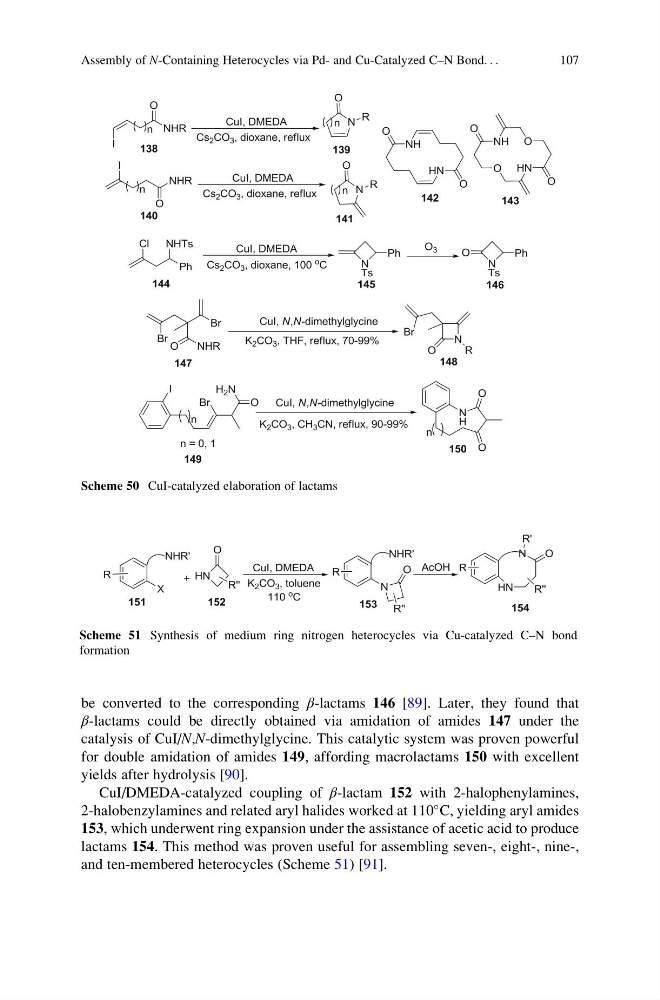
be converted to the corresponding β-lactams 146 [89]. Later, they found that
β-lactams could be directly obtained via amidation of amides 147 under the
catalysis of CuI/N,N-dimethylglycine. This catalytic system was proven powerful
for double amidation of amides 149, affording macrolactams 150 with excellent
yields after hydrolysis [90].
CuI/DMEDA-catalyzed coupling of β-lactam 152 with 2-halophenylamines,
2-halobenzylamines and related aryl halides worked at 110
C, yielding aryl amides
153, which underwent ring expansion under the assistance of acetic acid to produce
lactams 154. This method was proven useful for assembling seven-, eight-, nine-,
and ten-membered heterocycles (Scheme 51) [91].
Scheme 50 CuI-catalyzed elaboration of lactams
Scheme 51 Synthesis of medium ring nitrogen heterocycles via Cu-catalyzed C–N bond
formation
Assembly of N-Containing Heterocycles via Pd- and Cu-Catalyzed C–N Bond. . .
107
β-lactams could be directly obtained via amidation of amides 147 under the
catalysis of CuI/N,N-dimethylglycine. This catalytic system was proven powerful
for double amidation of amides 149, affording macrolactams 150 with excellent
yields after hydrolysis [90].
CuI/DMEDA-catalyzed coupling of β-lactam 152 with 2-halophenylamines,
2-halobenzylamines and related aryl halides worked at 110
C, yielding aryl amides
153, which underwent ring expansion under the assistance of acetic acid to produce
lactams 154. This method was proven useful for assembling seven-, eight-, nine-,
and ten-membered heterocycles (Scheme 51) [91].
Scheme 50 CuI-catalyzed elaboration of lactams
Scheme 51 Synthesis of medium ring nitrogen heterocycles via Cu-catalyzed C–N bond
formation
Assembly of N-Containing Heterocycles via Pd- and Cu-Catalyzed C–N Bond. . .
107