

9 Carbapenems
Two reports on the synthesis of carbapenems via N-vinylation have been disclosed.
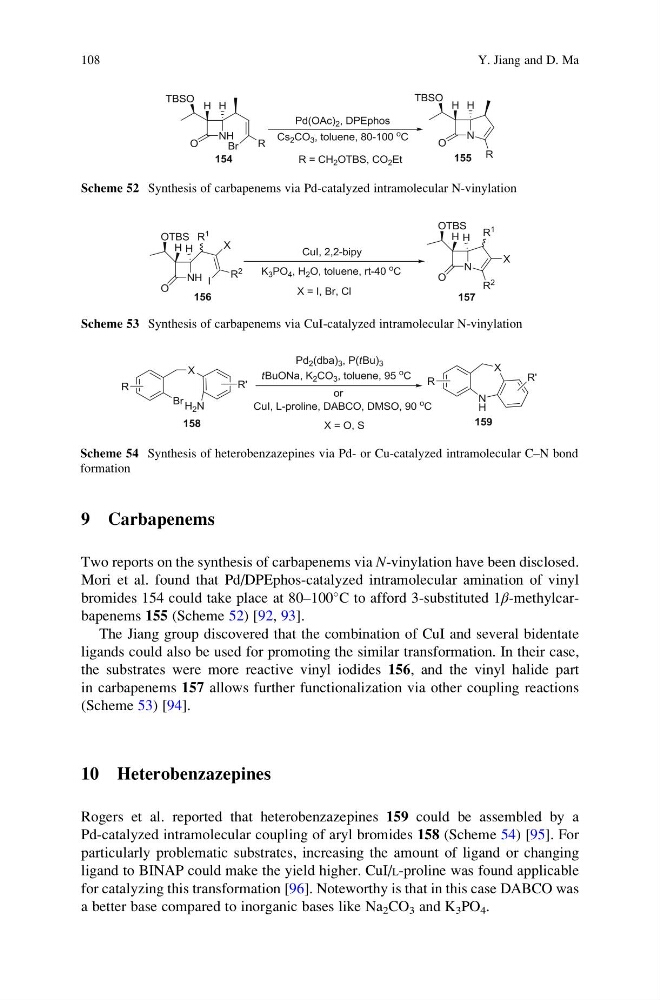
Mori et al. found that Pd/DPEphos-catalyzed intramolecular amination of vinyl
bromides 154 could take place at 80–100
C to afford 3-substituted 1β-methylcarbapenems 155 (Scheme 52) [92, 93].
The Jiang group discovered that the combination of CuI and several bidentate
ligands could also be used for promoting the similar transformation. In their case,
the substrates were more reactive vinyl iodides 156, and the vinyl halide part
in carbapenems 157 allows further functionalization via other coupling reactions
(Scheme 53) [94].
10 Heterobenzazepines
Rogers et al. reported that heterobenzazepines 159 could be assembled by a
Pd-catalyzed intramolecular coupling of aryl bromides 158 (Scheme 54) [95]. For
particularly problematic substrates, increasing the amount of ligand or changing
ligand to BINAP could make the yield higher. CuI/L-proline was found applicable
for catalyzing this transformation [96]. Noteworthy is that in this case DABCO was
a better base compared to inorganic bases like Na 2 CO 3 and K 3 PO 4 .
Scheme 52 Synthesis of carbapenems via Pd-catalyzed intramolecular N-vinylation
Scheme 53 Synthesis of carbapenems via CuI-catalyzed intramolecular N-vinylation
Scheme 54 Synthesis of heterobenzazepines via Pd- or Cu-catalyzed intramolecular C–N bond
formation
108
Y. Jiang and D. Ma
Two reports on the synthesis of carbapenems via N-vinylation have been disclosed.
Mori et al. found that Pd/DPEphos-catalyzed intramolecular amination of vinyl
bromides 154 could take place at 80–100
C to afford 3-substituted 1β-methylcarbapenems 155 (Scheme 52) [92, 93].
The Jiang group discovered that the combination of CuI and several bidentate
ligands could also be used for promoting the similar transformation. In their case,
the substrates were more reactive vinyl iodides 156, and the vinyl halide part
in carbapenems 157 allows further functionalization via other coupling reactions
(Scheme 53) [94].
10 Heterobenzazepines
Rogers et al. reported that heterobenzazepines 159 could be assembled by a
Pd-catalyzed intramolecular coupling of aryl bromides 158 (Scheme 54) [95]. For
particularly problematic substrates, increasing the amount of ligand or changing
ligand to BINAP could make the yield higher. CuI/L-proline was found applicable
for catalyzing this transformation [96]. Noteworthy is that in this case DABCO was
a better base compared to inorganic bases like Na 2 CO 3 and K 3 PO 4 .
Scheme 52 Synthesis of carbapenems via Pd-catalyzed intramolecular N-vinylation
Scheme 53 Synthesis of carbapenems via CuI-catalyzed intramolecular N-vinylation
Scheme 54 Synthesis of heterobenzazepines via Pd- or Cu-catalyzed intramolecular C–N bond
formation
108
Y. Jiang and D. Ma