

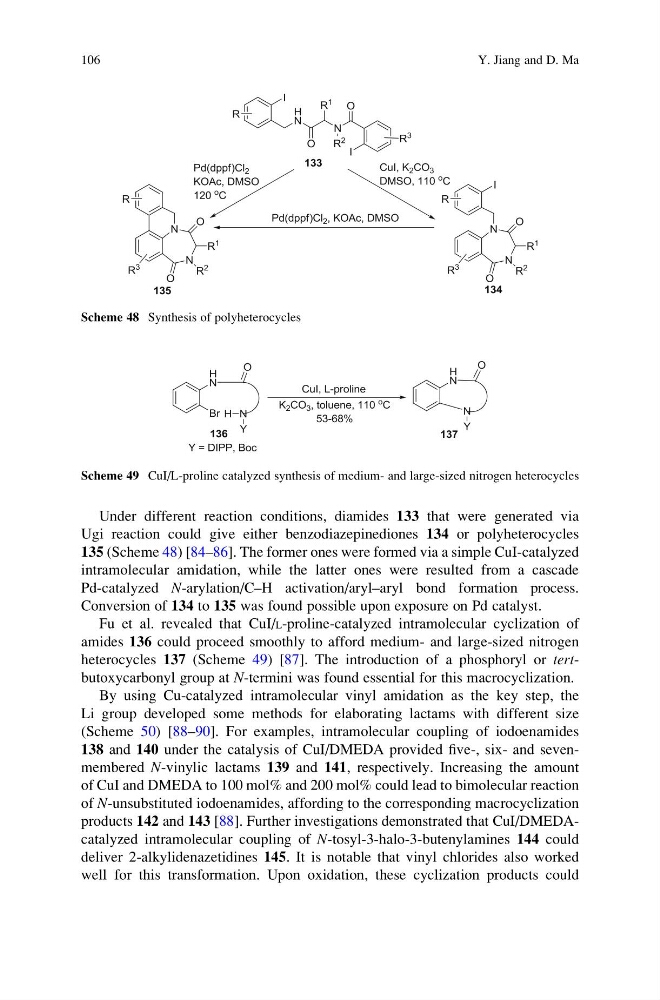
Under different reaction conditions, diamides 133 that were generated via
Ugi reaction could give either benzodiazepinediones 134 or polyheterocycles
135 (Scheme 48) [84–86]. The former ones were formed via a simple CuI-catalyzed
intramolecular amidation, while the latter ones were resulted from a cascade
Pd-catalyzed N-arylation/C–H activation/aryl–aryl bond formation process.
Conversion of 134 to 135 was found possible upon exposure on Pd catalyst.
Fu et al. revealed that CuI/L-proline-catalyzed intramolecular cyclization of
amides 136 could proceed smoothly to afford medium- and large-sized nitrogen
heterocycles 137 (Scheme 49) [87]. The introduction of a phosphoryl or tertbutoxycarbonyl group at N-termini was found essential for this macrocyclization.
By using Cu-catalyzed intramolecular vinyl amidation as the key step, the
Li group developed some methods for elaborating lactams with different size
(Scheme 50) [88–90]. For examples, intramolecular coupling of iodoenamides
138 and 140 under the catalysis of CuI/DMEDA provided five-, six- and sevenmembered N-vinylic lactams 139 and 141, respectively. Increasing the amount
of CuI and DMEDA to 100 mol% and 200 mol% could lead to bimolecular reaction
of N-unsubstituted iodoenamides, affording to the corresponding macrocyclization
products 142 and 143 [88]. Further investigations demonstrated that CuI/DMEDAcatalyzed intramolecular coupling of N-tosyl-3-halo-3-butenylamines 144 could
deliver 2-alkylidenazetidines 145. It is notable that vinyl chlorides also worked
well for this transformation. Upon oxidation, these cyclization products could
Scheme 48 Synthesis of polyheterocycles
Scheme 49 CuI/L-proline catalyzed synthesis of medium- and large-sized nitrogen heterocycles
106
Y. Jiang and D. Ma
Ugi reaction could give either benzodiazepinediones 134 or polyheterocycles
135 (Scheme 48) [84–86]. The former ones were formed via a simple CuI-catalyzed
intramolecular amidation, while the latter ones were resulted from a cascade
Pd-catalyzed N-arylation/C–H activation/aryl–aryl bond formation process.
Conversion of 134 to 135 was found possible upon exposure on Pd catalyst.
Fu et al. revealed that CuI/L-proline-catalyzed intramolecular cyclization of
amides 136 could proceed smoothly to afford medium- and large-sized nitrogen
heterocycles 137 (Scheme 49) [87]. The introduction of a phosphoryl or tertbutoxycarbonyl group at N-termini was found essential for this macrocyclization.
By using Cu-catalyzed intramolecular vinyl amidation as the key step, the
Li group developed some methods for elaborating lactams with different size
(Scheme 50) [88–90]. For examples, intramolecular coupling of iodoenamides
138 and 140 under the catalysis of CuI/DMEDA provided five-, six- and sevenmembered N-vinylic lactams 139 and 141, respectively. Increasing the amount
of CuI and DMEDA to 100 mol% and 200 mol% could lead to bimolecular reaction
of N-unsubstituted iodoenamides, affording to the corresponding macrocyclization
products 142 and 143 [88]. Further investigations demonstrated that CuI/DMEDAcatalyzed intramolecular coupling of N-tosyl-3-halo-3-butenylamines 144 could
deliver 2-alkylidenazetidines 145. It is notable that vinyl chlorides also worked
well for this transformation. Upon oxidation, these cyclization products could
Scheme 48 Synthesis of polyheterocycles
Scheme 49 CuI/L-proline catalyzed synthesis of medium- and large-sized nitrogen heterocycles
106
Y. Jiang and D. Ma