

followed by Cu-catalyzed intramolecular N-arylation furnished various substituted
2-mercapto benzimidazoles. Among ligands examined for this process, 1,10-Phen
gave a best result.
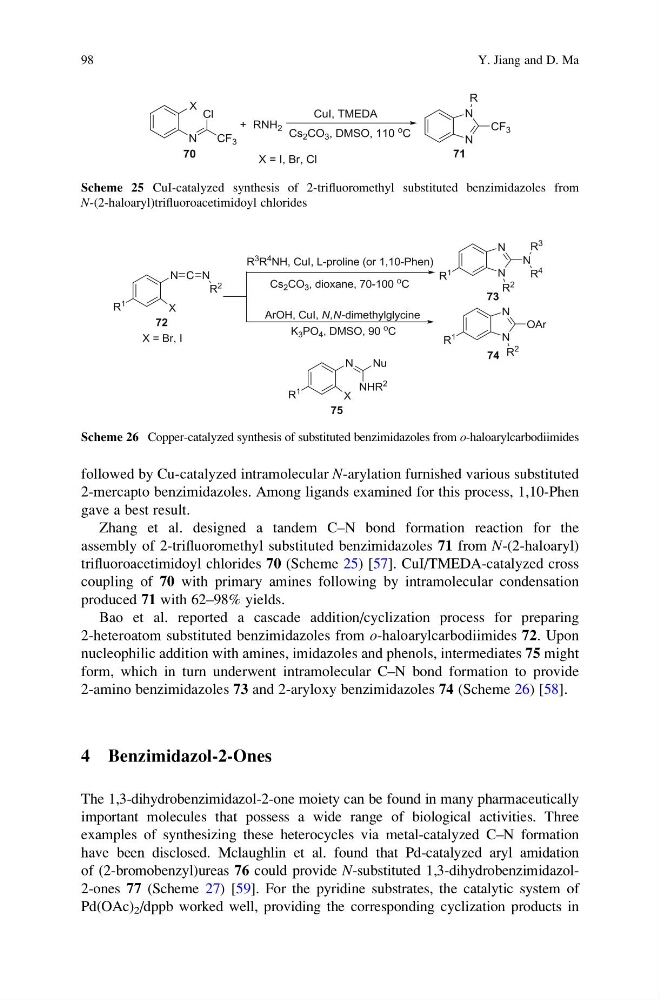
Zhang et al. designed a tandem C–N bond formation reaction for the
assembly of 2-trifluoromethyl substituted benzimidazoles 71 from N-(2-haloaryl)
trifluoroacetimidoyl chlorides 70 (Scheme 25) [57]. CuI/TMEDA-catalyzed cross
coupling of 70 with primary amines following by intramolecular condensation
produced 71 with 62–98% yields.
Bao et al. reported a cascade addition/cyclization process for preparing
2-heteroatom substituted benzimidazoles from o-haloarylcarbodiimides 72. Upon
nucleophilic addition with amines, imidazoles and phenols, intermediates 75 might
form, which in turn underwent intramolecular C–N bond formation to provide
2-amino benzimidazoles 73 and 2-aryloxy benzimidazoles 74 (Scheme 26) [58].
4 Benzimidazol-2-Ones
The 1,3-dihydrobenzimidazol-2-one moiety can be found in many pharmaceutically
important molecules that possess a wide range of biological activities. Three
examples of synthesizing these heterocycles via metal-catalyzed C–N formation
have been disclosed. Mclaughlin et al. found that Pd-catalyzed aryl amidation
of (2-bromobenzyl)ureas 76 could provide N-substituted 1,3-dihydrobenzimidazol2-ones 77 (Scheme 27) [59]. For the pyridine substrates, the catalytic system of
Pd(OAc) 2 /dppb worked well, providing the corresponding cyclization products in
Scheme 25 CuI-catalyzed synthesis of 2-trifluoromethyl substituted benzimidazoles from
N-(2-haloaryl)trifluoroacetimidoyl chlorides
Scheme 26 Copper-catalyzed synthesis of substituted benzimidazoles from o-haloarylcarbodiimides
98
Y. Jiang and D. Ma
2-mercapto benzimidazoles. Among ligands examined for this process, 1,10-Phen
gave a best result.
Zhang et al. designed a tandem C–N bond formation reaction for the
assembly of 2-trifluoromethyl substituted benzimidazoles 71 from N-(2-haloaryl)
trifluoroacetimidoyl chlorides 70 (Scheme 25) [57]. CuI/TMEDA-catalyzed cross
coupling of 70 with primary amines following by intramolecular condensation
produced 71 with 62–98% yields.
Bao et al. reported a cascade addition/cyclization process for preparing
2-heteroatom substituted benzimidazoles from o-haloarylcarbodiimides 72. Upon
nucleophilic addition with amines, imidazoles and phenols, intermediates 75 might
form, which in turn underwent intramolecular C–N bond formation to provide
2-amino benzimidazoles 73 and 2-aryloxy benzimidazoles 74 (Scheme 26) [58].
4 Benzimidazol-2-Ones
The 1,3-dihydrobenzimidazol-2-one moiety can be found in many pharmaceutically
important molecules that possess a wide range of biological activities. Three
examples of synthesizing these heterocycles via metal-catalyzed C–N formation
have been disclosed. Mclaughlin et al. found that Pd-catalyzed aryl amidation
of (2-bromobenzyl)ureas 76 could provide N-substituted 1,3-dihydrobenzimidazol2-ones 77 (Scheme 27) [59]. For the pyridine substrates, the catalytic system of
Pd(OAc) 2 /dppb worked well, providing the corresponding cyclization products in
Scheme 25 CuI-catalyzed synthesis of 2-trifluoromethyl substituted benzimidazoles from
N-(2-haloaryl)trifluoroacetimidoyl chlorides
Scheme 26 Copper-catalyzed synthesis of substituted benzimidazoles from o-haloarylcarbodiimides
98
Y. Jiang and D. Ma