

almost quantitative yield. But for haloaniline substrates, X-phos was a better ligand
for this cyclization.
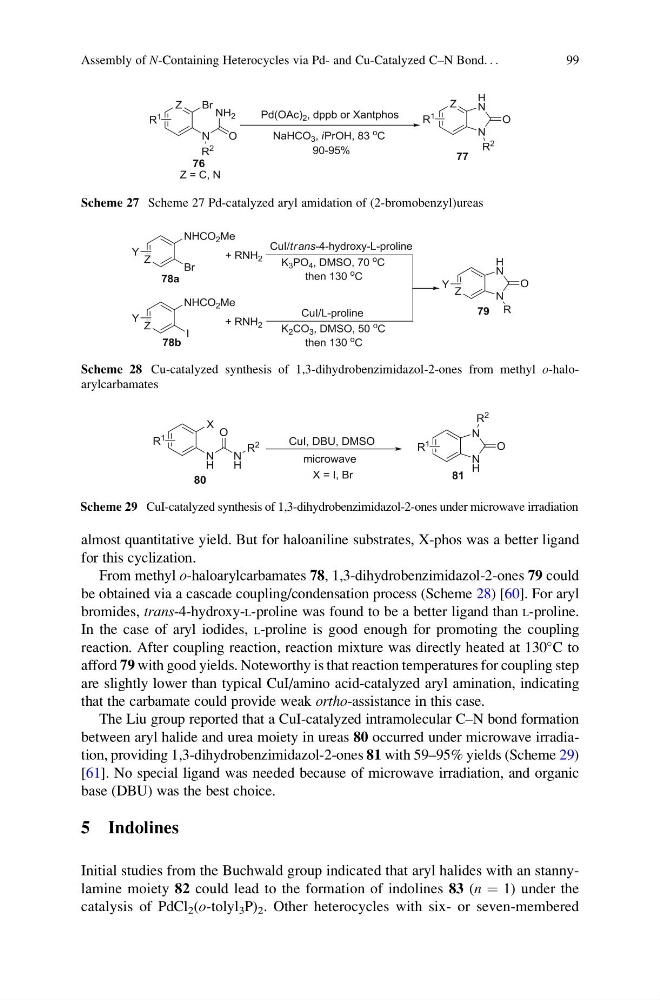
From methyl o-haloarylcarbamates 78, 1,3-dihydrobenzimidazol-2-ones 79 could
be obtained via a cascade coupling/condensation process (Scheme 28) [60]. For aryl
bromides, trans-4-hydroxy-L-proline was found to be a better ligand than L-proline.
In the case of aryl iodides, L-proline is good enough for promoting the coupling
reaction. After coupling reaction, reaction mixture was directly heated at 130
C to
afford 79 with good yields. Noteworthy is that reaction temperatures for coupling step
are slightly lower than typical CuI/amino acid-catalyzed aryl amination, indicating
that the carbamate could provide weak ortho-assistance in this case.
The Liu group reported that a CuI-catalyzed intramolecular C–N bond formation
between aryl halide and urea moiety in ureas 80 occurred under microwave irradiation, providing 1,3-dihydrobenzimidazol-2-ones 81 with 59–95% yields (Scheme 29)
[61]. No special ligand was needed because of microwave irradiation, and organic
base (DBU) was the best choice.
5 Indolines
Initial studies from the Buchwald group indicated that aryl halides with an stannylamine moiety 82 could lead to the formation of indolines 83 (n ¼ 1) under the
catalysis of PdCl 2 (o-tolyl 3 P) 2 . Other heterocycles with six- or seven-membered
Scheme 27 Scheme 27 Pd-catalyzed aryl amidation of (2-bromobenzyl)ureas
Scheme 28 Cu-catalyzed synthesis of 1,3-dihydrobenzimidazol-2-ones from methyl o-haloarylcarbamates
Scheme 29 CuI-catalyzed synthesis of 1,3-dihydrobenzimidazol-2-ones under microwave irradiation
Assembly of N-Containing Heterocycles via Pd- and Cu-Catalyzed C–N Bond. . .
99
for this cyclization.
From methyl o-haloarylcarbamates 78, 1,3-dihydrobenzimidazol-2-ones 79 could
be obtained via a cascade coupling/condensation process (Scheme 28) [60]. For aryl
bromides, trans-4-hydroxy-L-proline was found to be a better ligand than L-proline.
In the case of aryl iodides, L-proline is good enough for promoting the coupling
reaction. After coupling reaction, reaction mixture was directly heated at 130
C to
afford 79 with good yields. Noteworthy is that reaction temperatures for coupling step
are slightly lower than typical CuI/amino acid-catalyzed aryl amination, indicating
that the carbamate could provide weak ortho-assistance in this case.
The Liu group reported that a CuI-catalyzed intramolecular C–N bond formation
between aryl halide and urea moiety in ureas 80 occurred under microwave irradiation, providing 1,3-dihydrobenzimidazol-2-ones 81 with 59–95% yields (Scheme 29)
[61]. No special ligand was needed because of microwave irradiation, and organic
base (DBU) was the best choice.
5 Indolines
Initial studies from the Buchwald group indicated that aryl halides with an stannylamine moiety 82 could lead to the formation of indolines 83 (n ¼ 1) under the
catalysis of PdCl 2 (o-tolyl 3 P) 2 . Other heterocycles with six- or seven-membered
Scheme 27 Scheme 27 Pd-catalyzed aryl amidation of (2-bromobenzyl)ureas
Scheme 28 Cu-catalyzed synthesis of 1,3-dihydrobenzimidazol-2-ones from methyl o-haloarylcarbamates
Scheme 29 CuI-catalyzed synthesis of 1,3-dihydrobenzimidazol-2-ones under microwave irradiation
Assembly of N-Containing Heterocycles via Pd- and Cu-Catalyzed C–N Bond. . .
99