

34
2 Advantages of Hybrid Bioreactor
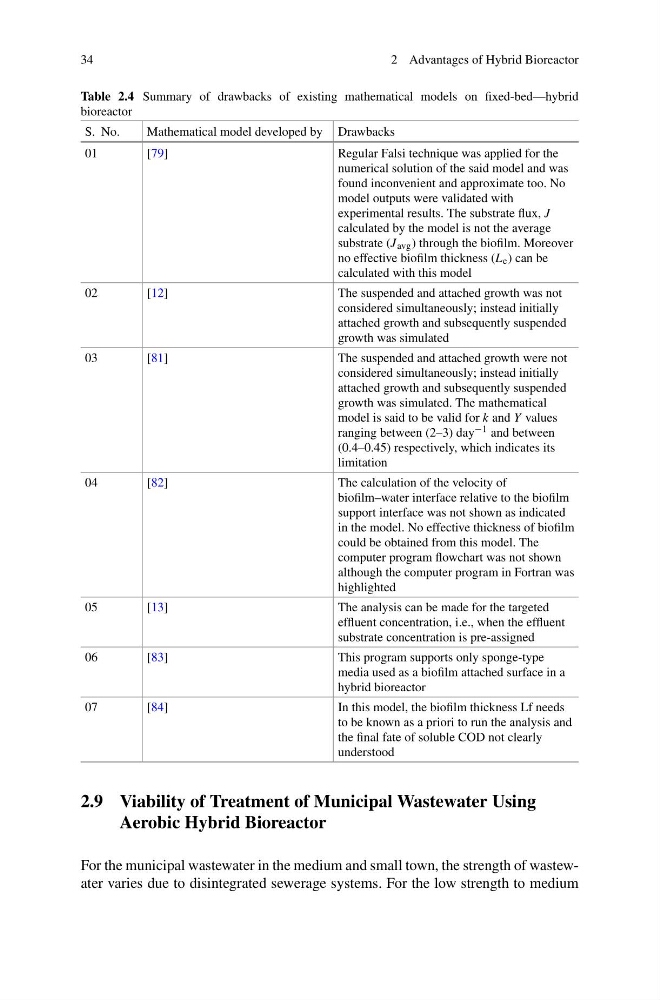
Table 2.4 Summary of drawbacks of existing mathematical models on fixed-bed—hybrid
bioreactor
S. No.
Mathematical model developed by Drawbacks
01
[79]
Regular Falsi technique was applied for the
numerical solution of the said model and was
found inconvenient and approximate too. No
model outputs were validated with
experimental results. The substrate flux, J
calculated by the model is not the average
substrate (J avg ) through the biofilm. Moreover
no effective biofilm thickness (L e ) can be
calculated with this model
02
[12]
The suspended and attached growth was not
considered simultaneously; instead initially
attached growth and subsequently suspended
growth was simulated
03
[81]
The suspended and attached growth were not
considered simultaneously; instead initially
attached growth and subsequently suspended
growth was simulated. The mathematical
model is said to be valid for k and Y values
ranging between (2–3) day −1 and between
(0.4–0.45) respectively, which indicates its
limitation
04
[82]
The calculation of the velocity of
biofilm–water interface relative to the biofilm
support interface was not shown as indicated
in the model. No effective thickness of biofilm
could be obtained from this model. The
computer program flowchart was not shown
although the computer program in Fortran was
highlighted
05
[13]
The analysis can be made for the targeted
effluent concentration, i.e., when the effluent
substrate concentration is pre-assigned
06
[83]
This program supports only sponge-type
media used as a biofilm attached surface in a
hybrid bioreactor
07
[84]
In this model, the biofilm thickness Lf needs
to be known as a priori to run the analysis and
the final fate of soluble COD not clearly
understood
2.9 Viability of Treatment of Municipal Wastewater Using
Aerobic Hybrid Bioreactor
For the municipal wastewater in the medium and small town, the strength of wastewater varies due to disintegrated sewerage systems. For the low strength to medium
2 Advantages of Hybrid Bioreactor
Table 2.4 Summary of drawbacks of existing mathematical models on fixed-bed—hybrid
bioreactor
S. No.
Mathematical model developed by Drawbacks
01
[79]
Regular Falsi technique was applied for the
numerical solution of the said model and was
found inconvenient and approximate too. No
model outputs were validated with
experimental results. The substrate flux, J
calculated by the model is not the average
substrate (J avg ) through the biofilm. Moreover
no effective biofilm thickness (L e ) can be
calculated with this model
02
[12]
The suspended and attached growth was not
considered simultaneously; instead initially
attached growth and subsequently suspended
growth was simulated
03
[81]
The suspended and attached growth were not
considered simultaneously; instead initially
attached growth and subsequently suspended
growth was simulated. The mathematical
model is said to be valid for k and Y values
ranging between (2–3) day −1 and between
(0.4–0.45) respectively, which indicates its
limitation
04
[82]
The calculation of the velocity of
biofilm–water interface relative to the biofilm
support interface was not shown as indicated
in the model. No effective thickness of biofilm
could be obtained from this model. The
computer program flowchart was not shown
although the computer program in Fortran was
highlighted
05
[13]
The analysis can be made for the targeted
effluent concentration, i.e., when the effluent
substrate concentration is pre-assigned
06
[83]
This program supports only sponge-type
media used as a biofilm attached surface in a
hybrid bioreactor
07
[84]
In this model, the biofilm thickness Lf needs
to be known as a priori to run the analysis and
the final fate of soluble COD not clearly
understood
2.9 Viability of Treatment of Municipal Wastewater Using
Aerobic Hybrid Bioreactor
For the municipal wastewater in the medium and small town, the strength of wastewater varies due to disintegrated sewerage systems. For the low strength to medium