

2.8 Mathematical Modeling of Aerobic Hybrid Bioreactor System
33
The above equation was developed by adding two individual substrate removal
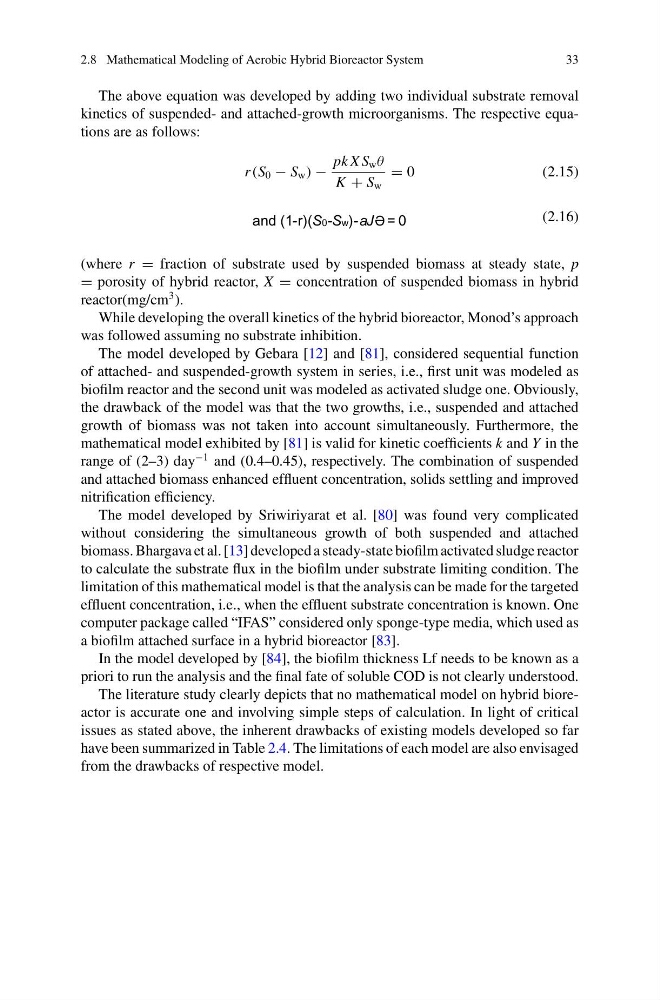
kinetics of suspended- and attached-growth microorganisms. The respective equations are as follows:
r (S 0 − S w ) −
pk X S w θ
K + S w
= 0
(2.15)
and (1-r)(S0-Sw)-aJ = 0
(2.16)
(where r = fraction of substrate used by suspended biomass at steady state, p
= porosity of hybrid reactor, X = concentration of suspended biomass in hybrid
reactor(mg/cm
3 ).
While developing the overall kinetics of the hybrid bioreactor, Monod’s approach
was followed assuming no substrate inhibition.
The model developed by Gebara [12] and [81], considered sequential function
of attached- and suspended-growth system in series, i.e., first unit was modeled as
biofilm reactor and the second unit was modeled as activated sludge one. Obviously,
the drawback of the model was that the two growths, i.e., suspended and attached
growth of biomass was not taken into account simultaneously. Furthermore, the
mathematical model exhibited by [81] is valid for kinetic coefficients k and Y in the
range of (2–3) day
−1 and (0.4–0.45), respectively. The combination of suspended
and attached biomass enhanced effluent concentration, solids settling and improved
nitrification efficiency.
The model developed by Sriwiriyarat et al. [80] was found very complicated
without considering the simultaneous growth of both suspended and attached
biomass. Bhargava et al. [13] developed a steady-state biofilm activated sludge reactor
to calculate the substrate flux in the biofilm under substrate limiting condition. The
limitation of this mathematical model is that the analysis can be made for the targeted
effluent concentration, i.e., when the effluent substrate concentration is known. One
computer package called “IFAS” considered only sponge-type media, which used as
a biofilm attached surface in a hybrid bioreactor [83].
In the model developed by [84], the biofilm thickness Lf needs to be known as a
priori to run the analysis and the final fate of soluble COD is not clearly understood.
The literature study clearly depicts that no mathematical model on hybrid bioreactor is accurate one and involving simple steps of calculation. In light of critical
issues as stated above, the inherent drawbacks of existing models developed so far
have been summarized in Table 2.4. The limitations of each model are also envisaged
from the drawbacks of respective model.
33
The above equation was developed by adding two individual substrate removal
kinetics of suspended- and attached-growth microorganisms. The respective equations are as follows:
r (S 0 − S w ) −
pk X S w θ
K + S w
= 0
(2.15)
and (1-r)(S0-Sw)-aJ = 0
(2.16)
(where r = fraction of substrate used by suspended biomass at steady state, p
= porosity of hybrid reactor, X = concentration of suspended biomass in hybrid
reactor(mg/cm
3 ).
While developing the overall kinetics of the hybrid bioreactor, Monod’s approach
was followed assuming no substrate inhibition.
The model developed by Gebara [12] and [81], considered sequential function
of attached- and suspended-growth system in series, i.e., first unit was modeled as
biofilm reactor and the second unit was modeled as activated sludge one. Obviously,
the drawback of the model was that the two growths, i.e., suspended and attached
growth of biomass was not taken into account simultaneously. Furthermore, the
mathematical model exhibited by [81] is valid for kinetic coefficients k and Y in the
range of (2–3) day
−1 and (0.4–0.45), respectively. The combination of suspended
and attached biomass enhanced effluent concentration, solids settling and improved
nitrification efficiency.
The model developed by Sriwiriyarat et al. [80] was found very complicated
without considering the simultaneous growth of both suspended and attached
biomass. Bhargava et al. [13] developed a steady-state biofilm activated sludge reactor
to calculate the substrate flux in the biofilm under substrate limiting condition. The
limitation of this mathematical model is that the analysis can be made for the targeted
effluent concentration, i.e., when the effluent substrate concentration is known. One
computer package called “IFAS” considered only sponge-type media, which used as
a biofilm attached surface in a hybrid bioreactor [83].
In the model developed by [84], the biofilm thickness Lf needs to be known as a
priori to run the analysis and the final fate of soluble COD is not clearly understood.
The literature study clearly depicts that no mathematical model on hybrid bioreactor is accurate one and involving simple steps of calculation. In light of critical
issues as stated above, the inherent drawbacks of existing models developed so far
have been summarized in Table 2.4. The limitations of each model are also envisaged
from the drawbacks of respective model.