

32
2 Advantages of Hybrid Bioreactor
In the fixed-bed hybrid bioreactor, there may be shallow to deep biofilm on the
attachment surface. When the biofilm is shallow in thickness, oxygen may be available up to the end of biofilm layer making it aerobic as a whole. On the other
hand, for the deep biofilm there would be scarcity of oxygen after a certain point of
biofilm layer, where anoxic/anaerobic environment will start to develop. This situation is absolutely favorable for denitrification and initiation for phosphorus removal.
Hence, there is a great potential of fixed-bed hybrid bioreactor to achieve combined
carbon oxidation-nitrification, denitrification and phosphorus removal in the same
system depending on the biofilm thickness.
The Monod kinetics was used for developing most of the fixed-bed aerobic, hybrid
bioreactor models assuming the substrate is highly biodegradable. However, this kind
of reactor system may also be subjected to slowly biodegradable/toxic substances,
where the biofilm plays an important role. Under such circumstances, the kinetics
should be altered and it may be considered as follows in accordance with Haldane’s
approach (Gnzen 1999).
μ =
μ m S f
K s + S f + S
2
f /K i
(2.13)
In that case, the procedure of analysis of the hybrid bioreactor system will also
change. It is therefore required to establish the kinetics of substrate removal to check
out any sort of inhibition.
Although [79] earlier developed in a true sense a hybrid bioreactor model considering both suspended and attached growth simultaneously, no explicit relationship
between substrate concentration (S) and substrate flux (J) was depicted in his model.
As a result, it was difficult to determine the flux (J) because S and J are interdependent in his model. Another drawback of this model was that the Regular Falsi
technique was applied for the numerical solution of the said model and was found
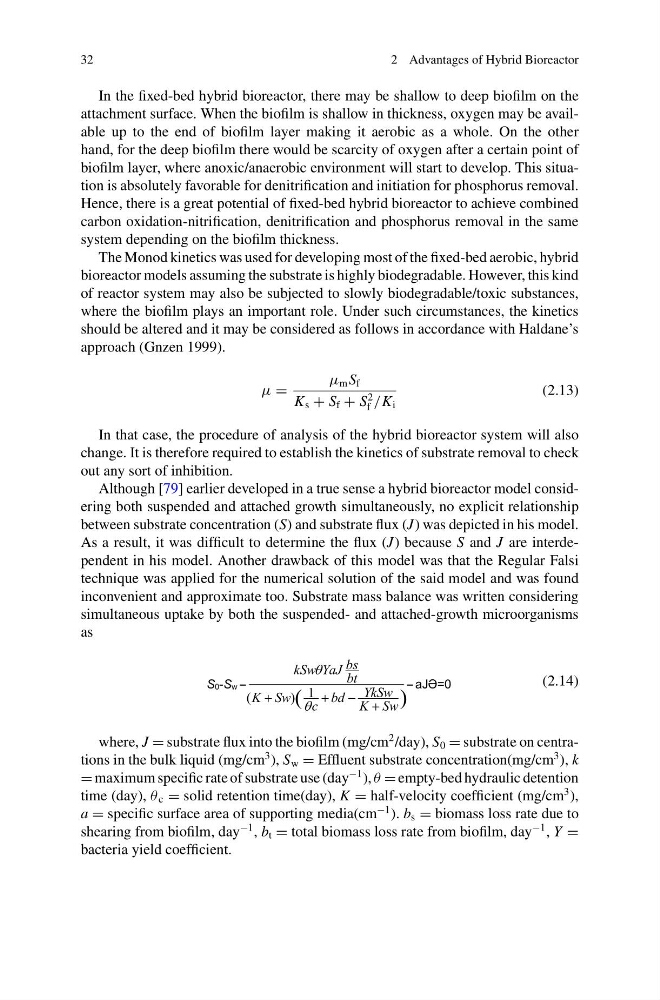
inconvenient and approximate too. Substrate mass balance was written considering
simultaneous uptake by both the suspended- and attached-growth microorganisms
as
S0-Sw
1
(
) (
)
bs
kSw YaJ bt
YkSw
K Sw
bd
c
K S w
aJ =0
(2.14)
where, J = substrate flux into the biofilm (mg/cm
2 /day), S 0 = substrate on centrations in the bulk liquid (mg/cm
3 ), S w = Effluent substrate concentration(mg/cm
3 ), k
= maximum specific rate of substrate use (day
−1 ), θ = empty-bed hydraulic detention
time (day), θ c = solid retention time(day), K = half-velocity coefficient (mg/cm
3 ),
a = specific surface area of supporting media(cm
−1 ). b s = biomass loss rate due to
shearing from biofilm, day
−1 , b t = total biomass loss rate from biofilm, day
−1 , Y =
bacteria yield coefficient.
2 Advantages of Hybrid Bioreactor
In the fixed-bed hybrid bioreactor, there may be shallow to deep biofilm on the
attachment surface. When the biofilm is shallow in thickness, oxygen may be available up to the end of biofilm layer making it aerobic as a whole. On the other
hand, for the deep biofilm there would be scarcity of oxygen after a certain point of
biofilm layer, where anoxic/anaerobic environment will start to develop. This situation is absolutely favorable for denitrification and initiation for phosphorus removal.
Hence, there is a great potential of fixed-bed hybrid bioreactor to achieve combined
carbon oxidation-nitrification, denitrification and phosphorus removal in the same
system depending on the biofilm thickness.
The Monod kinetics was used for developing most of the fixed-bed aerobic, hybrid
bioreactor models assuming the substrate is highly biodegradable. However, this kind
of reactor system may also be subjected to slowly biodegradable/toxic substances,
where the biofilm plays an important role. Under such circumstances, the kinetics
should be altered and it may be considered as follows in accordance with Haldane’s
approach (Gnzen 1999).
μ =
μ m S f
K s + S f + S
2
f /K i
(2.13)
In that case, the procedure of analysis of the hybrid bioreactor system will also
change. It is therefore required to establish the kinetics of substrate removal to check
out any sort of inhibition.
Although [79] earlier developed in a true sense a hybrid bioreactor model considering both suspended and attached growth simultaneously, no explicit relationship
between substrate concentration (S) and substrate flux (J) was depicted in his model.
As a result, it was difficult to determine the flux (J) because S and J are interdependent in his model. Another drawback of this model was that the Regular Falsi
technique was applied for the numerical solution of the said model and was found
inconvenient and approximate too. Substrate mass balance was written considering
simultaneous uptake by both the suspended- and attached-growth microorganisms
as
S0-Sw
1
(
) (
)
bs
kSw YaJ bt
YkSw
K Sw
bd
c
K S w
aJ =0
(2.14)
where, J = substrate flux into the biofilm (mg/cm
2 /day), S 0 = substrate on centrations in the bulk liquid (mg/cm
3 ), S w = Effluent substrate concentration(mg/cm
3 ), k
= maximum specific rate of substrate use (day
−1 ), θ = empty-bed hydraulic detention
time (day), θ c = solid retention time(day), K = half-velocity coefficient (mg/cm
3 ),
a = specific surface area of supporting media(cm
−1 ). b s = biomass loss rate due to
shearing from biofilm, day
−1 , b t = total biomass loss rate from biofilm, day
−1 , Y =
bacteria yield coefficient.