

2.8 Mathematical Modeling of Aerobic Hybrid Bioreactor System
31
1996). The transition layer is also called diffusion boundary layer as mass transfer
in this zone is assumed to be diffusive.
The first model regarding the substrate flux at the biofilm surface through the
diffusion process came into light in 1976 [67, 61]. Substrate conversion in the biofilm
was assumed to follow Monod kinetics which was coupled to diffusion based on
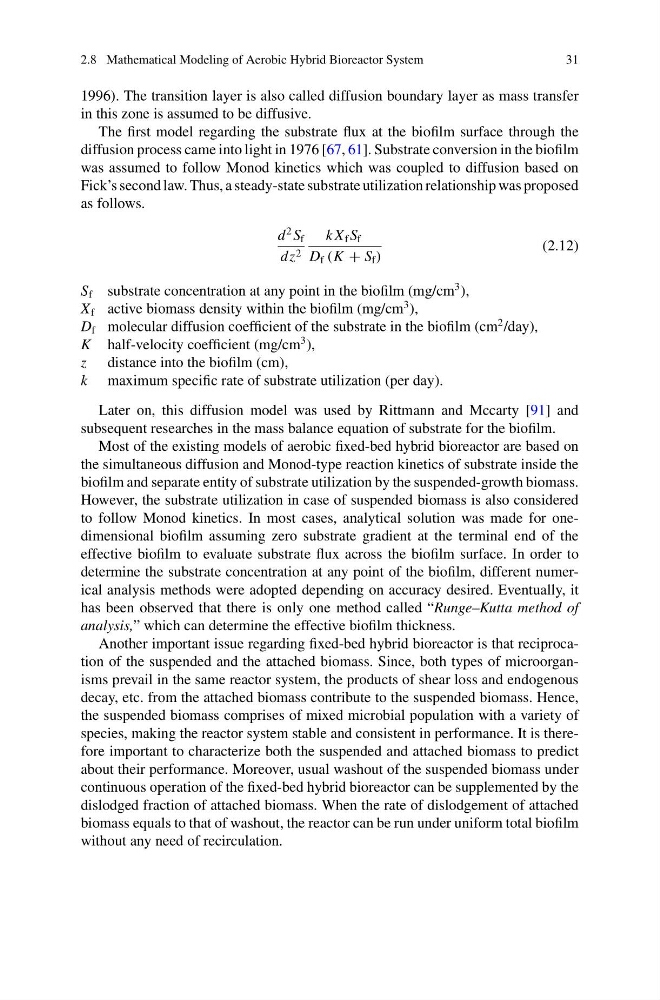
Fick’s second law. Thus, a steady-state substrate utilization relationship was proposed
as follows.
d
2 S f
dz 2
k X f S f
D f (K + S f )
(2.12)
S f substrate concentration at any point in the biofilm (mg/cm
3 ),
X f active biomass density within the biofilm (mg/cm
3 ),
D f molecular diffusion coefficient of the substrate in the biofilm (cm
2 /day),
K half-velocity coefficient (mg/cm
3 ),
z distance into the biofilm (cm),
k maximum specific rate of substrate utilization (per day).
Later on, this diffusion model was used by Rittmann and Mccarty [91] and
subsequent researches in the mass balance equation of substrate for the biofilm.
Most of the existing models of aerobic fixed-bed hybrid bioreactor are based on
the simultaneous diffusion and Monod-type reaction kinetics of substrate inside the
biofilm and separate entity of substrate utilization by the suspended-growth biomass.
However, the substrate utilization in case of suspended biomass is also considered
to follow Monod kinetics. In most cases, analytical solution was made for onedimensional biofilm assuming zero substrate gradient at the terminal end of the
effective biofilm to evaluate substrate flux across the biofilm surface. In order to
determine the substrate concentration at any point of the biofilm, different numerical analysis methods were adopted depending on accuracy desired. Eventually, it
has been observed that there is only one method called “Runge–Kutta method of
analysis,” which can determine the effective biofilm thickness.
Another important issue regarding fixed-bed hybrid bioreactor is that reciprocation of the suspended and the attached biomass. Since, both types of microorganisms prevail in the same reactor system, the products of shear loss and endogenous
decay, etc. from the attached biomass contribute to the suspended biomass. Hence,
the suspended biomass comprises of mixed microbial population with a variety of
species, making the reactor system stable and consistent in performance. It is therefore important to characterize both the suspended and attached biomass to predict
about their performance. Moreover, usual washout of the suspended biomass under
continuous operation of the fixed-bed hybrid bioreactor can be supplemented by the
dislodged fraction of attached biomass. When the rate of dislodgement of attached
biomass equals to that of washout, the reactor can be run under uniform total biofilm
without any need of recirculation.
31
1996). The transition layer is also called diffusion boundary layer as mass transfer
in this zone is assumed to be diffusive.
The first model regarding the substrate flux at the biofilm surface through the
diffusion process came into light in 1976 [67, 61]. Substrate conversion in the biofilm
was assumed to follow Monod kinetics which was coupled to diffusion based on
Fick’s second law. Thus, a steady-state substrate utilization relationship was proposed
as follows.
d
2 S f
dz 2
k X f S f
D f (K + S f )
(2.12)
S f substrate concentration at any point in the biofilm (mg/cm
3 ),
X f active biomass density within the biofilm (mg/cm
3 ),
D f molecular diffusion coefficient of the substrate in the biofilm (cm
2 /day),
K half-velocity coefficient (mg/cm
3 ),
z distance into the biofilm (cm),
k maximum specific rate of substrate utilization (per day).
Later on, this diffusion model was used by Rittmann and Mccarty [91] and
subsequent researches in the mass balance equation of substrate for the biofilm.
Most of the existing models of aerobic fixed-bed hybrid bioreactor are based on
the simultaneous diffusion and Monod-type reaction kinetics of substrate inside the
biofilm and separate entity of substrate utilization by the suspended-growth biomass.
However, the substrate utilization in case of suspended biomass is also considered
to follow Monod kinetics. In most cases, analytical solution was made for onedimensional biofilm assuming zero substrate gradient at the terminal end of the
effective biofilm to evaluate substrate flux across the biofilm surface. In order to
determine the substrate concentration at any point of the biofilm, different numerical analysis methods were adopted depending on accuracy desired. Eventually, it
has been observed that there is only one method called “Runge–Kutta method of
analysis,” which can determine the effective biofilm thickness.
Another important issue regarding fixed-bed hybrid bioreactor is that reciprocation of the suspended and the attached biomass. Since, both types of microorganisms prevail in the same reactor system, the products of shear loss and endogenous
decay, etc. from the attached biomass contribute to the suspended biomass. Hence,
the suspended biomass comprises of mixed microbial population with a variety of
species, making the reactor system stable and consistent in performance. It is therefore important to characterize both the suspended and attached biomass to predict
about their performance. Moreover, usual washout of the suspended biomass under
continuous operation of the fixed-bed hybrid bioreactor can be supplemented by the
dislodged fraction of attached biomass. When the rate of dislodgement of attached
biomass equals to that of washout, the reactor can be run under uniform total biofilm
without any need of recirculation.