

118
8 Experimental Validation of the Model Developed …
8.5 Process Design Approach for Fixed-Bed Hybrid
Bioreactor
The process design of hybrid bioreactor is aimed to find out its volume, physical
dimension and other operational requirements including oxygen for any targeted
effluent substrate concentration. Besides this, it is also possible to calculate the solid
retention time (θ c ), average substrate flux into the biofilm (J avg ) and effective as
well as total biofilm thickness (L e and L f ). There must have certain design criteria,
which can be checked accordingly for any physical configuration adopted for the
reactor. The process design has been performed considering steady-state condition
for biomass and substrate.
Monod kinetics is assumed rational for the aerobic hybrid bioreactor treating
municipal wastewater. Transport of the dissolved substrate into the liquid phase and
subsequently to the attached biomass was considered due to molecular diffusion as
described by Fick’s 2nd law.
The rational design of the above hybrid bioreactor is contemplated employing
Monod’s growth pattern and associated kinetic coefficients. The values of kinetic
coefficients, i.e., K, k, Y, b t , b s and b d , are determined experimentally. The items for
the design of an aerobic hybrid bioreactor are aeration tank capacity and dimensions,
aeration facilities, porosity of the reactor, optimum hydraulic retention time (HRT),
solid retention time (SRT), biofilm thickness and specific surface area of the biofilm.
It is observed that economical volume of the reactor can be achieved by adopting a
large value of suspended biomass (X) and a thick biofilm in the attached surface. A
common range of X between 2500 and 3000 mg/L may be considered in the design
of the hybrid bioreactor for the sake of good settleability. The biomass concentration
in waste sludge is denoted as X r , which may be considered between 10,000 and
12,000 mg/L, in case of hybrid bioreactor with recirculation.
8.5.1 Determination of Volume of Aeration Basin (V)
The volume of the aeration basin (reactor) V is calculated as per the following steps:
8.5.1.1 For Case 1: Hybrid Bioreactor Without Recirculation
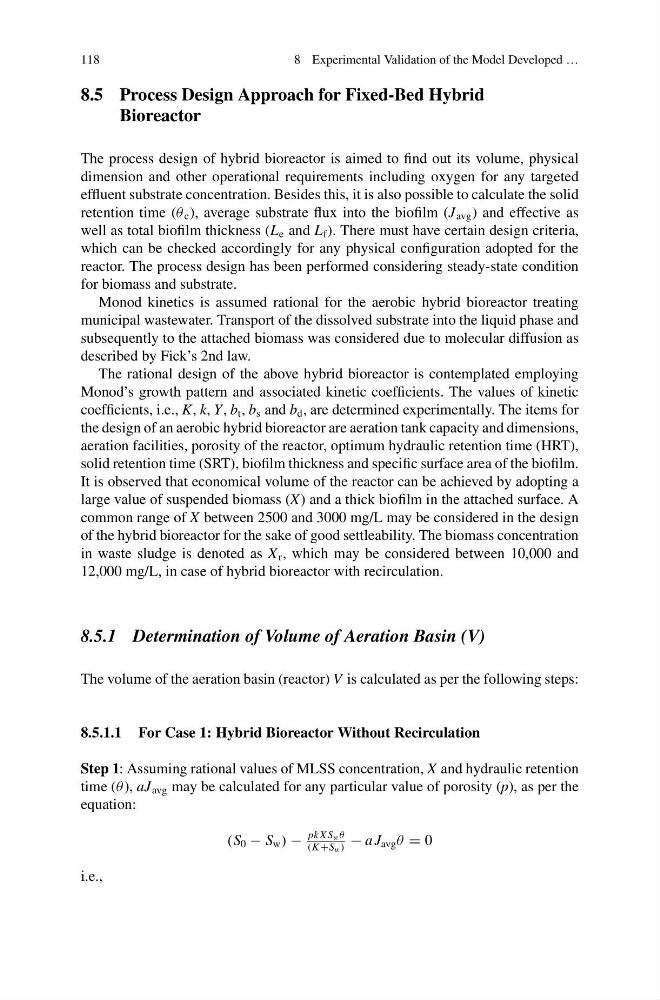
Step 1: Assuming rational values of MLSS concentration, X and hydraulic retention
time (θ ), aJ avg may be calculated for any particular value of porosity (p), as per the
equation:
(S 0 − S w ) −
pk X S w θ
(K +S w )
− a J avg θ = 0
i.e.,
8 Experimental Validation of the Model Developed …
8.5 Process Design Approach for Fixed-Bed Hybrid
Bioreactor
The process design of hybrid bioreactor is aimed to find out its volume, physical
dimension and other operational requirements including oxygen for any targeted
effluent substrate concentration. Besides this, it is also possible to calculate the solid
retention time (θ c ), average substrate flux into the biofilm (J avg ) and effective as
well as total biofilm thickness (L e and L f ). There must have certain design criteria,
which can be checked accordingly for any physical configuration adopted for the
reactor. The process design has been performed considering steady-state condition
for biomass and substrate.
Monod kinetics is assumed rational for the aerobic hybrid bioreactor treating
municipal wastewater. Transport of the dissolved substrate into the liquid phase and
subsequently to the attached biomass was considered due to molecular diffusion as
described by Fick’s 2nd law.
The rational design of the above hybrid bioreactor is contemplated employing
Monod’s growth pattern and associated kinetic coefficients. The values of kinetic
coefficients, i.e., K, k, Y, b t , b s and b d , are determined experimentally. The items for
the design of an aerobic hybrid bioreactor are aeration tank capacity and dimensions,
aeration facilities, porosity of the reactor, optimum hydraulic retention time (HRT),
solid retention time (SRT), biofilm thickness and specific surface area of the biofilm.
It is observed that economical volume of the reactor can be achieved by adopting a
large value of suspended biomass (X) and a thick biofilm in the attached surface. A
common range of X between 2500 and 3000 mg/L may be considered in the design
of the hybrid bioreactor for the sake of good settleability. The biomass concentration
in waste sludge is denoted as X r , which may be considered between 10,000 and
12,000 mg/L, in case of hybrid bioreactor with recirculation.
8.5.1 Determination of Volume of Aeration Basin (V)
The volume of the aeration basin (reactor) V is calculated as per the following steps:
8.5.1.1 For Case 1: Hybrid Bioreactor Without Recirculation
Step 1: Assuming rational values of MLSS concentration, X and hydraulic retention
time (θ ), aJ avg may be calculated for any particular value of porosity (p), as per the
equation:
(S 0 − S w ) −
pk X S w θ
(K +S w )
− a J avg θ = 0
i.e.,