

44
M. Maity et al.
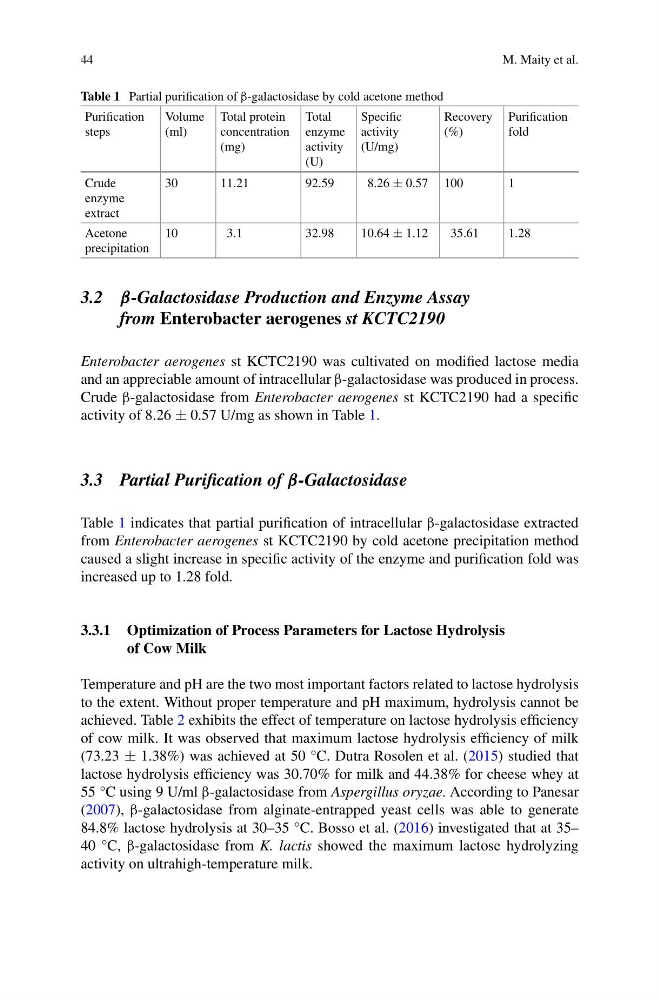
Table 1 Partial purification of β-galactosidase by cold acetone method
Purification
steps
Volume
(ml)
Total protein
concentration
(mg)
Total
enzyme
activity
(U)
Specific
activity
(U/mg)
Recovery
(%)
Purification
fold
Crude
enzyme
extract
30
11.21
92.59
8.26 ± 0.57 100
1
Acetone
precipitation
10
3.1
32.98
10.64 ± 1.12
35.61
1.28
3.2 β-Galactosidase Production and Enzyme Assay
from Enterobacter aerogenes st KCTC2190
Enterobacter aerogenes st KCTC2190 was cultivated on modified lactose media
and an appreciable amount of intracellular β-galactosidase was produced in process.
Crude β-galactosidase from Enterobacter aerogenes st KCTC2190 had a specific
activity of 8.26 ± 0.57 U/mg as shown in Table 1.
3.3 Partial Purification of β-Galactosidase
Table 1 indicates that partial purification of intracellular β-galactosidase extracted
from Enterobacter aerogenes st KCTC2190 by cold acetone precipitation method
caused a slight increase in specific activity of the enzyme and purification fold was
increased up to 1.28 fold.
3.3.1 Optimization of Process Parameters for Lactose Hydrolysis
of Cow Milk
Temperature and pH are the two most important factors related to lactose hydrolysis
to the extent. Without proper temperature and pH maximum, hydrolysis cannot be
achieved. Table 2 exhibits the effect of temperature on lactose hydrolysis efficiency
of cow milk. It was observed that maximum lactose hydrolysis efficiency of milk
(73.23 ± 1.38%) was achieved at 50 °C. Dutra Rosolen et al. (2015) studied that
lactose hydrolysis efficiency was 30.70% for milk and 44.38% for cheese whey at
55 °C using 9 U/ml β-galactosidase from Aspergillus oryzae. According to Panesar
(2007), β-galactosidase from alginate-entrapped yeast cells was able to generate
84.8% lactose hydrolysis at 30–35 °C. Bosso et al. (2016) investigated that at 35–
40 °C, β-galactosidase from K. lactis showed the maximum lactose hydrolyzing
activity on ultrahigh-temperature milk.
M. Maity et al.
Table 1 Partial purification of β-galactosidase by cold acetone method
Purification
steps
Volume
(ml)
Total protein
concentration
(mg)
Total
enzyme
activity
(U)
Specific
activity
(U/mg)
Recovery
(%)
Purification
fold
Crude
enzyme
extract
30
11.21
92.59
8.26 ± 0.57 100
1
Acetone
precipitation
10
3.1
32.98
10.64 ± 1.12
35.61
1.28
3.2 β-Galactosidase Production and Enzyme Assay
from Enterobacter aerogenes st KCTC2190
Enterobacter aerogenes st KCTC2190 was cultivated on modified lactose media
and an appreciable amount of intracellular β-galactosidase was produced in process.
Crude β-galactosidase from Enterobacter aerogenes st KCTC2190 had a specific
activity of 8.26 ± 0.57 U/mg as shown in Table 1.
3.3 Partial Purification of β-Galactosidase
Table 1 indicates that partial purification of intracellular β-galactosidase extracted
from Enterobacter aerogenes st KCTC2190 by cold acetone precipitation method
caused a slight increase in specific activity of the enzyme and purification fold was
increased up to 1.28 fold.
3.3.1 Optimization of Process Parameters for Lactose Hydrolysis
of Cow Milk
Temperature and pH are the two most important factors related to lactose hydrolysis
to the extent. Without proper temperature and pH maximum, hydrolysis cannot be
achieved. Table 2 exhibits the effect of temperature on lactose hydrolysis efficiency
of cow milk. It was observed that maximum lactose hydrolysis efficiency of milk
(73.23 ± 1.38%) was achieved at 50 °C. Dutra Rosolen et al. (2015) studied that
lactose hydrolysis efficiency was 30.70% for milk and 44.38% for cheese whey at
55 °C using 9 U/ml β-galactosidase from Aspergillus oryzae. According to Panesar
(2007), β-galactosidase from alginate-entrapped yeast cells was able to generate
84.8% lactose hydrolysis at 30–35 °C. Bosso et al. (2016) investigated that at 35–
40 °C, β-galactosidase from K. lactis showed the maximum lactose hydrolyzing
activity on ultrahigh-temperature milk.