

Production of Lactose-Free Cheese Using Partially Purified …
43
bacteria, yeast, and coliform bacteria was estimated using plate count agar, potato
dextrose agar, and violet red bile agar, respectively, by the processes described by
American Public Health Association (2005).
2.5 Statistical Analysis
All samples were analyzed in triplicates. One-way analysis of variance (ANOVA) of
data was analyzed by Tukey test at a significance level of 5% (P < 0.05).
3 Results and Discussion
3.1 Screening, Isolation, and Identification
During screening of microorganisms, 43 strains were observed on modified lactose
agar media. Among them, 16 strains showed blue colonies on lactose agar media in
the presence of X-gal and indicated the ability to produce β-galactosidase activity
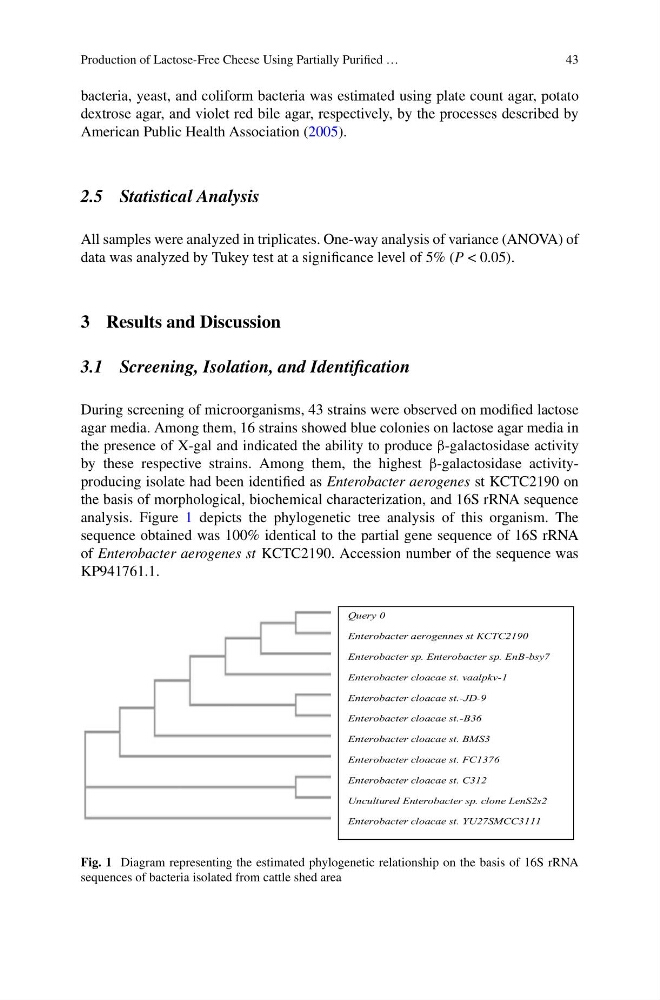
by these respective strains. Among them, the highest β-galactosidase activityproducing isolate had been identified as Enterobacter aerogenes st KCTC2190 on
the basis of morphological, biochemical characterization, and 16S rRNA sequence
analysis. Figure 1 depicts the phylogenetic tree analysis of this organism. The
sequence obtained was 100% identical to the partial gene sequence of 16S rRNA
of Enterobacter aerogenes st KCTC2190. Accession number of the sequence was
KP941761.1.
Query 0
Enterobacter aerogennes st KCTC2190
Enterobacter sp. Enterobacter sp. EnB-bsy7
Enterobacter cloacae st. vaalpkv-1
Enterobacter cloacae st.-JD-9
Enterobacter cloacae st.-B36
Enterobacter cloacae st. BMS3
Enterobacter cloacae st. FC1376
Enterobacter cloacae st. C312
Uncultured Enterobacter sp. clone LenS2s2
Enterobacter cloacae st. YU27SMCC3111
Fig. 1 Diagram representing the estimated phylogenetic relationship on the basis of 16S rRNA
sequences of bacteria isolated from cattle shed area
43
bacteria, yeast, and coliform bacteria was estimated using plate count agar, potato
dextrose agar, and violet red bile agar, respectively, by the processes described by
American Public Health Association (2005).
2.5 Statistical Analysis
All samples were analyzed in triplicates. One-way analysis of variance (ANOVA) of
data was analyzed by Tukey test at a significance level of 5% (P < 0.05).
3 Results and Discussion
3.1 Screening, Isolation, and Identification
During screening of microorganisms, 43 strains were observed on modified lactose
agar media. Among them, 16 strains showed blue colonies on lactose agar media in
the presence of X-gal and indicated the ability to produce β-galactosidase activity
by these respective strains. Among them, the highest β-galactosidase activityproducing isolate had been identified as Enterobacter aerogenes st KCTC2190 on
the basis of morphological, biochemical characterization, and 16S rRNA sequence
analysis. Figure 1 depicts the phylogenetic tree analysis of this organism. The
sequence obtained was 100% identical to the partial gene sequence of 16S rRNA
of Enterobacter aerogenes st KCTC2190. Accession number of the sequence was
KP941761.1.
Query 0
Enterobacter aerogennes st KCTC2190
Enterobacter sp. Enterobacter sp. EnB-bsy7
Enterobacter cloacae st. vaalpkv-1
Enterobacter cloacae st.-JD-9
Enterobacter cloacae st.-B36
Enterobacter cloacae st. BMS3
Enterobacter cloacae st. FC1376
Enterobacter cloacae st. C312
Uncultured Enterobacter sp. clone LenS2s2
Enterobacter cloacae st. YU27SMCC3111
Fig. 1 Diagram representing the estimated phylogenetic relationship on the basis of 16S rRNA
sequences of bacteria isolated from cattle shed area