

Systems Biology Approach to Screen and Identify Algae-Based …
435
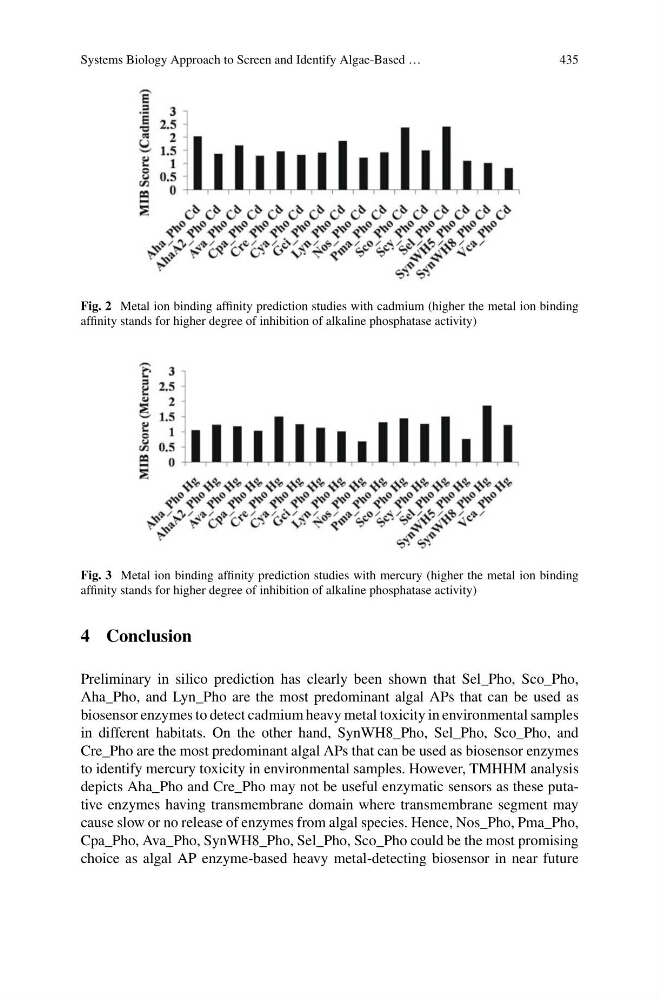
Fig. 2 Metal ion binding affinity prediction studies with cadmium (higher the metal ion binding
affinity stands for higher degree of inhibition of alkaline phosphatase activity)
Fig. 3 Metal ion binding affinity prediction studies with mercury (higher the metal ion binding
affinity stands for higher degree of inhibition of alkaline phosphatase activity)
4 Conclusion
Preliminary in silico prediction has clearly been shown that Sel_Pho, Sco_Pho,
Aha_Pho, and Lyn_Pho are the most predominant algal APs that can be used as
biosensor enzymes to detect cadmium heavy metal toxicity in environmental samples
in different habitats. On the other hand, SynWH8_Pho, Sel_Pho, Sco_Pho, and
Cre_Pho are the most predominant algal APs that can be used as biosensor enzymes
to identify mercury toxicity in environmental samples. However, TMHHM analysis
depicts Aha_Pho and Cre_Pho may not be useful enzymatic sensors as these putative enzymes having transmembrane domain where transmembrane segment may
cause slow or no release of enzymes from algal species. Hence, Nos_Pho, Pma_Pho,
Cpa_Pho, Ava_Pho, SynWH8_Pho, Sel_Pho, Sco_Pho could be the most promising
choice as algal AP enzyme-based heavy metal-detecting biosensor in near future
435
Fig. 2 Metal ion binding affinity prediction studies with cadmium (higher the metal ion binding
affinity stands for higher degree of inhibition of alkaline phosphatase activity)
Fig. 3 Metal ion binding affinity prediction studies with mercury (higher the metal ion binding
affinity stands for higher degree of inhibition of alkaline phosphatase activity)
4 Conclusion
Preliminary in silico prediction has clearly been shown that Sel_Pho, Sco_Pho,
Aha_Pho, and Lyn_Pho are the most predominant algal APs that can be used as
biosensor enzymes to detect cadmium heavy metal toxicity in environmental samples
in different habitats. On the other hand, SynWH8_Pho, Sel_Pho, Sco_Pho, and
Cre_Pho are the most predominant algal APs that can be used as biosensor enzymes
to identify mercury toxicity in environmental samples. However, TMHHM analysis
depicts Aha_Pho and Cre_Pho may not be useful enzymatic sensors as these putative enzymes having transmembrane domain where transmembrane segment may
cause slow or no release of enzymes from algal species. Hence, Nos_Pho, Pma_Pho,
Cpa_Pho, Ava_Pho, SynWH8_Pho, Sel_Pho, Sco_Pho could be the most promising
choice as algal AP enzyme-based heavy metal-detecting biosensor in near future