

434
D. Ghosh et al.
of about 50%. Phylogenetic study on algal APs has been carried out considering the following sequences Vca_Pho (Volvox carteri); Cre_Pho (Chlamydomonas reinhardtii); Lyn_Pho (Lyngbya sp.PCC 8106); Scy_Pho (Synechocystis
sp.PCC 6803); Sco_Pho (Synechococcus sp.PCC 7942); Nos_Pho (Nostos sp.PCC
7120); SynWH5_Pho (Synechococcus sp.WH5701); SynWH8_Pho (Synechococcus
sp. WH8120); Sel_Pho (Synechococcus elongatus PCC 6301); Cya_Pho (Cyanothece sp.ATCC 51142); Gci_Pho (Gloeothece citriformis PCC 7424); Pma_Pho
(Prochlorococcus marinus NATL1A); Cpa_Pho (Calothrix parietina); Ava_Pho
(Anabaena variabilis ATCC 29413); AhaA2_Pho (Aphanothece halophytica A2);
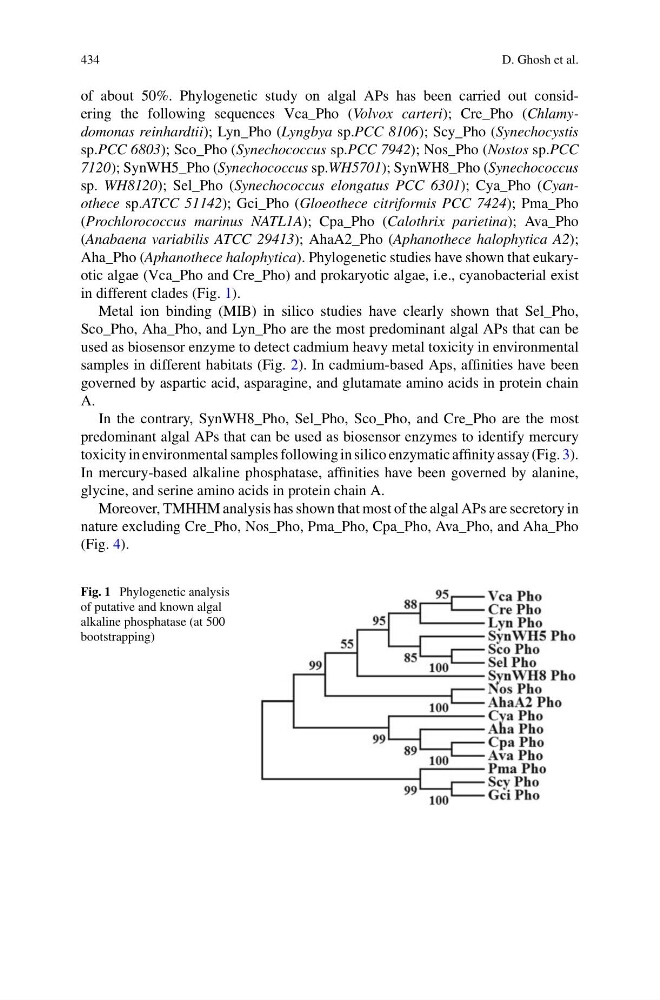
Aha_Pho (Aphanothece halophytica). Phylogenetic studies have shown that eukaryotic algae (Vca_Pho and Cre_Pho) and prokaryotic algae, i.e., cyanobacterial exist
in different clades (Fig. 1).
Metal ion binding (MIB) in silico studies have clearly shown that Sel_Pho,
Sco_Pho, Aha_Pho, and Lyn_Pho are the most predominant algal APs that can be
used as biosensor enzyme to detect cadmium heavy metal toxicity in environmental
samples in different habitats (Fig. 2). In cadmium-based Aps, affinities have been
governed by aspartic acid, asparagine, and glutamate amino acids in protein chain
A.
In the contrary, SynWH8_Pho, Sel_Pho, Sco_Pho, and Cre_Pho are the most
predominant algal APs that can be used as biosensor enzymes to identify mercury
toxicity in environmental samples following in silico enzymatic affinity assay (Fig. 3).
In mercury-based alkaline phosphatase, affinities have been governed by alanine,
glycine, and serine amino acids in protein chain A.
Moreover, TMHHM analysis has shown that most of the algal APs are secretory in
nature excluding Cre_Pho, Nos_Pho, Pma_Pho, Cpa_Pho, Ava_Pho, and Aha_Pho
(Fig. 4).
Fig. 1 Phylogenetic analysis
of putative and known algal
alkaline phosphatase (at 500
bootstrapping)
D. Ghosh et al.
of about 50%. Phylogenetic study on algal APs has been carried out considering the following sequences Vca_Pho (Volvox carteri); Cre_Pho (Chlamydomonas reinhardtii); Lyn_Pho (Lyngbya sp.PCC 8106); Scy_Pho (Synechocystis
sp.PCC 6803); Sco_Pho (Synechococcus sp.PCC 7942); Nos_Pho (Nostos sp.PCC
7120); SynWH5_Pho (Synechococcus sp.WH5701); SynWH8_Pho (Synechococcus
sp. WH8120); Sel_Pho (Synechococcus elongatus PCC 6301); Cya_Pho (Cyanothece sp.ATCC 51142); Gci_Pho (Gloeothece citriformis PCC 7424); Pma_Pho
(Prochlorococcus marinus NATL1A); Cpa_Pho (Calothrix parietina); Ava_Pho
(Anabaena variabilis ATCC 29413); AhaA2_Pho (Aphanothece halophytica A2);
Aha_Pho (Aphanothece halophytica). Phylogenetic studies have shown that eukaryotic algae (Vca_Pho and Cre_Pho) and prokaryotic algae, i.e., cyanobacterial exist
in different clades (Fig. 1).
Metal ion binding (MIB) in silico studies have clearly shown that Sel_Pho,
Sco_Pho, Aha_Pho, and Lyn_Pho are the most predominant algal APs that can be
used as biosensor enzyme to detect cadmium heavy metal toxicity in environmental
samples in different habitats (Fig. 2). In cadmium-based Aps, affinities have been
governed by aspartic acid, asparagine, and glutamate amino acids in protein chain
A.
In the contrary, SynWH8_Pho, Sel_Pho, Sco_Pho, and Cre_Pho are the most
predominant algal APs that can be used as biosensor enzymes to identify mercury
toxicity in environmental samples following in silico enzymatic affinity assay (Fig. 3).
In mercury-based alkaline phosphatase, affinities have been governed by alanine,
glycine, and serine amino acids in protein chain A.
Moreover, TMHHM analysis has shown that most of the algal APs are secretory in
nature excluding Cre_Pho, Nos_Pho, Pma_Pho, Cpa_Pho, Ava_Pho, and Aha_Pho
(Fig. 4).
Fig. 1 Phylogenetic analysis
of putative and known algal
alkaline phosphatase (at 500
bootstrapping)