

426
S. Banerjee and R. Ganguly
perpendicular to the cavity. The (normalized) magnetic field strength contours are
also shown.
The fluid working medium is an electrically conducting magnetic fluid exhibiting
paramagnetic behavior. The fluid rheology is Newtonian and conforms to the mathematical model proposed in Tzirtzilakis (2005) and Tzirtzilakis and Xenos (2012).
The increment of viscosity due to external imposed field (or magneto-viscous effect)
is neglected. The rotational forces acting on the erythrocytes, when entering and
exiting the magnetic field, are also not taken into account (equilibrium magnetization). Finally, the electric field is neglected for the 2D flow field. Under the above
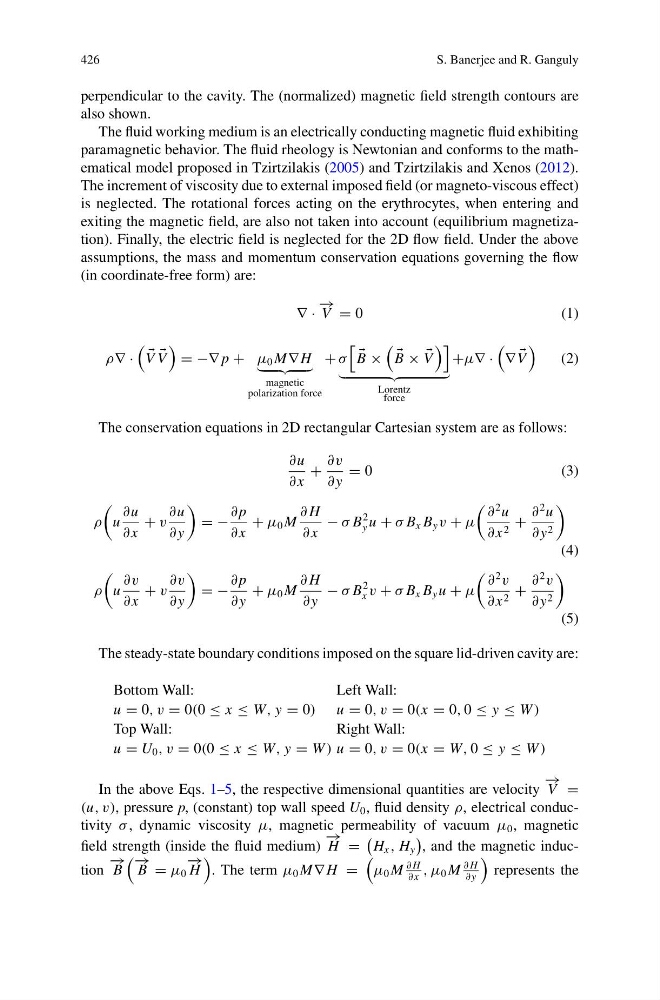
assumptions, the mass and momentum conservation equations governing the flow
(in coordinate-free form) are:
∇ ·
− →
V = 0
( 1 )
ρ∇ ·
V
V
= −∇ p + μ 0 M∇ H
magnetic
polarization force
+ σ
B ×
B ×
V
Lorentz
force
+μ∇ ·
∇
V
(2)
The conservation equations in 2D rectangular Cartesian system are as follows:
∂u
∂ x
+
∂v
∂ y
= 0
( 3 )
ρ
u
∂u
∂ x
+ v
∂u
∂ y
= −
∂ p
∂ x
+ μ 0 M
∂ H
∂ x
− σ B
2
y u + σ B x B y v + μ
∂
2 u
∂ x 2 +
∂
2 u
∂ y 2
(4)
ρ
u
∂v
∂ x
+ v
∂v
∂ y
= −
∂ p
∂ y
+ μ 0 M
∂ H
∂ y
− σ B
2
x v + σ B x B y u + μ
∂
2
v
∂ x 2 +
∂
2
v
∂ y 2
(5)
The steady-state boundary conditions imposed on the square lid-driven cavity are:
Bottom Wall:
Left Wall:
u = 0, v = 0(0 ≤ x ≤ W, y = 0) u = 0, v = 0(x = 0, 0 ≤ y ≤ W )
Top Wall:
Right Wall:
u = U 0 , v = 0(0 ≤ x ≤ W, y = W ) u = 0, v = 0(x = W, 0 ≤ y ≤ W )
In the above Eqs. 1–5, the respective dimensional quantities are velocity
− →
V =
(u, v), pressure p, (constant) top wall speed U 0 , fluid density ρ, electrical conductivity σ , dynamic viscosity μ, magnetic permeability of vacuum μ 0 , magnetic
field strength (inside the fluid medium)
− →
H =
H x , H y
, and the magnetic induction
− →
B
− →
B = μ 0
− →
H
. The term μ 0 M∇ H =
μ 0 M
∂ H
∂ x
, μ 0 M
∂ H
∂ y
represents the
S. Banerjee and R. Ganguly
perpendicular to the cavity. The (normalized) magnetic field strength contours are
also shown.
The fluid working medium is an electrically conducting magnetic fluid exhibiting
paramagnetic behavior. The fluid rheology is Newtonian and conforms to the mathematical model proposed in Tzirtzilakis (2005) and Tzirtzilakis and Xenos (2012).
The increment of viscosity due to external imposed field (or magneto-viscous effect)
is neglected. The rotational forces acting on the erythrocytes, when entering and
exiting the magnetic field, are also not taken into account (equilibrium magnetization). Finally, the electric field is neglected for the 2D flow field. Under the above
assumptions, the mass and momentum conservation equations governing the flow
(in coordinate-free form) are:
∇ ·
− →
V = 0
( 1 )
ρ∇ ·
V
V
= −∇ p + μ 0 M∇ H
magnetic
polarization force
+ σ
B ×
B ×
V
Lorentz
force
+μ∇ ·
∇
V
(2)
The conservation equations in 2D rectangular Cartesian system are as follows:
∂u
∂ x
+
∂v
∂ y
= 0
( 3 )
ρ
u
∂u
∂ x
+ v
∂u
∂ y
= −
∂ p
∂ x
+ μ 0 M
∂ H
∂ x
− σ B
2
y u + σ B x B y v + μ
∂
2 u
∂ x 2 +
∂
2 u
∂ y 2
(4)
ρ
u
∂v
∂ x
+ v
∂v
∂ y
= −
∂ p
∂ y
+ μ 0 M
∂ H
∂ y
− σ B
2
x v + σ B x B y u + μ
∂
2
v
∂ x 2 +
∂
2
v
∂ y 2
(5)
The steady-state boundary conditions imposed on the square lid-driven cavity are:
Bottom Wall:
Left Wall:
u = 0, v = 0(0 ≤ x ≤ W, y = 0) u = 0, v = 0(x = 0, 0 ≤ y ≤ W )
Top Wall:
Right Wall:
u = U 0 , v = 0(0 ≤ x ≤ W, y = W ) u = 0, v = 0(x = W, 0 ≤ y ≤ W )
In the above Eqs. 1–5, the respective dimensional quantities are velocity
− →
V =
(u, v), pressure p, (constant) top wall speed U 0 , fluid density ρ, electrical conductivity σ , dynamic viscosity μ, magnetic permeability of vacuum μ 0 , magnetic
field strength (inside the fluid medium)
− →
H =
H x , H y
, and the magnetic induction
− →
B
− →
B = μ 0
− →
H
. The term μ 0 M∇ H =
μ 0 M
∂ H
∂ x
, μ 0 M
∂ H
∂ y
represents the