

Simulation of Biomagnetic Fluid Flow in a Lid-Driven Cavity …
425
lid-driven cavity. Studies employing the stream function–vorticity formulation for the
numerical treatment of laminar, incompressible BFD problems have been reported.
Nonisothermal boundary conditions that promote thermal convection have also been
investigated. In all of these situations, it is observed that the flow dynamics is greatly
influenced by the application of the magnetic field. The form (penetration parameter)
and the strength (Stuart number) of the magnetic field have been conclusively established as primal factors in controlling the generation, shape, and size of the vortices
in these and allied confined flows.
In the present study, the BFD flow inside a lid-driven cavity is numerically investigated. The 2D flow field is isothermal, laminar, and incompressible. A linear equation
governs the dependence of fluid magnetization on the field intensity (Rosensweig
1985). The mathematical model of Tzirtzilakis (2005) enables to formulate a system
of coupled, nonlinear PDEs governing system behavior. The solution of the problem
is obtained numerically by the SIMPLER algorithm in a staggered grid framework.
A sinusoidal mesh distribution that employs fine gridding close to the cavity walls
and near the vicinity of the field source ensures numerical stability.
2 Mathematical Model
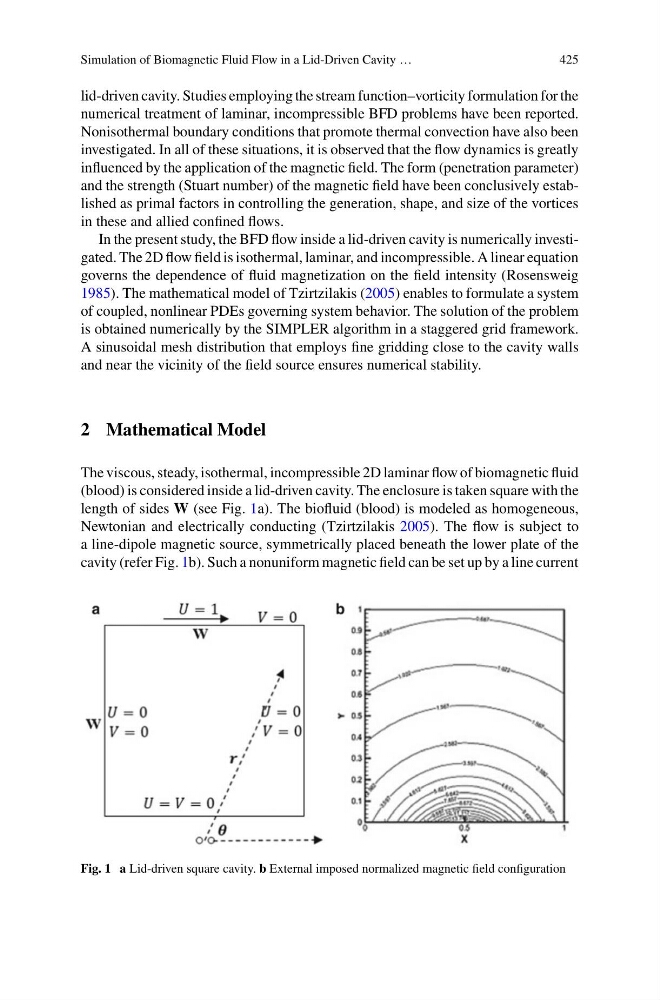
The viscous, steady, isothermal, incompressible 2D laminar flow of biomagnetic fluid
(blood) is considered inside a lid-driven cavity. The enclosure is taken square with the
length of sides W (see Fig. 1a). The biofluid (blood) is modeled as homogeneous,
Newtonian and electrically conducting (Tzirtzilakis 2005). The flow is subject to
a line-dipole magnetic source, symmetrically placed beneath the lower plate of the
cavity (refer Fig. 1b). Such a nonuniform magnetic field can be set up by a line current
Fig. 1 a Lid-driven square cavity. b External imposed normalized magnetic field configuration
425
lid-driven cavity. Studies employing the stream function–vorticity formulation for the
numerical treatment of laminar, incompressible BFD problems have been reported.
Nonisothermal boundary conditions that promote thermal convection have also been
investigated. In all of these situations, it is observed that the flow dynamics is greatly
influenced by the application of the magnetic field. The form (penetration parameter)
and the strength (Stuart number) of the magnetic field have been conclusively established as primal factors in controlling the generation, shape, and size of the vortices
in these and allied confined flows.
In the present study, the BFD flow inside a lid-driven cavity is numerically investigated. The 2D flow field is isothermal, laminar, and incompressible. A linear equation
governs the dependence of fluid magnetization on the field intensity (Rosensweig
1985). The mathematical model of Tzirtzilakis (2005) enables to formulate a system
of coupled, nonlinear PDEs governing system behavior. The solution of the problem
is obtained numerically by the SIMPLER algorithm in a staggered grid framework.
A sinusoidal mesh distribution that employs fine gridding close to the cavity walls
and near the vicinity of the field source ensures numerical stability.
2 Mathematical Model
The viscous, steady, isothermal, incompressible 2D laminar flow of biomagnetic fluid
(blood) is considered inside a lid-driven cavity. The enclosure is taken square with the
length of sides W (see Fig. 1a). The biofluid (blood) is modeled as homogeneous,
Newtonian and electrically conducting (Tzirtzilakis 2005). The flow is subject to
a line-dipole magnetic source, symmetrically placed beneath the lower plate of the
cavity (refer Fig. 1b). Such a nonuniform magnetic field can be set up by a line current
Fig. 1 a Lid-driven square cavity. b External imposed normalized magnetic field configuration