

Simulation of Biomagnetic Fluid Flow in a Lid-Driven Cavity …
427
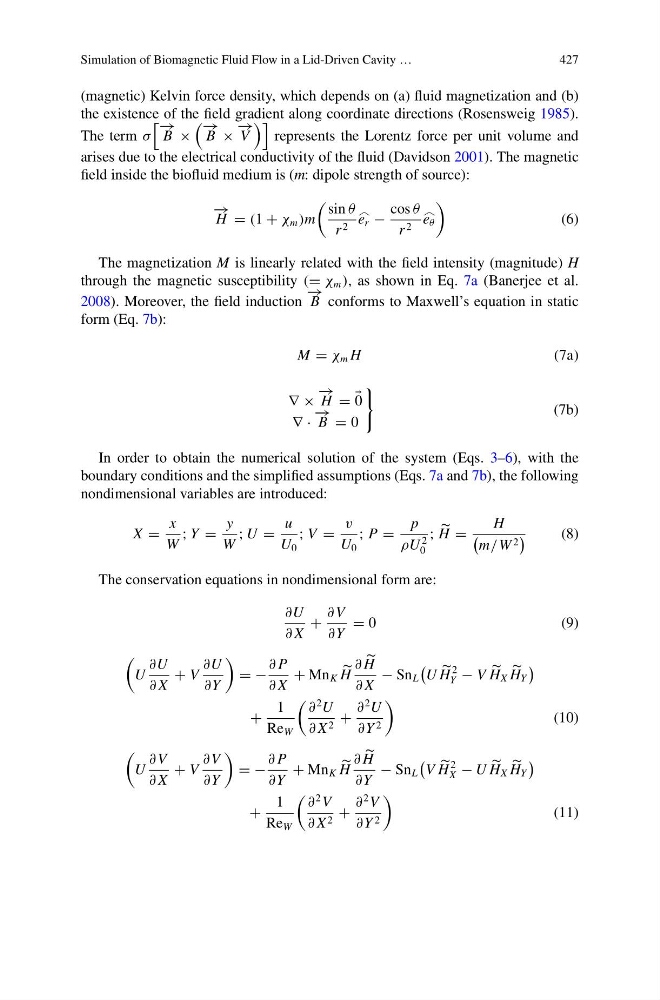
(magnetic) Kelvin force density, which depends on (a) fluid magnetization and (b)
the existence of the field gradient along coordinate directions (Rosensweig 1985).
The term σ
− →
B ×
− →
B ×
− →
V
represents the Lorentz force per unit volume and
arises due to the electrical conductivity of the fluid (Davidson 2001). The magnetic
field inside the biofluid medium is (m: dipole strength of source):
− →
H = (1 + χ m )m
sin θ
r 2 e r
−
cos θ
r 2 e θ
(6)
The magnetization M is linearly related with the field intensity (magnitude) H
through the magnetic susceptibility (= χ m ), as shown in Eq. 7a (Banerjee et al.
2008). Moreover, the field induction
− →
B conforms to Maxwell’s equation in static
form (Eq. 7b):
M = χ m H
(7a)
∇ ×
− →
H =
0
∇ ·
− →
B = 0
(7b)
In order to obtain the numerical solution of the system (Eqs. 3–6), with the
boundary conditions and the simplified assumptions (Eqs. 7a and 7b), the following
nondimensional variables are introduced:
X =
x
W
; Y =
y
W
; U =
u
U 0
; V =
v
U 0
; P =
p
ρU
2
0
;
H =
H
m/W 2
(8)
The conservation equations in nondimensional form are:
∂U
∂ X
+
∂ V
∂Y
= 0
( 9 )
U
∂U
∂ X
+ V
∂U
∂Y
= −
∂ P
∂ X
+ Mn K
H
∂
H
∂ X
− Sn L
U
H
2
Y − V
H X
H Y
+
1
Re W
∂
2 U
∂ X 2 +
∂
2 U
∂Y 2
(10)
U
∂ V
∂ X
+ V
∂ V
∂Y
= −
∂ P
∂Y
+ Mn K
H
∂
H
∂Y
− Sn L
V
H
2
X − U
H X
H Y
+
1
Re W
∂
2 V
∂ X 2 +
∂
2 V
∂Y 2
(11)
427
(magnetic) Kelvin force density, which depends on (a) fluid magnetization and (b)
the existence of the field gradient along coordinate directions (Rosensweig 1985).
The term σ
− →
B ×
− →
B ×
− →
V
represents the Lorentz force per unit volume and
arises due to the electrical conductivity of the fluid (Davidson 2001). The magnetic
field inside the biofluid medium is (m: dipole strength of source):
− →
H = (1 + χ m )m
sin θ
r 2 e r
−
cos θ
r 2 e θ
(6)
The magnetization M is linearly related with the field intensity (magnitude) H
through the magnetic susceptibility (= χ m ), as shown in Eq. 7a (Banerjee et al.
2008). Moreover, the field induction
− →
B conforms to Maxwell’s equation in static
form (Eq. 7b):
M = χ m H
(7a)
∇ ×
− →
H =
0
∇ ·
− →
B = 0
(7b)
In order to obtain the numerical solution of the system (Eqs. 3–6), with the
boundary conditions and the simplified assumptions (Eqs. 7a and 7b), the following
nondimensional variables are introduced:
X =
x
W
; Y =
y
W
; U =
u
U 0
; V =
v
U 0
; P =
p
ρU
2
0
;
H =
H
m/W 2
(8)
The conservation equations in nondimensional form are:
∂U
∂ X
+
∂ V
∂Y
= 0
( 9 )
U
∂U
∂ X
+ V
∂U
∂Y
= −
∂ P
∂ X
+ Mn K
H
∂
H
∂ X
− Sn L
U
H
2
Y − V
H X
H Y
+
1
Re W
∂
2 U
∂ X 2 +
∂
2 U
∂Y 2
(10)
U
∂ V
∂ X
+ V
∂ V
∂Y
= −
∂ P
∂Y
+ Mn K
H
∂
H
∂Y
− Sn L
V
H
2
X − U
H X
H Y
+
1
Re W
∂
2 V
∂ X 2 +
∂
2 V
∂Y 2
(11)