

410
B. Bej et al.
The dry reformate stream contains gas mixture of H 2 , CO, CO 2, and CH 4 , and
selectivity of products dramatically changes with temperature. The experimental
results predict the occurrence of water–gas shift reaction (WGS) (Eq. 2), methanation reaction (Eq. 3), reverse water–gas shift reaction, and methanol decomposition
reaction (Eq. 4).
CO + H 2 O CO 2 + H 2 H
0
298 = −41.1 kJ/mol
(2)
CO + 3H 2 → CH 4 + H 2 O H
0
298 = −49.3 kJ/mol
(3)
CH 3 OH CO + 2H 2 H
0
298 = +92.0 kJ/mol
(4)
3.3 Effect of Feed Composition
As the highest conversion was obtained at 425 °C to find the optimum steam to
methanol molar ratio, experiments were carried out at different steam to methanol
molar ratio at 425 °C temperature and space velocity of 0.16 kmol methanol fed per
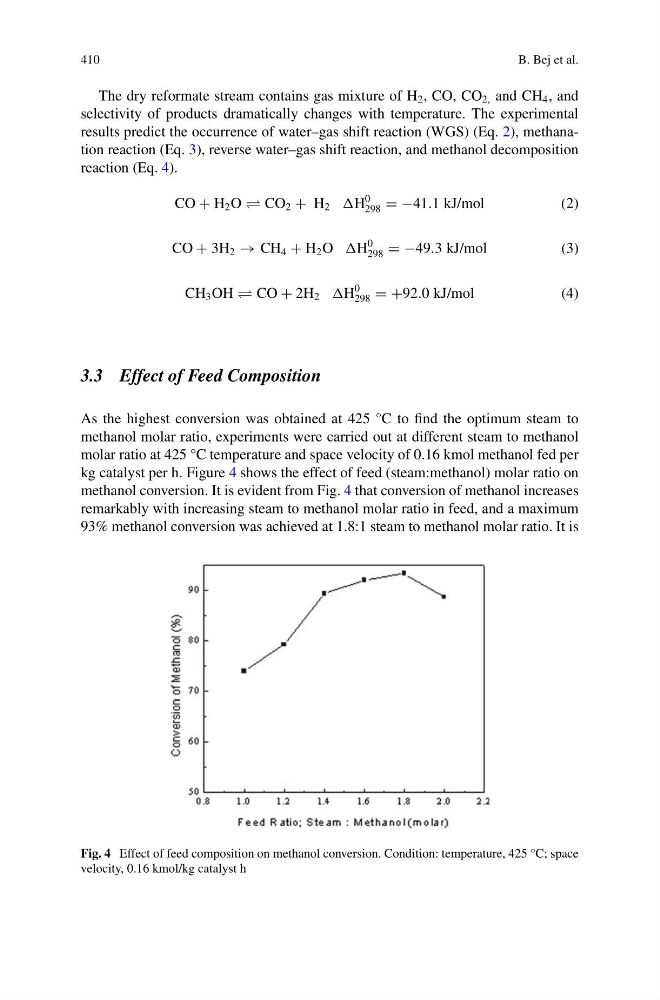
kg catalyst per h. Figure 4 shows the effect of feed (steam:methanol) molar ratio on
methanol conversion. It is evident from Fig. 4 that conversion of methanol increases
remarkably with increasing steam to methanol molar ratio in feed, and a maximum
93% methanol conversion was achieved at 1.8:1 steam to methanol molar ratio. It is
Fig. 4 Effect of feed composition on methanol conversion. Condition: temperature, 425 °C; space
velocity, 0.16 kmol/kg catalyst h
B. Bej et al.
The dry reformate stream contains gas mixture of H 2 , CO, CO 2, and CH 4 , and
selectivity of products dramatically changes with temperature. The experimental
results predict the occurrence of water–gas shift reaction (WGS) (Eq. 2), methanation reaction (Eq. 3), reverse water–gas shift reaction, and methanol decomposition
reaction (Eq. 4).
CO + H 2 O CO 2 + H 2 H
0
298 = −41.1 kJ/mol
(2)
CO + 3H 2 → CH 4 + H 2 O H
0
298 = −49.3 kJ/mol
(3)
CH 3 OH CO + 2H 2 H
0
298 = +92.0 kJ/mol
(4)
3.3 Effect of Feed Composition
As the highest conversion was obtained at 425 °C to find the optimum steam to
methanol molar ratio, experiments were carried out at different steam to methanol
molar ratio at 425 °C temperature and space velocity of 0.16 kmol methanol fed per
kg catalyst per h. Figure 4 shows the effect of feed (steam:methanol) molar ratio on
methanol conversion. It is evident from Fig. 4 that conversion of methanol increases
remarkably with increasing steam to methanol molar ratio in feed, and a maximum
93% methanol conversion was achieved at 1.8:1 steam to methanol molar ratio. It is
Fig. 4 Effect of feed composition on methanol conversion. Condition: temperature, 425 °C; space
velocity, 0.16 kmol/kg catalyst h