

Production of Hydrogen by Steam Reforming of Methanol Over …
409
Fig. 2 SEM image of alumina-supported nano-NiO/SiO 2 after reaction (450 °C)
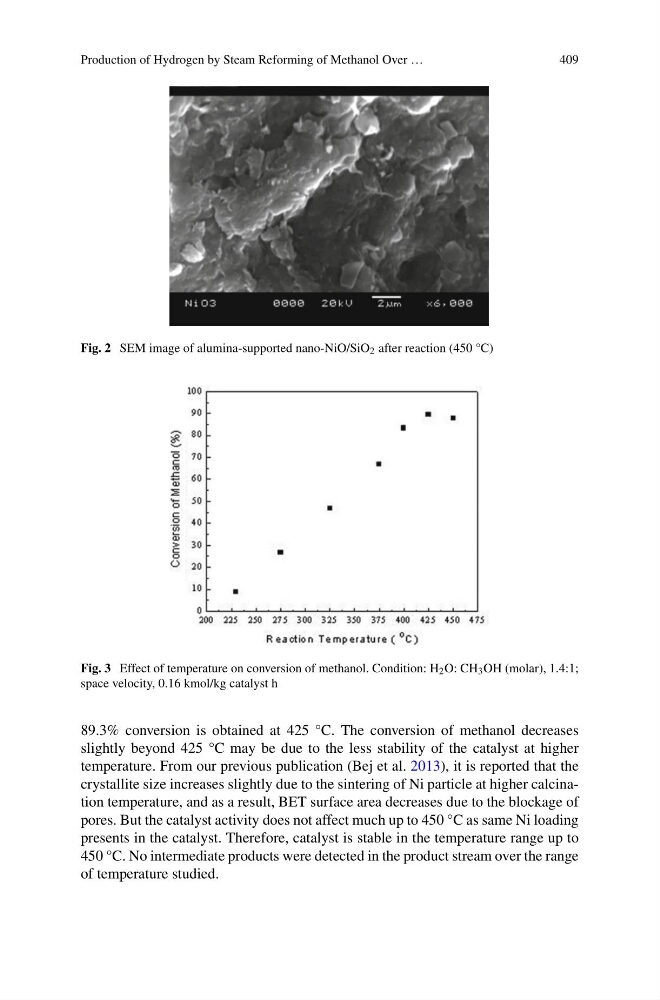
Fig. 3 Effect of temperature on conversion of methanol. Condition: H 2 O: CH 3 OH (molar), 1.4:1;
space velocity, 0.16 kmol/kg catalyst h
89.3% conversion is obtained at 425 °C. The conversion of methanol decreases
slightly beyond 425 °C may be due to the less stability of the catalyst at higher
temperature. From our previous publication (Bej et al. 2013), it is reported that the
crystallite size increases slightly due to the sintering of Ni particle at higher calcination temperature, and as a result, BET surface area decreases due to the blockage of
pores. But the catalyst activity does not affect much up to 450 °C as same Ni loading
presents in the catalyst. Therefore, catalyst is stable in the temperature range up to
450 °C. No intermediate products were detected in the product stream over the range
of temperature studied.
409
Fig. 2 SEM image of alumina-supported nano-NiO/SiO 2 after reaction (450 °C)
Fig. 3 Effect of temperature on conversion of methanol. Condition: H 2 O: CH 3 OH (molar), 1.4:1;
space velocity, 0.16 kmol/kg catalyst h
89.3% conversion is obtained at 425 °C. The conversion of methanol decreases
slightly beyond 425 °C may be due to the less stability of the catalyst at higher
temperature. From our previous publication (Bej et al. 2013), it is reported that the
crystallite size increases slightly due to the sintering of Ni particle at higher calcination temperature, and as a result, BET surface area decreases due to the blockage of
pores. But the catalyst activity does not affect much up to 450 °C as same Ni loading
presents in the catalyst. Therefore, catalyst is stable in the temperature range up to
450 °C. No intermediate products were detected in the product stream over the range
of temperature studied.