

Production of Hydrogen by Steam Reforming of Methanol Over …
411
clear from the figure that conversion of methanol decreases beyond steam to methanol
molar ratio of 1.8:1.
It was observed that in product stream, H 2 selectivity increases gradually with
the addition of more steam in feed, indicating the occurrence of WGS reaction.
Moreover, suppression of methanation reaction with increasing steam to methanol
molar ratio favors the enhancement of H 2 selectivity.
3.4 Effect of Space Velocity
Catalyst activity was found to be dependent on contact time of liquid feed. The reverse
of contact time is known as space velocity. Therefore, to find optimum space velocity,
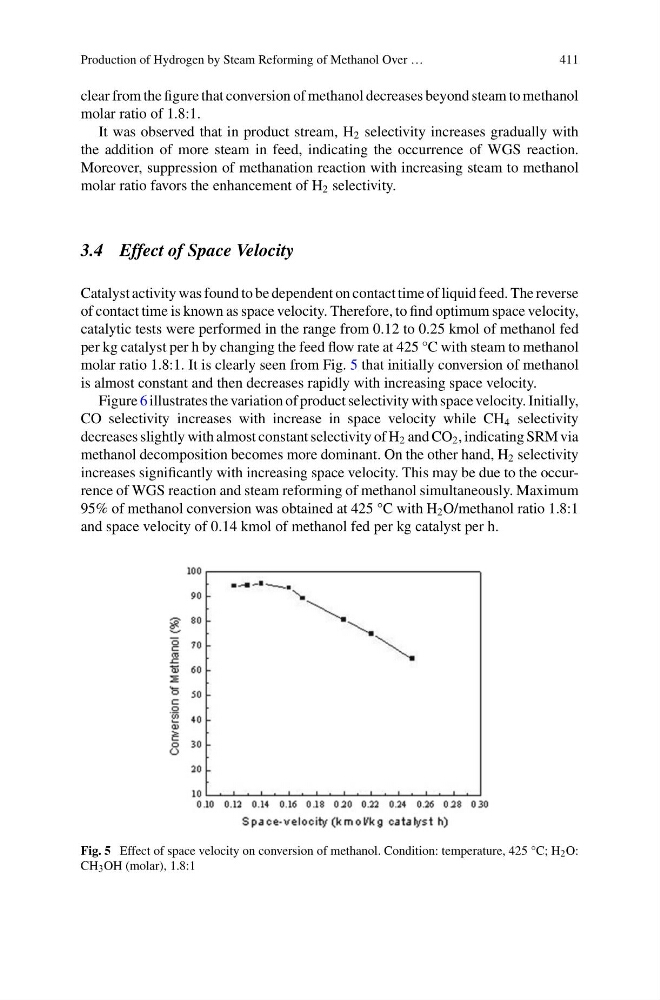
catalytic tests were performed in the range from 0.12 to 0.25 kmol of methanol fed
per kg catalyst per h by changing the feed flow rate at 425 °C with steam to methanol
molar ratio 1.8:1. It is clearly seen from Fig. 5 that initially conversion of methanol
is almost constant and then decreases rapidly with increasing space velocity.
Figure 6 illustrates the variation of product selectivity with space velocity. Initially,
CO selectivity increases with increase in space velocity while CH 4 selectivity
decreases slightly with almost constant selectivity of H 2 and CO 2 , indicating SRM via
methanol decomposition becomes more dominant. On the other hand, H 2 selectivity
increases significantly with increasing space velocity. This may be due to the occurrence of WGS reaction and steam reforming of methanol simultaneously. Maximum
95% of methanol conversion was obtained at 425 °C with H 2 O/methanol ratio 1.8:1
and space velocity of 0.14 kmol of methanol fed per kg catalyst per h.
Fig. 5 Effect of space velocity on conversion of methanol. Condition: temperature, 425 °C; H 2 O:
CH 3 OH (molar), 1.8:1
411
clear from the figure that conversion of methanol decreases beyond steam to methanol
molar ratio of 1.8:1.
It was observed that in product stream, H 2 selectivity increases gradually with
the addition of more steam in feed, indicating the occurrence of WGS reaction.
Moreover, suppression of methanation reaction with increasing steam to methanol
molar ratio favors the enhancement of H 2 selectivity.
3.4 Effect of Space Velocity
Catalyst activity was found to be dependent on contact time of liquid feed. The reverse
of contact time is known as space velocity. Therefore, to find optimum space velocity,
catalytic tests were performed in the range from 0.12 to 0.25 kmol of methanol fed
per kg catalyst per h by changing the feed flow rate at 425 °C with steam to methanol
molar ratio 1.8:1. It is clearly seen from Fig. 5 that initially conversion of methanol
is almost constant and then decreases rapidly with increasing space velocity.
Figure 6 illustrates the variation of product selectivity with space velocity. Initially,
CO selectivity increases with increase in space velocity while CH 4 selectivity
decreases slightly with almost constant selectivity of H 2 and CO 2 , indicating SRM via
methanol decomposition becomes more dominant. On the other hand, H 2 selectivity
increases significantly with increasing space velocity. This may be due to the occurrence of WGS reaction and steam reforming of methanol simultaneously. Maximum
95% of methanol conversion was obtained at 425 °C with H 2 O/methanol ratio 1.8:1
and space velocity of 0.14 kmol of methanol fed per kg catalyst per h.
Fig. 5 Effect of space velocity on conversion of methanol. Condition: temperature, 425 °C; H 2 O:
CH 3 OH (molar), 1.8:1