

Optimization of Process Parameters for Biodegradation …
365
3.3 Comparative Study of Maximum Specific Growth Rate
of Mixed Bacterial Consortium, Maximum Specific
Degradation Rate of Resorcinol, and Removal Efficiency
of Resorcinol in Presence of Heavy Metals
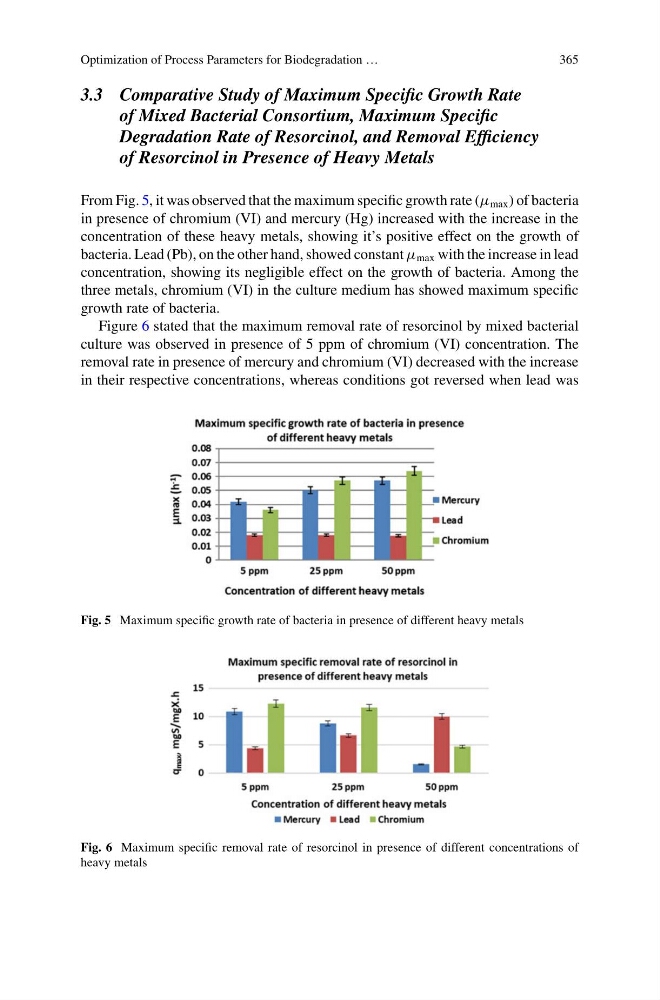
From Fig. 5, it was observed that the maximum specific growth rate (µ max ) of bacteria
in presence of chromium (VI) and mercury (Hg) increased with the increase in the
concentration of these heavy metals, showing it’s positive effect on the growth of
bacteria. Lead (Pb), on the other hand, showed constant µ max with the increase in lead
concentration, showing its negligible effect on the growth of bacteria. Among the
three metals, chromium (VI) in the culture medium has showed maximum specific
growth rate of bacteria.
Figure 6 stated that the maximum removal rate of resorcinol by mixed bacterial
culture was observed in presence of 5 ppm of chromium (VI) concentration. The
removal rate in presence of mercury and chromium (VI) decreased with the increase
in their respective concentrations, whereas conditions got reversed when lead was
Fig. 5 Maximum specific growth rate of bacteria in presence of different heavy metals
Fig. 6 Maximum specific removal rate of resorcinol in presence of different concentrations of
heavy metals
365
3.3 Comparative Study of Maximum Specific Growth Rate
of Mixed Bacterial Consortium, Maximum Specific
Degradation Rate of Resorcinol, and Removal Efficiency
of Resorcinol in Presence of Heavy Metals
From Fig. 5, it was observed that the maximum specific growth rate (µ max ) of bacteria
in presence of chromium (VI) and mercury (Hg) increased with the increase in the
concentration of these heavy metals, showing it’s positive effect on the growth of
bacteria. Lead (Pb), on the other hand, showed constant µ max with the increase in lead
concentration, showing its negligible effect on the growth of bacteria. Among the
three metals, chromium (VI) in the culture medium has showed maximum specific
growth rate of bacteria.
Figure 6 stated that the maximum removal rate of resorcinol by mixed bacterial
culture was observed in presence of 5 ppm of chromium (VI) concentration. The
removal rate in presence of mercury and chromium (VI) decreased with the increase
in their respective concentrations, whereas conditions got reversed when lead was
Fig. 5 Maximum specific growth rate of bacteria in presence of different heavy metals
Fig. 6 Maximum specific removal rate of resorcinol in presence of different concentrations of
heavy metals