

Effect of Calcium Salts on Salinity Stress on Morphology …
313
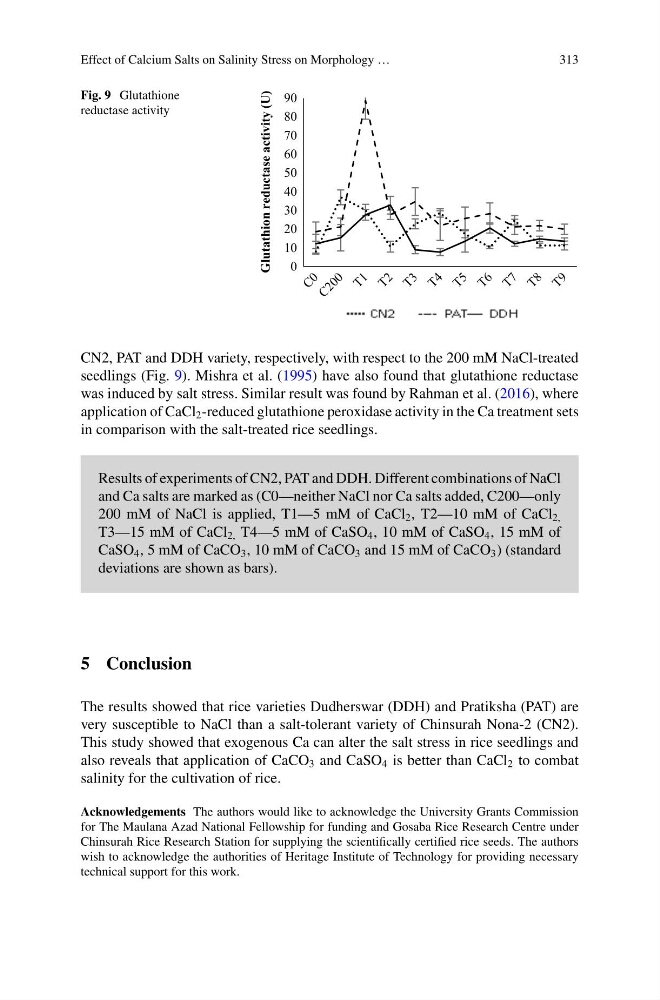
Fig. 9 Glutathione
reductase activity
0
10
20
30
40
50
60
70
80
90
Glutathion reductase activity (U)
CN2, PAT and DDH variety, respectively, with respect to the 200 mM NaCl-treated
seedlings (Fig. 9). Mishra et al. (1995) have also found that glutathione reductase
was induced by salt stress. Similar result was found by Rahman et al. (2016), where
application of CaCl 2 -reduced glutathione peroxidase activity in the Ca treatment sets
in comparison with the salt-treated rice seedlings.
Results of experiments of CN2, PAT and DDH. Different combinations of NaCl
and Ca salts are marked as (C0—neither NaCl nor Ca salts added, C200—only
200 mM of NaCl is applied, T1—5 mM of CaCl 2 , T2—10 mM of CaCl 2,
T3—15 mM of CaCl 2, T4—5 mM of CaSO 4 , 10 mM of CaSO 4 , 15 mM of
CaSO 4 , 5 mM of CaCO 3 , 10 mM of CaCO 3 and 15 mM of CaCO 3 ) (standard
deviations are shown as bars).
5 Conclusion
The results showed that rice varieties Dudherswar (DDH) and Pratiksha (PAT) are
very susceptible to NaCl than a salt-tolerant variety of Chinsurah Nona-2 (CN2).
This study showed that exogenous Ca can alter the salt stress in rice seedlings and
also reveals that application of CaCO 3 and CaSO 4 is better than CaCl 2 to combat
salinity for the cultivation of rice.
Acknowledgements The authors would like to acknowledge the University Grants Commission
for The Maulana Azad National Fellowship for funding and Gosaba Rice Research Centre under
Chinsurah Rice Research Station for supplying the scientifically certified rice seeds. The authors
wish to acknowledge the authorities of Heritage Institute of Technology for providing necessary
technical support for this work.
313
Fig. 9 Glutathione
reductase activity
0
10
20
30
40
50
60
70
80
90
Glutathion reductase activity (U)
CN2, PAT and DDH variety, respectively, with respect to the 200 mM NaCl-treated
seedlings (Fig. 9). Mishra et al. (1995) have also found that glutathione reductase
was induced by salt stress. Similar result was found by Rahman et al. (2016), where
application of CaCl 2 -reduced glutathione peroxidase activity in the Ca treatment sets
in comparison with the salt-treated rice seedlings.
Results of experiments of CN2, PAT and DDH. Different combinations of NaCl
and Ca salts are marked as (C0—neither NaCl nor Ca salts added, C200—only
200 mM of NaCl is applied, T1—5 mM of CaCl 2 , T2—10 mM of CaCl 2,
T3—15 mM of CaCl 2, T4—5 mM of CaSO 4 , 10 mM of CaSO 4 , 15 mM of
CaSO 4 , 5 mM of CaCO 3 , 10 mM of CaCO 3 and 15 mM of CaCO 3 ) (standard
deviations are shown as bars).
5 Conclusion
The results showed that rice varieties Dudherswar (DDH) and Pratiksha (PAT) are
very susceptible to NaCl than a salt-tolerant variety of Chinsurah Nona-2 (CN2).
This study showed that exogenous Ca can alter the salt stress in rice seedlings and
also reveals that application of CaCO 3 and CaSO 4 is better than CaCl 2 to combat
salinity for the cultivation of rice.
Acknowledgements The authors would like to acknowledge the University Grants Commission
for The Maulana Azad National Fellowship for funding and Gosaba Rice Research Centre under
Chinsurah Rice Research Station for supplying the scientifically certified rice seeds. The authors
wish to acknowledge the authorities of Heritage Institute of Technology for providing necessary
technical support for this work.