

312
B. Singh and S. Banerjee
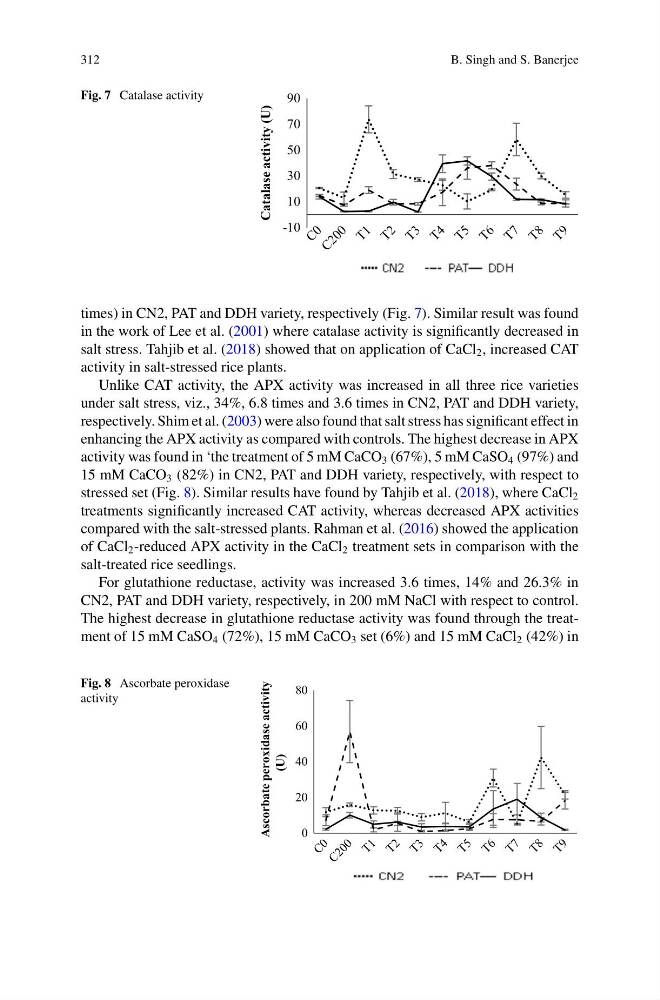
Fig. 7 Catalase activity
-10
10
30
50
70
90
Catalase activity (U)
times) in CN2, PAT and DDH variety, respectively (Fig. 7). Similar result was found
in the work of Lee et al. (2001) where catalase activity is significantly decreased in
salt stress. Tahjib et al. (2018) showed that on application of CaCl 2 , increased CAT
activity in salt-stressed rice plants.
Unlike CAT activity, the APX activity was increased in all three rice varieties
under salt stress, viz., 34%, 6.8 times and 3.6 times in CN2, PAT and DDH variety,
respectively. Shim et al. (2003) were also found that salt stress has significant effect in
enhancing the APX activity as compared with controls. The highest decrease in APX
activity was found in ‘the treatment of 5 mM CaCO 3 (67%), 5 mM CaSO 4 (97%) and
15 mM CaCO 3 (82%) in CN2, PAT and DDH variety, respectively, with respect to
stressed set (Fig. 8). Similar results have found by Tahjib et al. (2018), where CaCl 2
treatments significantly increased CAT activity, whereas decreased APX activities
compared with the salt-stressed plants. Rahman et al. (2016) showed the application
of CaCl 2 -reduced APX activity in the CaCl 2 treatment sets in comparison with the
salt-treated rice seedlings.
For glutathione reductase, activity was increased 3.6 times, 14% and 26.3% in
CN2, PAT and DDH variety, respectively, in 200 mM NaCl with respect to control.
The highest decrease in glutathione reductase activity was found through the treatment of 15 mM CaSO 4 (72%), 15 mM CaCO 3 set (6%) and 15 mM CaCl 2 (42%) in
Fig. 8 Ascorbate peroxidase
activity
0
20
40
60
80
Ascorbate peroxidase activity
(U)
B. Singh and S. Banerjee
Fig. 7 Catalase activity
-10
10
30
50
70
90
Catalase activity (U)
times) in CN2, PAT and DDH variety, respectively (Fig. 7). Similar result was found
in the work of Lee et al. (2001) where catalase activity is significantly decreased in
salt stress. Tahjib et al. (2018) showed that on application of CaCl 2 , increased CAT
activity in salt-stressed rice plants.
Unlike CAT activity, the APX activity was increased in all three rice varieties
under salt stress, viz., 34%, 6.8 times and 3.6 times in CN2, PAT and DDH variety,
respectively. Shim et al. (2003) were also found that salt stress has significant effect in
enhancing the APX activity as compared with controls. The highest decrease in APX
activity was found in ‘the treatment of 5 mM CaCO 3 (67%), 5 mM CaSO 4 (97%) and
15 mM CaCO 3 (82%) in CN2, PAT and DDH variety, respectively, with respect to
stressed set (Fig. 8). Similar results have found by Tahjib et al. (2018), where CaCl 2
treatments significantly increased CAT activity, whereas decreased APX activities
compared with the salt-stressed plants. Rahman et al. (2016) showed the application
of CaCl 2 -reduced APX activity in the CaCl 2 treatment sets in comparison with the
salt-treated rice seedlings.
For glutathione reductase, activity was increased 3.6 times, 14% and 26.3% in
CN2, PAT and DDH variety, respectively, in 200 mM NaCl with respect to control.
The highest decrease in glutathione reductase activity was found through the treatment of 15 mM CaSO 4 (72%), 15 mM CaCO 3 set (6%) and 15 mM CaCl 2 (42%) in
Fig. 8 Ascorbate peroxidase
activity
0
20
40
60
80
Ascorbate peroxidase activity
(U)