

Effect of Calcium Salts on Salinity Stress on Morphology …
311
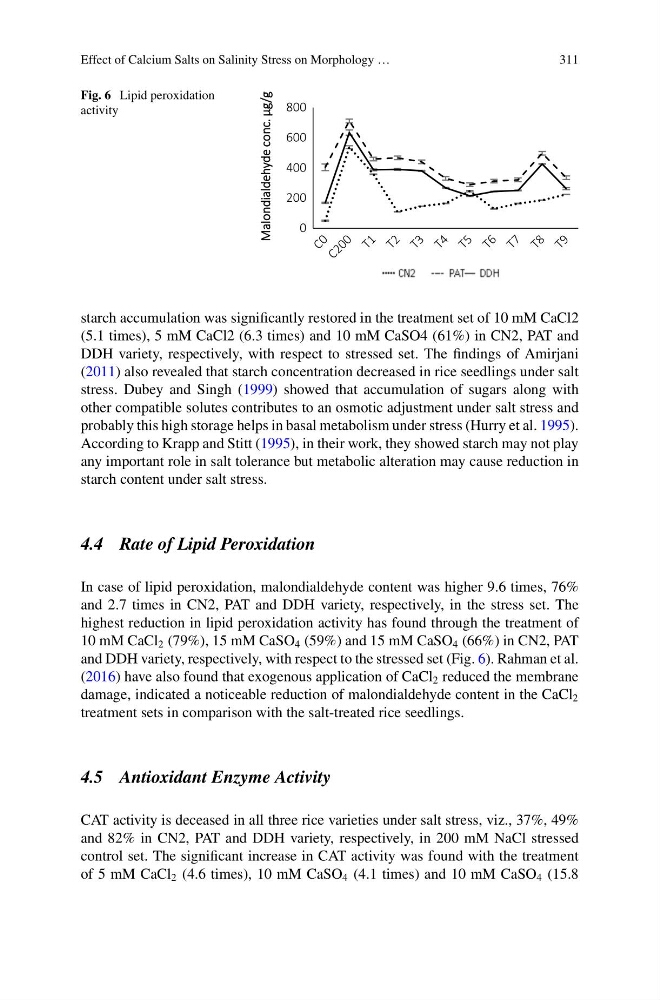
Fig. 6 Lipid peroxidation
activity
0
200
400
600
800
Malondialdehyde
conc. μg/g
starch accumulation was significantly restored in the treatment set of 10 mM CaCl2
(5.1 times), 5 mM CaCl2 (6.3 times) and 10 mM CaSO4 (61%) in CN2, PAT and
DDH variety, respectively, with respect to stressed set. The findings of Amirjani
(2011) also revealed that starch concentration decreased in rice seedlings under salt
stress. Dubey and Singh (1999) showed that accumulation of sugars along with
other compatible solutes contributes to an osmotic adjustment under salt stress and
probably this high storage helps in basal metabolism under stress (Hurry et al. 1995).
According to Krapp and Stitt (1995), in their work, they showed starch may not play
any important role in salt tolerance but metabolic alteration may cause reduction in
starch content under salt stress.
4.4 Rate of Lipid Peroxidation
In case of lipid peroxidation, malondialdehyde content was higher 9.6 times, 76%
and 2.7 times in CN2, PAT and DDH variety, respectively, in the stress set. The
highest reduction in lipid peroxidation activity has found through the treatment of
10 mM CaCl 2 (79%), 15 mM CaSO 4 (59%) and 15 mM CaSO 4 (66%) in CN2, PAT
and DDH variety, respectively, with respect to the stressed set (Fig. 6). Rahman et al.
(2016) have also found that exogenous application of CaCl 2 reduced the membrane
damage, indicated a noticeable reduction of malondialdehyde content in the CaCl 2
treatment sets in comparison with the salt-treated rice seedlings.
4.5 Antioxidant Enzyme Activity
CAT activity is deceased in all three rice varieties under salt stress, viz., 37%, 49%
and 82% in CN2, PAT and DDH variety, respectively, in 200 mM NaCl stressed
control set. The significant increase in CAT activity was found with the treatment
of 5 mM CaCl 2 (4.6 times), 10 mM CaSO 4 (4.1 times) and 10 mM CaSO 4 (15.8
311
Fig. 6 Lipid peroxidation
activity
0
200
400
600
800
Malondialdehyde
conc. μg/g
starch accumulation was significantly restored in the treatment set of 10 mM CaCl2
(5.1 times), 5 mM CaCl2 (6.3 times) and 10 mM CaSO4 (61%) in CN2, PAT and
DDH variety, respectively, with respect to stressed set. The findings of Amirjani
(2011) also revealed that starch concentration decreased in rice seedlings under salt
stress. Dubey and Singh (1999) showed that accumulation of sugars along with
other compatible solutes contributes to an osmotic adjustment under salt stress and
probably this high storage helps in basal metabolism under stress (Hurry et al. 1995).
According to Krapp and Stitt (1995), in their work, they showed starch may not play
any important role in salt tolerance but metabolic alteration may cause reduction in
starch content under salt stress.
4.4 Rate of Lipid Peroxidation
In case of lipid peroxidation, malondialdehyde content was higher 9.6 times, 76%
and 2.7 times in CN2, PAT and DDH variety, respectively, in the stress set. The
highest reduction in lipid peroxidation activity has found through the treatment of
10 mM CaCl 2 (79%), 15 mM CaSO 4 (59%) and 15 mM CaSO 4 (66%) in CN2, PAT
and DDH variety, respectively, with respect to the stressed set (Fig. 6). Rahman et al.
(2016) have also found that exogenous application of CaCl 2 reduced the membrane
damage, indicated a noticeable reduction of malondialdehyde content in the CaCl 2
treatment sets in comparison with the salt-treated rice seedlings.
4.5 Antioxidant Enzyme Activity
CAT activity is deceased in all three rice varieties under salt stress, viz., 37%, 49%
and 82% in CN2, PAT and DDH variety, respectively, in 200 mM NaCl stressed
control set. The significant increase in CAT activity was found with the treatment
of 5 mM CaCl 2 (4.6 times), 10 mM CaSO 4 (4.1 times) and 10 mM CaSO 4 (15.8