

Study on Application of Novel Synthesized Silver Metallosurfactant …
301
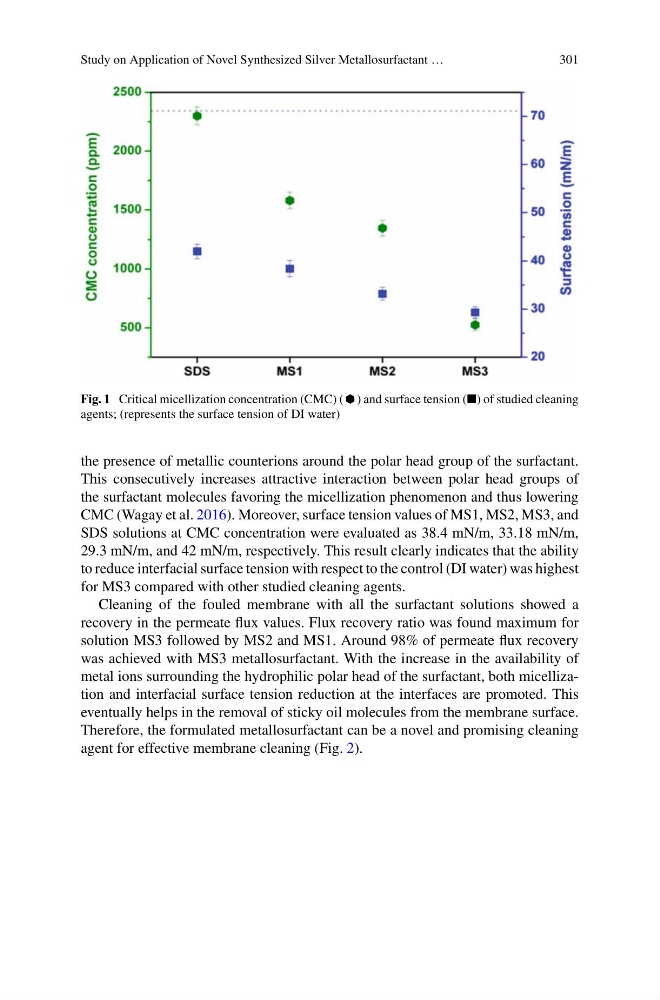
Fig. 1 Critical micellization concentration (CMC) ( ’ ) and surface tension () of studied cleaning
agents; (represents the surface tension of DI water)
the presence of metallic counterions around the polar head group of the surfactant.
This consecutively increases attractive interaction between polar head groups of
the surfactant molecules favoring the micellization phenomenon and thus lowering
CMC (Wagay et al. 2016). Moreover, surface tension values of MS1, MS2, MS3, and
SDS solutions at CMC concentration were evaluated as 38.4 mN/m, 33.18 mN/m,
29.3 mN/m, and 42 mN/m, respectively. This result clearly indicates that the ability
to reduce interfacial surface tension with respect to the control (DI water) was highest
for MS3 compared with other studied cleaning agents.
Cleaning of the fouled membrane with all the surfactant solutions showed a
recovery in the permeate flux values. Flux recovery ratio was found maximum for
solution MS3 followed by MS2 and MS1. Around 98% of permeate flux recovery
was achieved with MS3 metallosurfactant. With the increase in the availability of
metal ions surrounding the hydrophilic polar head of the surfactant, both micellization and interfacial surface tension reduction at the interfaces are promoted. This
eventually helps in the removal of sticky oil molecules from the membrane surface.
Therefore, the formulated metallosurfactant can be a novel and promising cleaning
agent for effective membrane cleaning (Fig. 2).
301
Fig. 1 Critical micellization concentration (CMC) ( ’ ) and surface tension () of studied cleaning
agents; (represents the surface tension of DI water)
the presence of metallic counterions around the polar head group of the surfactant.
This consecutively increases attractive interaction between polar head groups of
the surfactant molecules favoring the micellization phenomenon and thus lowering
CMC (Wagay et al. 2016). Moreover, surface tension values of MS1, MS2, MS3, and
SDS solutions at CMC concentration were evaluated as 38.4 mN/m, 33.18 mN/m,
29.3 mN/m, and 42 mN/m, respectively. This result clearly indicates that the ability
to reduce interfacial surface tension with respect to the control (DI water) was highest
for MS3 compared with other studied cleaning agents.
Cleaning of the fouled membrane with all the surfactant solutions showed a
recovery in the permeate flux values. Flux recovery ratio was found maximum for
solution MS3 followed by MS2 and MS1. Around 98% of permeate flux recovery
was achieved with MS3 metallosurfactant. With the increase in the availability of
metal ions surrounding the hydrophilic polar head of the surfactant, both micellization and interfacial surface tension reduction at the interfaces are promoted. This
eventually helps in the removal of sticky oil molecules from the membrane surface.
Therefore, the formulated metallosurfactant can be a novel and promising cleaning
agent for effective membrane cleaning (Fig. 2).