

300
A. Mazumder et al.
4 Materials
All chemicals were purchased from Merck (Mumbai, India). Deionized water (DI)
was collected from the hybrid Arium RO unit and the Arium 611 DI ultrapure water
system (Made: Sartorius). The membrane operations were carried out by polysulfone
(PSf) membrane procured from Sterlitech Corporation, USA.
5 Methods
SDS was blended with 175 mg of silver nitrate (AgNO 3 ) at the (w/w) ratio of 4:1,
3:1, and 2:1 in 100 mL of distilled water at room temperature and the mixtures were
designated as MS1, MS2, and MS3, respectively. These mixtures were then stirred
for 1 h at 550 rpm at 80 °C. After cooling it to room temperature, critical micelle
concentration (CMC) of each formulated mixture was determined by conventional the
conductivity method (Domínguez et al. 1997). The surface tension of these solutions
was also evaluated by the stalagmometric method at 25 °C (Donald and Bulloch
1915).
Primarily PSf membrane was fouled with emulsified oily wastewater till the
permeate flux drops to 10% of the original flux value of the new membrane. The
fouled membrane was then dipped in each of the formulated mixtures and was rested
for stirring up to 1 h at room temperature. After the accomplishment of the cleaning
operation, the permeate flux value was reevaluated at constant transmembrane pressure of 3 kgf. Foulant removal performance was analyzed by calculating the flux
recovery ratio as shown in Eq. 1 (Zhang et al. 2015).
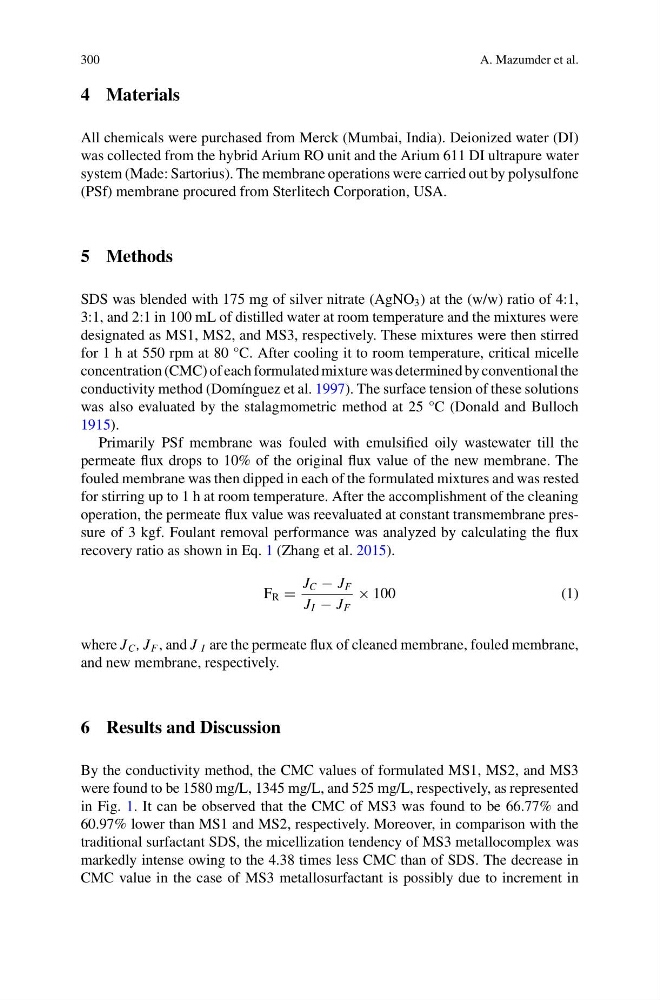
F R =
J C − J F
J I − J F
× 100
(1)
where J C , J F , and J I are the permeate flux of cleaned membrane, fouled membrane,
and new membrane, respectively.
6 Results and Discussion
By the conductivity method, the CMC values of formulated MS1, MS2, and MS3
were found to be 1580 mg/L, 1345 mg/L, and 525 mg/L, respectively, as represented
in Fig. 1. It can be observed that the CMC of MS3 was found to be 66.77% and
60.97% lower than MS1 and MS2, respectively. Moreover, in comparison with the
traditional surfactant SDS, the micellization tendency of MS3 metallocomplex was
markedly intense owing to the 4.38 times less CMC than of SDS. The decrease in
CMC value in the case of MS3 metallosurfactant is possibly due to increment in
A. Mazumder et al.
4 Materials
All chemicals were purchased from Merck (Mumbai, India). Deionized water (DI)
was collected from the hybrid Arium RO unit and the Arium 611 DI ultrapure water
system (Made: Sartorius). The membrane operations were carried out by polysulfone
(PSf) membrane procured from Sterlitech Corporation, USA.
5 Methods
SDS was blended with 175 mg of silver nitrate (AgNO 3 ) at the (w/w) ratio of 4:1,
3:1, and 2:1 in 100 mL of distilled water at room temperature and the mixtures were
designated as MS1, MS2, and MS3, respectively. These mixtures were then stirred
for 1 h at 550 rpm at 80 °C. After cooling it to room temperature, critical micelle
concentration (CMC) of each formulated mixture was determined by conventional the
conductivity method (Domínguez et al. 1997). The surface tension of these solutions
was also evaluated by the stalagmometric method at 25 °C (Donald and Bulloch
1915).
Primarily PSf membrane was fouled with emulsified oily wastewater till the
permeate flux drops to 10% of the original flux value of the new membrane. The
fouled membrane was then dipped in each of the formulated mixtures and was rested
for stirring up to 1 h at room temperature. After the accomplishment of the cleaning
operation, the permeate flux value was reevaluated at constant transmembrane pressure of 3 kgf. Foulant removal performance was analyzed by calculating the flux
recovery ratio as shown in Eq. 1 (Zhang et al. 2015).
F R =
J C − J F
J I − J F
× 100
(1)
where J C , J F , and J I are the permeate flux of cleaned membrane, fouled membrane,
and new membrane, respectively.
6 Results and Discussion
By the conductivity method, the CMC values of formulated MS1, MS2, and MS3
were found to be 1580 mg/L, 1345 mg/L, and 525 mg/L, respectively, as represented
in Fig. 1. It can be observed that the CMC of MS3 was found to be 66.77% and
60.97% lower than MS1 and MS2, respectively. Moreover, in comparison with the
traditional surfactant SDS, the micellization tendency of MS3 metallocomplex was
markedly intense owing to the 4.38 times less CMC than of SDS. The decrease in
CMC value in the case of MS3 metallosurfactant is possibly due to increment in