

302
A. Mazumder et al.
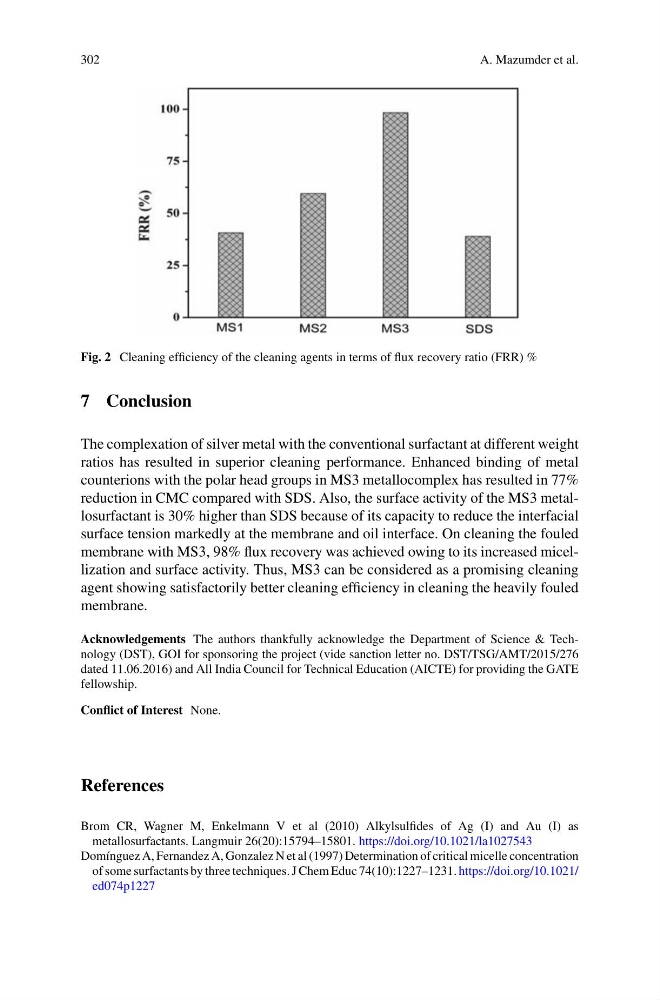
Fig. 2 Cleaning efficiency of the cleaning agents in terms of flux recovery ratio (FRR) %
7 Conclusion
The complexation of silver metal with the conventional surfactant at different weight
ratios has resulted in superior cleaning performance. Enhanced binding of metal
counterions with the polar head groups in MS3 metallocomplex has resulted in 77%
reduction in CMC compared with SDS. Also, the surface activity of the MS3 metallosurfactant is 30% higher than SDS because of its capacity to reduce the interfacial
surface tension markedly at the membrane and oil interface. On cleaning the fouled
membrane with MS3, 98% flux recovery was achieved owing to its increased micellization and surface activity. Thus, MS3 can be considered as a promising cleaning
agent showing satisfactorily better cleaning efficiency in cleaning the heavily fouled
membrane.
Acknowledgements The authors thankfully acknowledge the Department of Science & Technology (DST), GOI for sponsoring the project (vide sanction letter no. DST/TSG/AMT/2015/276
dated 11.06.2016) and All India Council for Technical Education (AICTE) for providing the GATE
fellowship.
Conflict of Interest None.
References
Brom CR, Wagner M, Enkelmann V et al (2010) Alkylsulfides of Ag (I) and Au (I) as
metallosurfactants. Langmuir 26(20):15794–15801. https://doi.org/10.1021/la1027543
Domínguez A, Fernandez A, Gonzalez N et al (1997) Determination of critical micelle concentration
of some surfactants by three techniques. J Chem Educ 74(10):1227–1231. https://doi.org/10.1021/
ed074p1227
A. Mazumder et al.
Fig. 2 Cleaning efficiency of the cleaning agents in terms of flux recovery ratio (FRR) %
7 Conclusion
The complexation of silver metal with the conventional surfactant at different weight
ratios has resulted in superior cleaning performance. Enhanced binding of metal
counterions with the polar head groups in MS3 metallocomplex has resulted in 77%
reduction in CMC compared with SDS. Also, the surface activity of the MS3 metallosurfactant is 30% higher than SDS because of its capacity to reduce the interfacial
surface tension markedly at the membrane and oil interface. On cleaning the fouled
membrane with MS3, 98% flux recovery was achieved owing to its increased micellization and surface activity. Thus, MS3 can be considered as a promising cleaning
agent showing satisfactorily better cleaning efficiency in cleaning the heavily fouled
membrane.
Acknowledgements The authors thankfully acknowledge the Department of Science & Technology (DST), GOI for sponsoring the project (vide sanction letter no. DST/TSG/AMT/2015/276
dated 11.06.2016) and All India Council for Technical Education (AICTE) for providing the GATE
fellowship.
Conflict of Interest None.
References
Brom CR, Wagner M, Enkelmann V et al (2010) Alkylsulfides of Ag (I) and Au (I) as
metallosurfactants. Langmuir 26(20):15794–15801. https://doi.org/10.1021/la1027543
Domínguez A, Fernandez A, Gonzalez N et al (1997) Determination of critical micelle concentration
of some surfactants by three techniques. J Chem Educ 74(10):1227–1231. https://doi.org/10.1021/
ed074p1227