

Application of Bacillus sp. NITD 19 for Utilization of Cyanide …
245
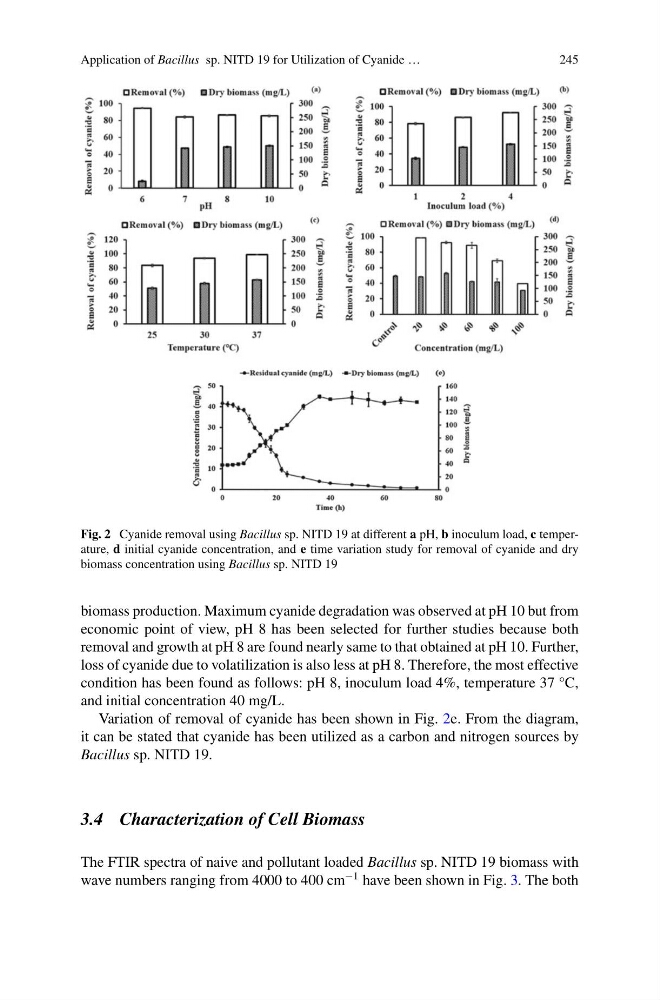
Fig. 2 Cyanide removal using Bacillus sp. NITD 19 at different a pH, b inoculum load, c temperature, d initial cyanide concentration, and e time variation study for removal of cyanide and dry
biomass concentration using Bacillus sp. NITD 19
biomass production. Maximum cyanide degradation was observed at pH 10 but from
economic point of view, pH 8 has been selected for further studies because both
removal and growth at pH 8 are found nearly same to that obtained at pH 10. Further,
loss of cyanide due to volatilization is also less at pH 8. Therefore, the most effective
condition has been found as follows: pH 8, inoculum load 4%, temperature 37 °C,
and initial concentration 40 mg/L.
Variation of removal of cyanide has been shown in Fig. 2e. From the diagram,
it can be stated that cyanide has been utilized as a carbon and nitrogen sources by
Bacillus sp. NITD 19.
3.4 Characterization of Cell Biomass
The FTIR spectra of naive and pollutant loaded Bacillus sp. NITD 19 biomass with
wave numbers ranging from 4000 to 400 cm
−1 have been shown in Fig. 3. The both
245
Fig. 2 Cyanide removal using Bacillus sp. NITD 19 at different a pH, b inoculum load, c temperature, d initial cyanide concentration, and e time variation study for removal of cyanide and dry
biomass concentration using Bacillus sp. NITD 19
biomass production. Maximum cyanide degradation was observed at pH 10 but from
economic point of view, pH 8 has been selected for further studies because both
removal and growth at pH 8 are found nearly same to that obtained at pH 10. Further,
loss of cyanide due to volatilization is also less at pH 8. Therefore, the most effective
condition has been found as follows: pH 8, inoculum load 4%, temperature 37 °C,
and initial concentration 40 mg/L.
Variation of removal of cyanide has been shown in Fig. 2e. From the diagram,
it can be stated that cyanide has been utilized as a carbon and nitrogen sources by
Bacillus sp. NITD 19.
3.4 Characterization of Cell Biomass
The FTIR spectra of naive and pollutant loaded Bacillus sp. NITD 19 biomass with
wave numbers ranging from 4000 to 400 cm
−1 have been shown in Fig. 3. The both