

246
A. Rai et al.
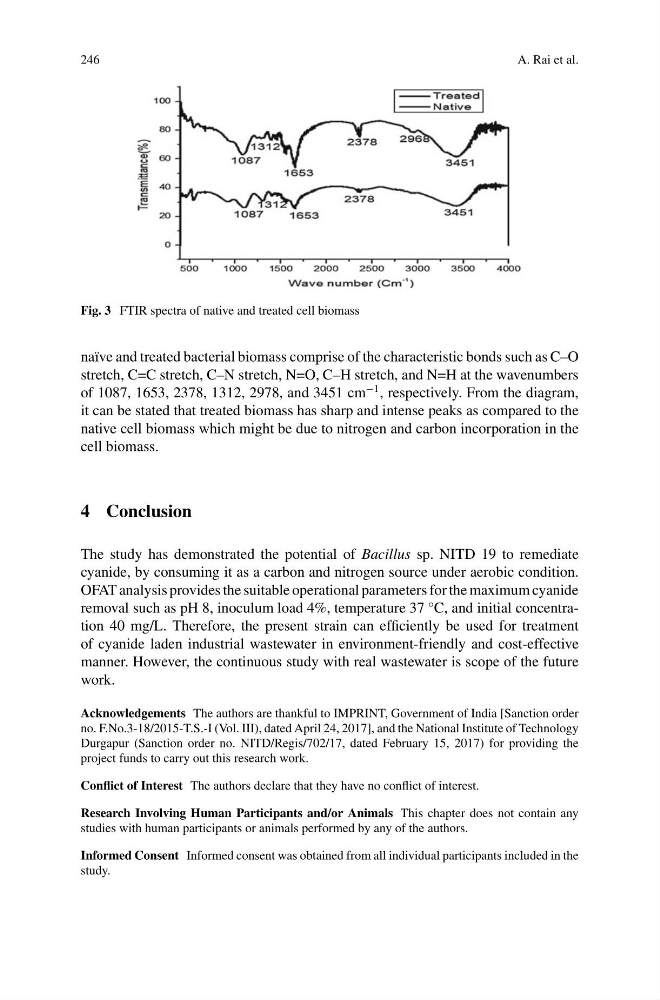
Fig. 3 FTIR spectra of native and treated cell biomass
naïve and treated bacterial biomass comprise of the characteristic bonds such as C–O
stretch, C=C stretch, C–N stretch, N=O, C–H stretch, and N=H at the wavenumbers
of 1087, 1653, 2378, 1312, 2978, and 3451 cm
−1 , respectively. From the diagram,
it can be stated that treated biomass has sharp and intense peaks as compared to the
native cell biomass which might be due to nitrogen and carbon incorporation in the
cell biomass.
4 Conclusion
The study has demonstrated the potential of Bacillus sp. NITD 19 to remediate
cyanide, by consuming it as a carbon and nitrogen source under aerobic condition.
OFAT analysis provides the suitable operational parameters for the maximum cyanide
removal such as pH 8, inoculum load 4%, temperature 37 °C, and initial concentration 40 mg/L. Therefore, the present strain can efficiently be used for treatment
of cyanide laden industrial wastewater in environment-friendly and cost-effective
manner. However, the continuous study with real wastewater is scope of the future
work.
Acknowledgements The authors are thankful to IMPRINT, Government of India [Sanction order
no. F.No.3-18/2015-T.S.-I (Vol. III), dated April 24, 2017], and the National Institute of Technology
Durgapur (Sanction order no. NITD/Regis/702/17, dated February 15, 2017) for providing the
project funds to carry out this research work.
Conflict of Interest The authors declare that they have no conflict of interest.
Research Involving Human Participants and/or Animals This chapter does not contain any
studies with human participants or animals performed by any of the authors.
Informed Consent Informed consent was obtained from all individual participants included in the
study.
A. Rai et al.
Fig. 3 FTIR spectra of native and treated cell biomass
naïve and treated bacterial biomass comprise of the characteristic bonds such as C–O
stretch, C=C stretch, C–N stretch, N=O, C–H stretch, and N=H at the wavenumbers
of 1087, 1653, 2378, 1312, 2978, and 3451 cm
−1 , respectively. From the diagram,
it can be stated that treated biomass has sharp and intense peaks as compared to the
native cell biomass which might be due to nitrogen and carbon incorporation in the
cell biomass.
4 Conclusion
The study has demonstrated the potential of Bacillus sp. NITD 19 to remediate
cyanide, by consuming it as a carbon and nitrogen source under aerobic condition.
OFAT analysis provides the suitable operational parameters for the maximum cyanide
removal such as pH 8, inoculum load 4%, temperature 37 °C, and initial concentration 40 mg/L. Therefore, the present strain can efficiently be used for treatment
of cyanide laden industrial wastewater in environment-friendly and cost-effective
manner. However, the continuous study with real wastewater is scope of the future
work.
Acknowledgements The authors are thankful to IMPRINT, Government of India [Sanction order
no. F.No.3-18/2015-T.S.-I (Vol. III), dated April 24, 2017], and the National Institute of Technology
Durgapur (Sanction order no. NITD/Regis/702/17, dated February 15, 2017) for providing the
project funds to carry out this research work.
Conflict of Interest The authors declare that they have no conflict of interest.
Research Involving Human Participants and/or Animals This chapter does not contain any
studies with human participants or animals performed by any of the authors.
Informed Consent Informed consent was obtained from all individual participants included in the
study.