

244
A. Rai et al.
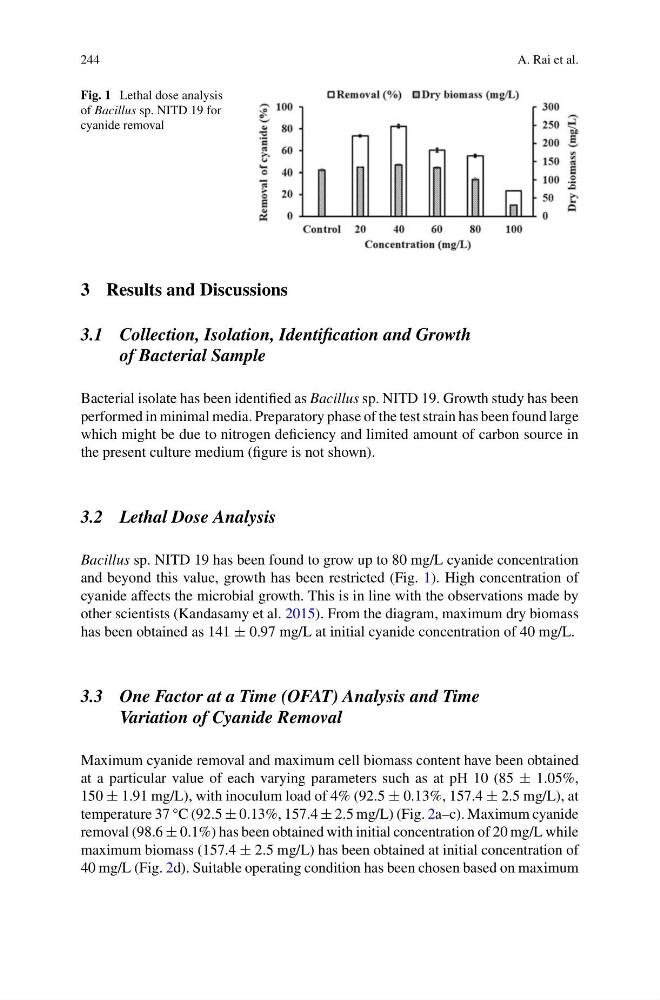
Fig. 1 Lethal dose analysis
of Bacillus sp. NITD 19 for
cyanide removal
3 Results and Discussions
3.1 Collection, Isolation, Identification and Growth
of Bacterial Sample
Bacterial isolate has been identified as Bacillus sp. NITD 19. Growth study has been
performed in minimal media. Preparatory phase of the test strain has been found large
which might be due to nitrogen deficiency and limited amount of carbon source in
the present culture medium (figure is not shown).
3.2 Lethal Dose Analysis
Bacillus sp. NITD 19 has been found to grow up to 80 mg/L cyanide concentration
and beyond this value, growth has been restricted (Fig. 1). High concentration of
cyanide affects the microbial growth. This is in line with the observations made by
other scientists (Kandasamy et al. 2015). From the diagram, maximum dry biomass
has been obtained as 141 ± 0.97 mg/L at initial cyanide concentration of 40 mg/L.
3.3 One Factor at a Time (OFAT) Analysis and Time
Variation of Cyanide Removal
Maximum cyanide removal and maximum cell biomass content have been obtained
at a particular value of each varying parameters such as at pH 10 (85 ± 1.05%,
150 ± 1.91 mg/L), with inoculum load of 4% (92.5 ± 0.13%, 157.4 ± 2.5 mg/L), at
temperature 37 °C (92.5 ± 0.13%, 157.4 ± 2.5 mg/L) (Fig. 2a–c). Maximum cyanide
removal (98.6 ± 0.1%) has been obtained with initial concentration of 20 mg/L while
maximum biomass (157.4 ± 2.5 mg/L) has been obtained at initial concentration of
40 mg/L (Fig. 2d). Suitable operating condition has been chosen based on maximum
A. Rai et al.
Fig. 1 Lethal dose analysis
of Bacillus sp. NITD 19 for
cyanide removal
3 Results and Discussions
3.1 Collection, Isolation, Identification and Growth
of Bacterial Sample
Bacterial isolate has been identified as Bacillus sp. NITD 19. Growth study has been
performed in minimal media. Preparatory phase of the test strain has been found large
which might be due to nitrogen deficiency and limited amount of carbon source in
the present culture medium (figure is not shown).
3.2 Lethal Dose Analysis
Bacillus sp. NITD 19 has been found to grow up to 80 mg/L cyanide concentration
and beyond this value, growth has been restricted (Fig. 1). High concentration of
cyanide affects the microbial growth. This is in line with the observations made by
other scientists (Kandasamy et al. 2015). From the diagram, maximum dry biomass
has been obtained as 141 ± 0.97 mg/L at initial cyanide concentration of 40 mg/L.
3.3 One Factor at a Time (OFAT) Analysis and Time
Variation of Cyanide Removal
Maximum cyanide removal and maximum cell biomass content have been obtained
at a particular value of each varying parameters such as at pH 10 (85 ± 1.05%,
150 ± 1.91 mg/L), with inoculum load of 4% (92.5 ± 0.13%, 157.4 ± 2.5 mg/L), at
temperature 37 °C (92.5 ± 0.13%, 157.4 ± 2.5 mg/L) (Fig. 2a–c). Maximum cyanide
removal (98.6 ± 0.1%) has been obtained with initial concentration of 20 mg/L while
maximum biomass (157.4 ± 2.5 mg/L) has been obtained at initial concentration of
40 mg/L (Fig. 2d). Suitable operating condition has been chosen based on maximum