

Isolation and Characterization of Arsenic Tolerant Bacteria …
239
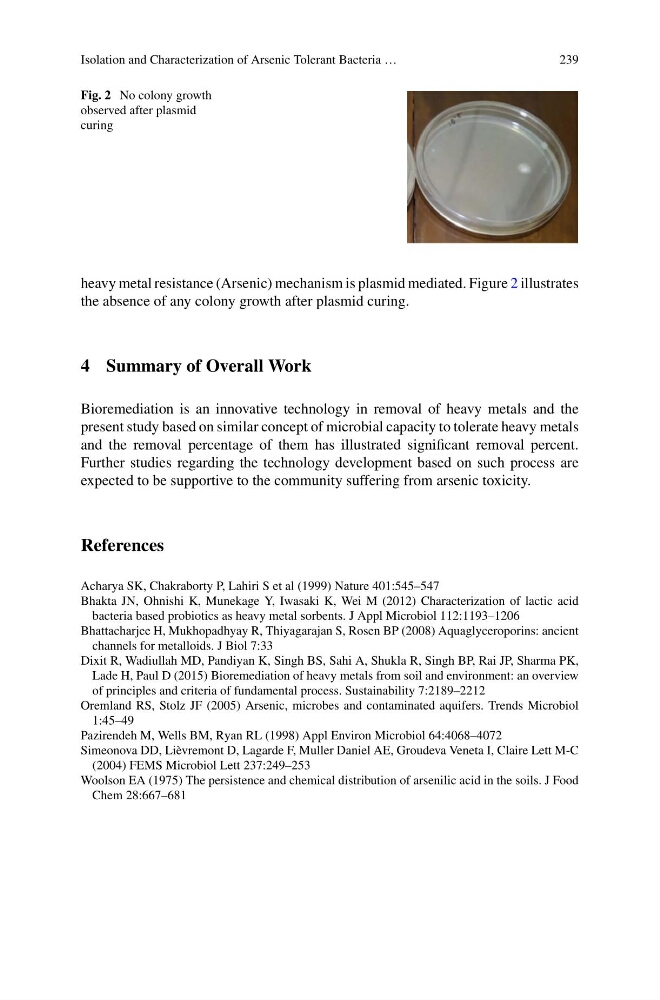
Fig. 2 No colony growth
observed after plasmid
curing
heavy metal resistance (Arsenic) mechanism is plasmid mediated. Figure 2 illustrates
the absence of any colony growth after plasmid curing.
4 Summary of Overall Work
Bioremediation is an innovative technology in removal of heavy metals and the
present study based on similar concept of microbial capacity to tolerate heavy metals
and the removal percentage of them has illustrated significant removal percent.
Further studies regarding the technology development based on such process are
expected to be supportive to the community suffering from arsenic toxicity.
References
Acharya SK, Chakraborty P, Lahiri S et al (1999) Nature 401:545–547
Bhakta JN, Ohnishi K, Munekage Y, Iwasaki K, Wei M (2012) Characterization of lactic acid
bacteria based probiotics as heavy metal sorbents. J Appl Microbiol 112:1193–1206
Bhattacharjee H, Mukhopadhyay R, Thiyagarajan S, Rosen BP (2008) Aquaglyceroporins: ancient
channels for metalloids. J Biol 7:33
Dixit R, Wadiullah MD, Pandiyan K, Singh BS, Sahi A, Shukla R, Singh BP, Rai JP, Sharma PK,
Lade H, Paul D (2015) Bioremediation of heavy metals from soil and environment: an overview
of principles and criteria of fundamental process. Sustainability 7:2189–2212
Oremland RS, Stolz JF (2005) Arsenic, microbes and contaminated aquifers. Trends Microbiol
1:45–49
Pazirendeh M, Wells BM, Ryan RL (1998) Appl Environ Microbiol 64:4068–4072
Simeonova DD, Lièvremont D, Lagarde F, Muller Daniel AE, Groudeva Veneta I, Claire Lett M-C
(2004) FEMS Microbiol Lett 237:249–253
Woolson EA (1975) The persistence and chemical distribution of arsenilic acid in the soils. J Food
Chem 28:667–681
239
Fig. 2 No colony growth
observed after plasmid
curing
heavy metal resistance (Arsenic) mechanism is plasmid mediated. Figure 2 illustrates
the absence of any colony growth after plasmid curing.
4 Summary of Overall Work
Bioremediation is an innovative technology in removal of heavy metals and the
present study based on similar concept of microbial capacity to tolerate heavy metals
and the removal percentage of them has illustrated significant removal percent.
Further studies regarding the technology development based on such process are
expected to be supportive to the community suffering from arsenic toxicity.
References
Acharya SK, Chakraborty P, Lahiri S et al (1999) Nature 401:545–547
Bhakta JN, Ohnishi K, Munekage Y, Iwasaki K, Wei M (2012) Characterization of lactic acid
bacteria based probiotics as heavy metal sorbents. J Appl Microbiol 112:1193–1206
Bhattacharjee H, Mukhopadhyay R, Thiyagarajan S, Rosen BP (2008) Aquaglyceroporins: ancient
channels for metalloids. J Biol 7:33
Dixit R, Wadiullah MD, Pandiyan K, Singh BS, Sahi A, Shukla R, Singh BP, Rai JP, Sharma PK,
Lade H, Paul D (2015) Bioremediation of heavy metals from soil and environment: an overview
of principles and criteria of fundamental process. Sustainability 7:2189–2212
Oremland RS, Stolz JF (2005) Arsenic, microbes and contaminated aquifers. Trends Microbiol
1:45–49
Pazirendeh M, Wells BM, Ryan RL (1998) Appl Environ Microbiol 64:4068–4072
Simeonova DD, Lièvremont D, Lagarde F, Muller Daniel AE, Groudeva Veneta I, Claire Lett M-C
(2004) FEMS Microbiol Lett 237:249–253
Woolson EA (1975) The persistence and chemical distribution of arsenilic acid in the soils. J Food
Chem 28:667–681