

Composition and Antioxidant Activity of Vapours …
155
bud oil and its roasted vapour. During roasting, there were decreased reducing power
capacity. Both control clove oil and roasted vapour showed FRAP in the range of
11.10 μM/ml–1.56 μM/ml and vapour sample had significantly lower antioxidant
activity than control.
3.1.2 DPPH Assay of Clove Bud Oil and Roasted Vapour of Clove Bud
The inhibitory effects of clove bud oil and roasted vapour of clove bud samples on
the DPPH activity were given in Table 1. DPPH presented the highest scavenging
power for clove bud oil (89.77%) among vapour sample. Clove bud oil, however,
exhibited a very different profile wherein a progressive decrease in DPPH activity of
roasted vapour samples (60%). There were significant differences observed between
above two samples.
3.1.3 ABTS
+ Assay of Clove Bud Oil and Roasted Vapour of Clove Bud
As seen in Table 1, clove bud oil had an effective ABTS
+ radical scavenging activity
(74.47%). Also, significant differences in ABTS
+ scavenging potential could be
determined among control clove bud oil (without heat) and roasted vapour (72.80%).
3.2 Total Phenolic Content of Clove Bud Oil and Roasted
Vapour of Clove Bud
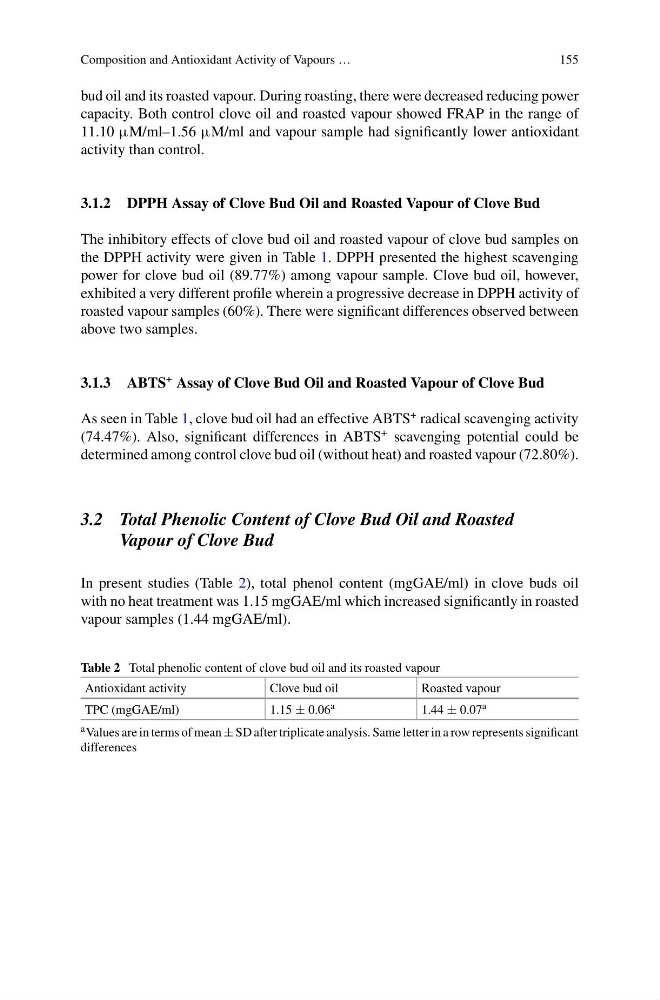
In present studies (Table 2), total phenol content (mgGAE/ml) in clove buds oil
with no heat treatment was 1.15 mgGAE/ml which increased significantly in roasted
vapour samples (1.44 mgGAE/ml).
Table 2 Total phenolic content of clove bud oil and its roasted vapour
Antioxidant activity
Clove bud oil
Roasted vapour
TPC (mgGAE/ml)
1.15 ± 0.06 a
1.44 ± 0.07 a
a Values are in terms of mean ± SD after triplicate analysis. Same letter in a row represents significant
differences
155
bud oil and its roasted vapour. During roasting, there were decreased reducing power
capacity. Both control clove oil and roasted vapour showed FRAP in the range of
11.10 μM/ml–1.56 μM/ml and vapour sample had significantly lower antioxidant
activity than control.
3.1.2 DPPH Assay of Clove Bud Oil and Roasted Vapour of Clove Bud
The inhibitory effects of clove bud oil and roasted vapour of clove bud samples on
the DPPH activity were given in Table 1. DPPH presented the highest scavenging
power for clove bud oil (89.77%) among vapour sample. Clove bud oil, however,
exhibited a very different profile wherein a progressive decrease in DPPH activity of
roasted vapour samples (60%). There were significant differences observed between
above two samples.
3.1.3 ABTS
+ Assay of Clove Bud Oil and Roasted Vapour of Clove Bud
As seen in Table 1, clove bud oil had an effective ABTS
+ radical scavenging activity
(74.47%). Also, significant differences in ABTS
+ scavenging potential could be
determined among control clove bud oil (without heat) and roasted vapour (72.80%).
3.2 Total Phenolic Content of Clove Bud Oil and Roasted
Vapour of Clove Bud
In present studies (Table 2), total phenol content (mgGAE/ml) in clove buds oil
with no heat treatment was 1.15 mgGAE/ml which increased significantly in roasted
vapour samples (1.44 mgGAE/ml).
Table 2 Total phenolic content of clove bud oil and its roasted vapour
Antioxidant activity
Clove bud oil
Roasted vapour
TPC (mgGAE/ml)
1.15 ± 0.06 a
1.44 ± 0.07 a
a Values are in terms of mean ± SD after triplicate analysis. Same letter in a row represents significant
differences