

Effect of Metabolic Risk Factors, Gene Polymorphisms …
147
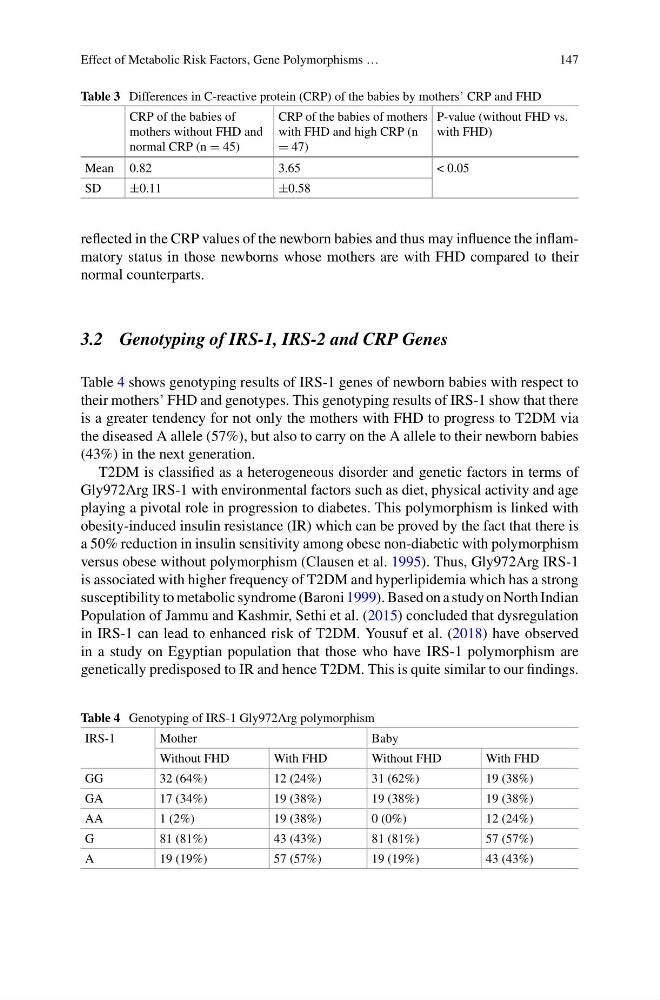
Table 3 Differences in C-reactive protein (CRP) of the babies by mothers’ CRP and FHD
CRP of the babies of
mothers without FHD and
normal CRP (n = 45)
CRP of the babies of mothers
with FHD and high CRP (n
= 47)
P-value (without FHD vs.
with FHD)
Mean 0.82
3.65
< 0.05
SD
±0.11
±0.58
reflected in the CRP values of the newborn babies and thus may influence the inflammatory status in those newborns whose mothers are with FHD compared to their
normal counterparts.
3.2 Genotyping of IRS-1, IRS-2 and CRP Genes
Table 4 shows genotyping results of IRS-1 genes of newborn babies with respect to
their mothers’ FHD and genotypes. This genotyping results of IRS-1 show that there
is a greater tendency for not only the mothers with FHD to progress to T2DM via
the diseased A allele (57%), but also to carry on the A allele to their newborn babies
(43%) in the next generation.
T2DM is classified as a heterogeneous disorder and genetic factors in terms of
Gly972Arg IRS-1 with environmental factors such as diet, physical activity and age
playing a pivotal role in progression to diabetes. This polymorphism is linked with
obesity-induced insulin resistance (IR) which can be proved by the fact that there is
a 50% reduction in insulin sensitivity among obese non-diabetic with polymorphism
versus obese without polymorphism (Clausen et al. 1995). Thus, Gly972Arg IRS-1
is associated with higher frequency of T2DM and hyperlipidemia which has a strong
susceptibility to metabolic syndrome (Baroni 1999). Based on a study on North Indian
Population of Jammu and Kashmir, Sethi et al. (2015) concluded that dysregulation
in IRS-1 can lead to enhanced risk of T2DM. Yousuf et al. (2018) have observed
in a study on Egyptian population that those who have IRS-1 polymorphism are
genetically predisposed to IR and hence T2DM. This is quite similar to our findings.
Table 4 Genotyping of IRS-1 Gly972Arg polymorphism
IRS-1
Mother
Baby
Without FHD
With FHD
Without FHD
With FHD
GG
32 (64%)
12 (24%)
31 (62%)
19 (38%)
GA
17 (34%)
19 (38%)
19 (38%)
19 (38%)
AA
1 (2%)
19 (38%)
0 (0%)
12 (24%)
G
81 (81%)
43 (43%)
81 (81%)
57 (57%)
A
19 (19%)
57 (57%)
19 (19%)
43 (43%)
147
Table 3 Differences in C-reactive protein (CRP) of the babies by mothers’ CRP and FHD
CRP of the babies of
mothers without FHD and
normal CRP (n = 45)
CRP of the babies of mothers
with FHD and high CRP (n
= 47)
P-value (without FHD vs.
with FHD)
Mean 0.82
3.65
< 0.05
SD
±0.11
±0.58
reflected in the CRP values of the newborn babies and thus may influence the inflammatory status in those newborns whose mothers are with FHD compared to their
normal counterparts.
3.2 Genotyping of IRS-1, IRS-2 and CRP Genes
Table 4 shows genotyping results of IRS-1 genes of newborn babies with respect to
their mothers’ FHD and genotypes. This genotyping results of IRS-1 show that there
is a greater tendency for not only the mothers with FHD to progress to T2DM via
the diseased A allele (57%), but also to carry on the A allele to their newborn babies
(43%) in the next generation.
T2DM is classified as a heterogeneous disorder and genetic factors in terms of
Gly972Arg IRS-1 with environmental factors such as diet, physical activity and age
playing a pivotal role in progression to diabetes. This polymorphism is linked with
obesity-induced insulin resistance (IR) which can be proved by the fact that there is
a 50% reduction in insulin sensitivity among obese non-diabetic with polymorphism
versus obese without polymorphism (Clausen et al. 1995). Thus, Gly972Arg IRS-1
is associated with higher frequency of T2DM and hyperlipidemia which has a strong
susceptibility to metabolic syndrome (Baroni 1999). Based on a study on North Indian
Population of Jammu and Kashmir, Sethi et al. (2015) concluded that dysregulation
in IRS-1 can lead to enhanced risk of T2DM. Yousuf et al. (2018) have observed
in a study on Egyptian population that those who have IRS-1 polymorphism are
genetically predisposed to IR and hence T2DM. This is quite similar to our findings.
Table 4 Genotyping of IRS-1 Gly972Arg polymorphism
IRS-1
Mother
Baby
Without FHD
With FHD
Without FHD
With FHD
GG
32 (64%)
12 (24%)
31 (62%)
19 (38%)
GA
17 (34%)
19 (38%)
19 (38%)
19 (38%)
AA
1 (2%)
19 (38%)
0 (0%)
12 (24%)
G
81 (81%)
43 (43%)
81 (81%)
57 (57%)
A
19 (19%)
57 (57%)
19 (19%)
43 (43%)