

136
S. Sengupta J. Bhowal
2.5.3 Ferric-Reducing Antioxidant Power (FRAP) Assay
The reducing power of the sample was done with the modified method of Benzie
and Strain’s (1996). Catechin was used as positive control. The FRAP value was
determined from the standard curve of Fe
2+ (FeSO 4 .7H 2 O).
2.5.4 Reducing Power Assay (RPA)
This assay was carried out according to the method reported by Jayanthi and Lalitha
(2011) with slight modifications. Ascorbic acid (AsA) and butylated hydroxy toluene
(BHT) were used as a positive and negative controls, respectively.
2.5.5 Metal Chelating Activity
The ability of pyocyanin to chelate ferrous ion was performed according to the
method reported by Dinis et al. (1994). EDTA was used as the positive control. The
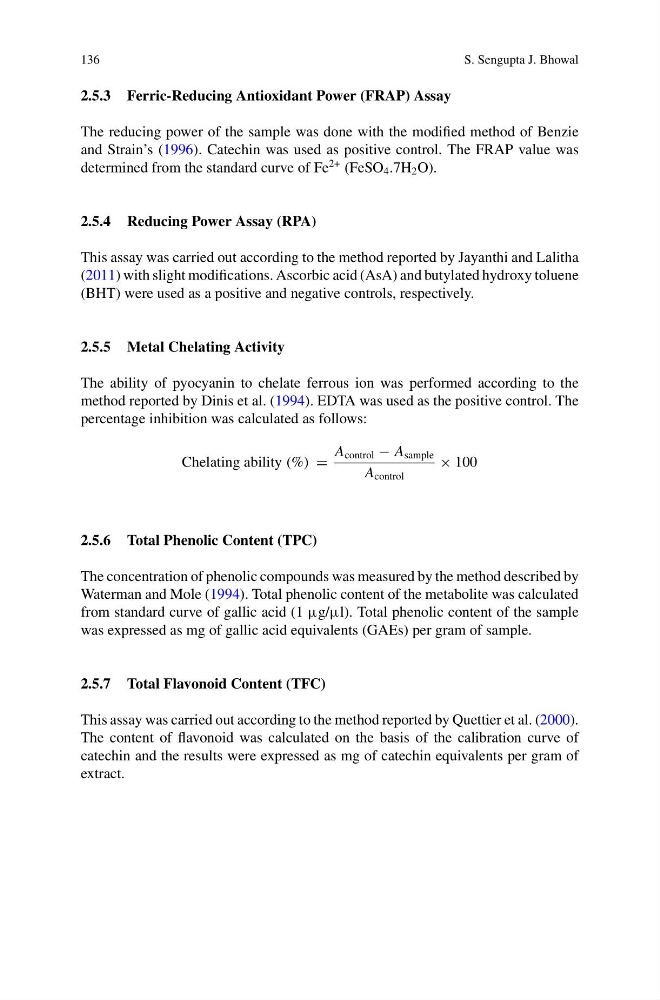
percentage inhibition was calculated as follows:
Chelating ability (%) =
A control − A sample
A control
× 100
2.5.6 Total Phenolic Content (TPC)
The concentration of phenolic compounds was measured by the method described by
Waterman and Mole (1994). Total phenolic content of the metabolite was calculated
from standard curve of gallic acid (1 µg/µl). Total phenolic content of the sample
was expressed as mg of gallic acid equivalents (GAEs) per gram of sample.
2.5.7 Total Flavonoid Content (TFC)
This assay was carried out according to the method reported by Quettier et al. (2000).
The content of flavonoid was calculated on the basis of the calibration curve of
catechin and the results were expressed as mg of catechin equivalents per gram of
extract.
S. Sengupta J. Bhowal
2.5.3 Ferric-Reducing Antioxidant Power (FRAP) Assay
The reducing power of the sample was done with the modified method of Benzie
and Strain’s (1996). Catechin was used as positive control. The FRAP value was
determined from the standard curve of Fe
2+ (FeSO 4 .7H 2 O).
2.5.4 Reducing Power Assay (RPA)
This assay was carried out according to the method reported by Jayanthi and Lalitha
(2011) with slight modifications. Ascorbic acid (AsA) and butylated hydroxy toluene
(BHT) were used as a positive and negative controls, respectively.
2.5.5 Metal Chelating Activity
The ability of pyocyanin to chelate ferrous ion was performed according to the
method reported by Dinis et al. (1994). EDTA was used as the positive control. The
percentage inhibition was calculated as follows:
Chelating ability (%) =
A control − A sample
A control
× 100
2.5.6 Total Phenolic Content (TPC)
The concentration of phenolic compounds was measured by the method described by
Waterman and Mole (1994). Total phenolic content of the metabolite was calculated
from standard curve of gallic acid (1 µg/µl). Total phenolic content of the sample
was expressed as mg of gallic acid equivalents (GAEs) per gram of sample.
2.5.7 Total Flavonoid Content (TFC)
This assay was carried out according to the method reported by Quettier et al. (2000).
The content of flavonoid was calculated on the basis of the calibration curve of
catechin and the results were expressed as mg of catechin equivalents per gram of
extract.