

Study on the Antioxidant and Cytotoxic Properties …
135
2.4 Production and Extraction of Extracellular Microbial
Pigment
Extraction of the pigment was done by solvent (chloroform) extraction method and
was stored in a dark-colored glass container at −20 °C for future experimental work.
This work had already been reported in our previous publication (Chatterjee and
Bhowal 2016).
2.5 Antioxidant Activity of the Pigment
Evaluation of antioxidant potentiality of the pigment was done by various antioxidant
assays.
2.5.1 2,2-Di Phenyl-1 Picryl-Hydrazyl (DPPH) Assay
DPPH radical scavenging activity was carried out according to the method reported
by Lamien-Meda et al. (2008). DPPH solution in methanol (1:1) served as control.
Radical scavenging activity of the pigment was expressed in terms of percentage
inhibition of DPPH radical.
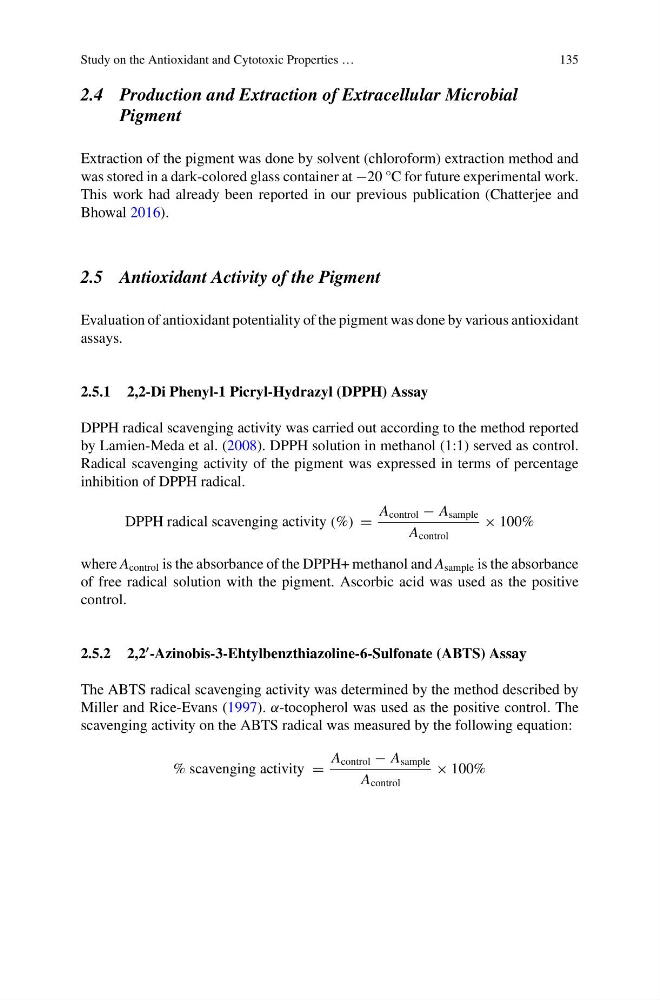
DPPH radical scavenging activity (%) =
A control − A sample
A control
× 100%
where A control is the absorbance of the DPPH+ methanol and A sample is the absorbance
of free radical solution with the pigment. Ascorbic acid was used as the positive
control.
2.5.2 2,2
-Azinobis-3-Ehtylbenzthiazoline-6-Sulfonate (ABTS) Assay
The ABTS radical scavenging activity was determined by the method described by
Miller and Rice-Evans (1997). α-tocopherol was used as the positive control. The
scavenging activity on the ABTS radical was measured by the following equation:
% scavenging activity =
A control − A sample
A control
× 100%
135
2.4 Production and Extraction of Extracellular Microbial
Pigment
Extraction of the pigment was done by solvent (chloroform) extraction method and
was stored in a dark-colored glass container at −20 °C for future experimental work.
This work had already been reported in our previous publication (Chatterjee and
Bhowal 2016).
2.5 Antioxidant Activity of the Pigment
Evaluation of antioxidant potentiality of the pigment was done by various antioxidant
assays.
2.5.1 2,2-Di Phenyl-1 Picryl-Hydrazyl (DPPH) Assay
DPPH radical scavenging activity was carried out according to the method reported
by Lamien-Meda et al. (2008). DPPH solution in methanol (1:1) served as control.
Radical scavenging activity of the pigment was expressed in terms of percentage
inhibition of DPPH radical.
DPPH radical scavenging activity (%) =
A control − A sample
A control
× 100%
where A control is the absorbance of the DPPH+ methanol and A sample is the absorbance
of free radical solution with the pigment. Ascorbic acid was used as the positive
control.
2.5.2 2,2
-Azinobis-3-Ehtylbenzthiazoline-6-Sulfonate (ABTS) Assay
The ABTS radical scavenging activity was determined by the method described by
Miller and Rice-Evans (1997). α-tocopherol was used as the positive control. The
scavenging activity on the ABTS radical was measured by the following equation:
% scavenging activity =
A control − A sample
A control
× 100%