

Study on the Antioxidant and Cytotoxic Properties …
137
2.6 Identification of Principal Antioxidant Compounds
by High-Performance Liquid Chromatography (HPLC)
The pigment extract was subjected to HPLC analysis. Ascorbic acid, phenolic acids
(gallic acid and ferulic acid), and flavonoids (catechin, myricetin, quercetin and
kaempferol) were used as standards. The gradient elution was conducted according
to the Evaristo and Leitao (2001) method with minor modifications. Identification of
the compounds was done by comparison of their retention’s time and UV absorption
spectrum with those of the standards.
2.7 In Vitro Cytotoxic Effect of Pyocyanin on MG-63
Osteosarcoma Cell Lines
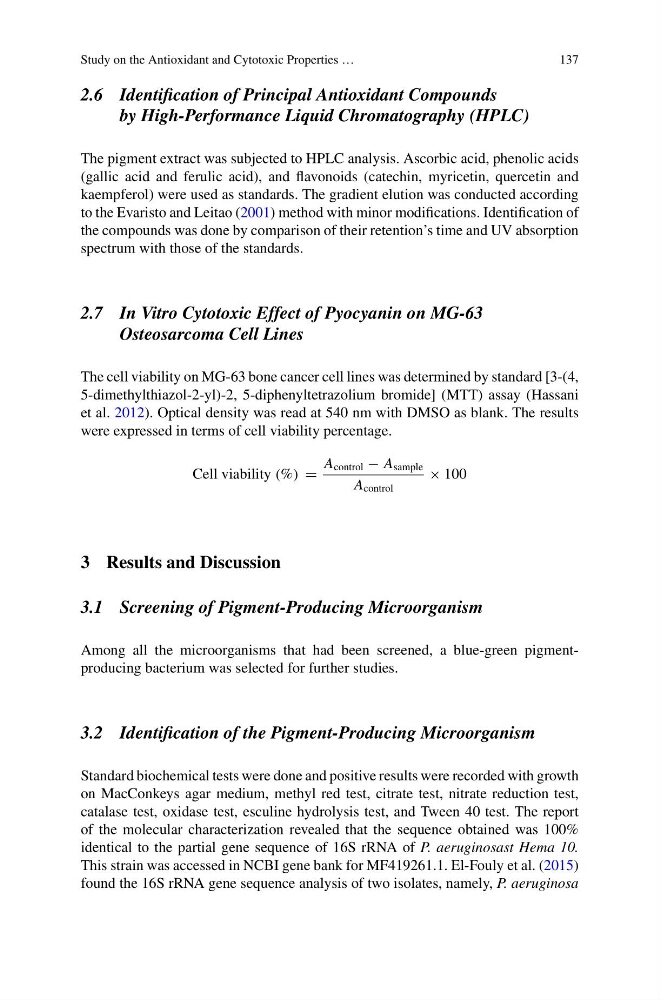
The cell viability on MG-63 bone cancer cell lines was determined by standard [3-(4,
5-dimethylthiazol-2-yl)-2, 5-diphenyltetrazolium bromide] (MTT) assay (Hassani
et al. 2012). Optical density was read at 540 nm with DMSO as blank. The results
were expressed in terms of cell viability percentage.
Cell viability (%) =
A control − A sample
A control
× 100
3 Results and Discussion
3.1 Screening of Pigment-Producing Microorganism
Among all the microorganisms that had been screened, a blue-green pigmentproducing bacterium was selected for further studies.
3.2 Identification of the Pigment-Producing Microorganism
Standard biochemical tests were done and positive results were recorded with growth
on MacConkeys agar medium, methyl red test, citrate test, nitrate reduction test,
catalase test, oxidase test, esculine hydrolysis test, and Tween 40 test. The report
of the molecular characterization revealed that the sequence obtained was 100%
identical to the partial gene sequence of 16S rRNA of P. aeruginosast Hema 10.
This strain was accessed in NCBI gene bank for MF419261.1. El-Fouly et al. (2015)
found the 16S rRNA gene sequence analysis of two isolates, namely, P. aeruginosa
137
2.6 Identification of Principal Antioxidant Compounds
by High-Performance Liquid Chromatography (HPLC)
The pigment extract was subjected to HPLC analysis. Ascorbic acid, phenolic acids
(gallic acid and ferulic acid), and flavonoids (catechin, myricetin, quercetin and
kaempferol) were used as standards. The gradient elution was conducted according
to the Evaristo and Leitao (2001) method with minor modifications. Identification of
the compounds was done by comparison of their retention’s time and UV absorption
spectrum with those of the standards.
2.7 In Vitro Cytotoxic Effect of Pyocyanin on MG-63
Osteosarcoma Cell Lines
The cell viability on MG-63 bone cancer cell lines was determined by standard [3-(4,
5-dimethylthiazol-2-yl)-2, 5-diphenyltetrazolium bromide] (MTT) assay (Hassani
et al. 2012). Optical density was read at 540 nm with DMSO as blank. The results
were expressed in terms of cell viability percentage.
Cell viability (%) =
A control − A sample
A control
× 100
3 Results and Discussion
3.1 Screening of Pigment-Producing Microorganism
Among all the microorganisms that had been screened, a blue-green pigmentproducing bacterium was selected for further studies.
3.2 Identification of the Pigment-Producing Microorganism
Standard biochemical tests were done and positive results were recorded with growth
on MacConkeys agar medium, methyl red test, citrate test, nitrate reduction test,
catalase test, oxidase test, esculine hydrolysis test, and Tween 40 test. The report
of the molecular characterization revealed that the sequence obtained was 100%
identical to the partial gene sequence of 16S rRNA of P. aeruginosast Hema 10.
This strain was accessed in NCBI gene bank for MF419261.1. El-Fouly et al. (2015)
found the 16S rRNA gene sequence analysis of two isolates, namely, P. aeruginosa