

Biodegradation of Dyes by Laccase from Isolated …
115
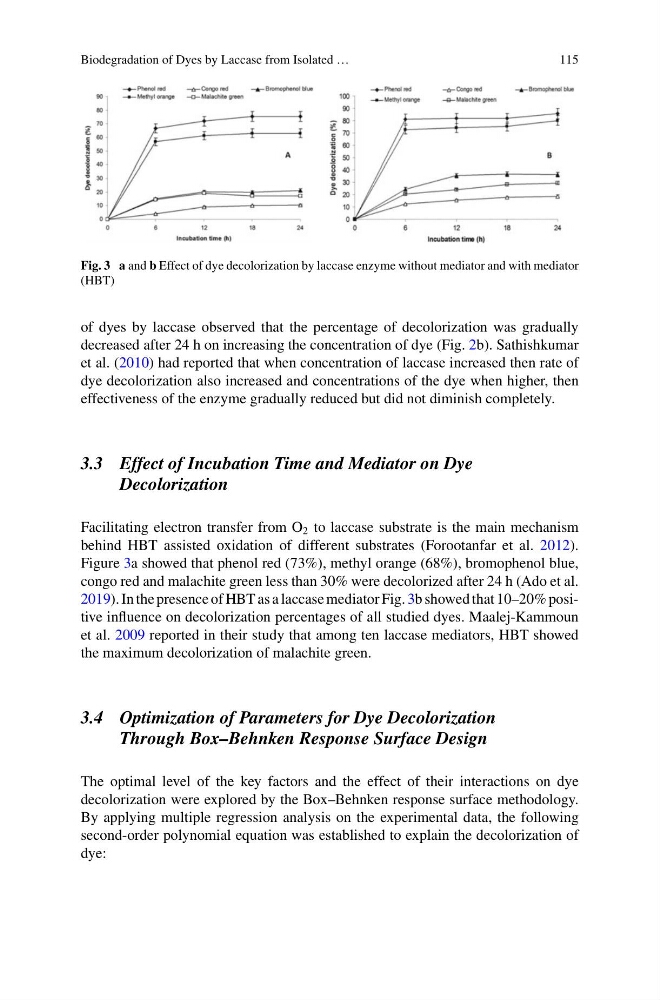
Fig. 3 a and b Effect of dye decolorization by laccase enzyme without mediator and with mediator
(HBT)
of dyes by laccase observed that the percentage of decolorization was gradually
decreased after 24 h on increasing the concentration of dye (Fig. 2b). Sathishkumar
et al. (2010) had reported that when concentration of laccase increased then rate of
dye decolorization also increased and concentrations of the dye when higher, then
effectiveness of the enzyme gradually reduced but did not diminish completely.
3.3 Effect of Incubation Time and Mediator on Dye
Decolorization
Facilitating electron transfer from O 2 to laccase substrate is the main mechanism
behind HBT assisted oxidation of different substrates (Forootanfar et al. 2012).
Figure 3a showed that phenol red (73%), methyl orange (68%), bromophenol blue,
congo red and malachite green less than 30% were decolorized after 24 h (Ado et al.
2019). In the presence of HBT as a laccase mediator Fig. 3b showed that 10–20% positive influence on decolorization percentages of all studied dyes. Maalej-Kammoun
et al. 2009 reported in their study that among ten laccase mediators, HBT showed
the maximum decolorization of malachite green.
3.4 Optimization of Parameters for Dye Decolorization
Through Box–Behnken Response Surface Design
The optimal level of the key factors and the effect of their interactions on dye
decolorization were explored by the Box–Behnken response surface methodology.
By applying multiple regression analysis on the experimental data, the following
second-order polynomial equation was established to explain the decolorization of
dye:
115
Fig. 3 a and b Effect of dye decolorization by laccase enzyme without mediator and with mediator
(HBT)
of dyes by laccase observed that the percentage of decolorization was gradually
decreased after 24 h on increasing the concentration of dye (Fig. 2b). Sathishkumar
et al. (2010) had reported that when concentration of laccase increased then rate of
dye decolorization also increased and concentrations of the dye when higher, then
effectiveness of the enzyme gradually reduced but did not diminish completely.
3.3 Effect of Incubation Time and Mediator on Dye
Decolorization
Facilitating electron transfer from O 2 to laccase substrate is the main mechanism
behind HBT assisted oxidation of different substrates (Forootanfar et al. 2012).
Figure 3a showed that phenol red (73%), methyl orange (68%), bromophenol blue,
congo red and malachite green less than 30% were decolorized after 24 h (Ado et al.
2019). In the presence of HBT as a laccase mediator Fig. 3b showed that 10–20% positive influence on decolorization percentages of all studied dyes. Maalej-Kammoun
et al. 2009 reported in their study that among ten laccase mediators, HBT showed
the maximum decolorization of malachite green.
3.4 Optimization of Parameters for Dye Decolorization
Through Box–Behnken Response Surface Design
The optimal level of the key factors and the effect of their interactions on dye
decolorization were explored by the Box–Behnken response surface methodology.
By applying multiple regression analysis on the experimental data, the following
second-order polynomial equation was established to explain the decolorization of
dye: