

50
J. Karloopia et al.
the process parameters with respect to overall mechanical properties, i.e., (i) ultimate tensile strength, (ii) elongation, and (iii) microhardness was made possible
using regression equations. To validate the predictive model, the final experiments
were conducted using the same process parameters.
Results and Discussion
Microstructural Analysis
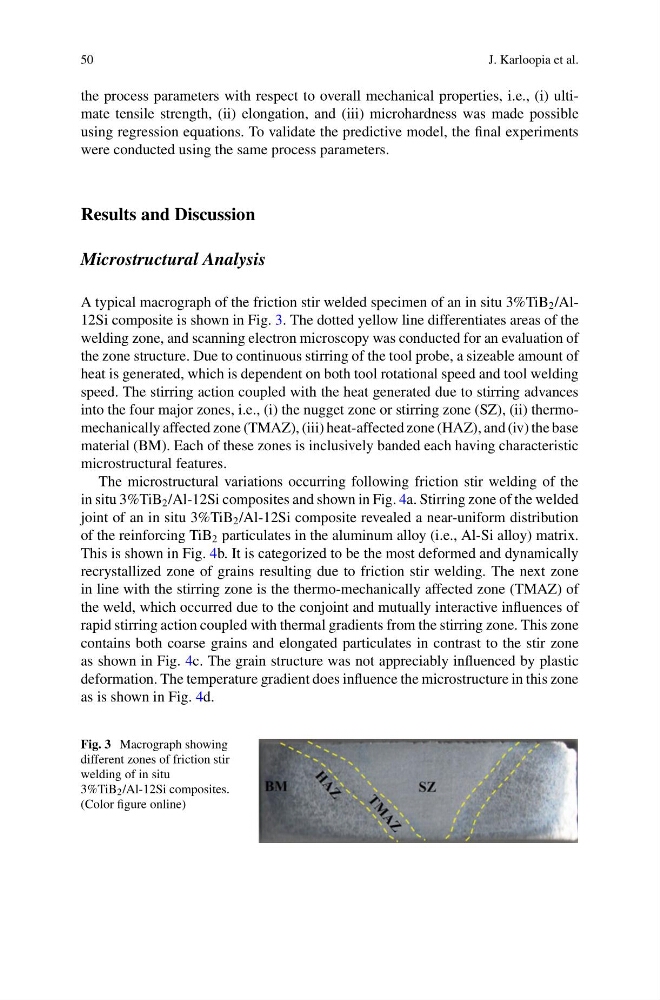
A typical macrograph of the friction stir welded specimen of an in situ 3%TiB 2 /Al12Si composite is shown in Fig. 3. The dotted yellow line differentiates areas of the
welding zone, and scanning electron microscopy was conducted for an evaluation of
the zone structure. Due to continuous stirring of the tool probe, a sizeable amount of
heat is generated, which is dependent on both tool rotational speed and tool welding
speed. The stirring action coupled with the heat generated due to stirring advances
into the four major zones, i.e., (i) the nugget zone or stirring zone (SZ), (ii) thermomechanically affected zone (TMAZ), (iii) heat-affected zone (HAZ), and (iv) the base
material (BM). Each of these zones is inclusively banded each having characteristic
microstructural features.
The microstructural variations occurring following friction stir welding of the
in situ 3%TiB 2 /Al-12Si composites and shown in Fig. 4a. Stirring zone of the welded
joint of an in situ 3%TiB 2 /Al-12Si composite revealed a near-uniform distribution
of the reinforcing TiB 2 particulates in the aluminum alloy (i.e., Al-Si alloy) matrix.
This is shown in Fig. 4b. It is categorized to be the most deformed and dynamically
recrystallized zone of grains resulting due to friction stir welding. The next zone
in line with the stirring zone is the thermo-mechanically affected zone (TMAZ) of
the weld, which occurred due to the conjoint and mutually interactive influences of
rapid stirring action coupled with thermal gradients from the stirring zone. This zone
contains both coarse grains and elongated particulates in contrast to the stir zone
as shown in Fig. 4c. The grain structure was not appreciably influenced by plastic
deformation. The temperature gradient does influence the microstructure in this zone
as is shown in Fig. 4d.
Fig. 3 Macrograph showing
different zones of friction stir
welding of in situ
3%TiB 2 /Al-12Si composites.
(Color figure online)
J. Karloopia et al.
the process parameters with respect to overall mechanical properties, i.e., (i) ultimate tensile strength, (ii) elongation, and (iii) microhardness was made possible
using regression equations. To validate the predictive model, the final experiments
were conducted using the same process parameters.
Results and Discussion
Microstructural Analysis
A typical macrograph of the friction stir welded specimen of an in situ 3%TiB 2 /Al12Si composite is shown in Fig. 3. The dotted yellow line differentiates areas of the
welding zone, and scanning electron microscopy was conducted for an evaluation of
the zone structure. Due to continuous stirring of the tool probe, a sizeable amount of
heat is generated, which is dependent on both tool rotational speed and tool welding
speed. The stirring action coupled with the heat generated due to stirring advances
into the four major zones, i.e., (i) the nugget zone or stirring zone (SZ), (ii) thermomechanically affected zone (TMAZ), (iii) heat-affected zone (HAZ), and (iv) the base
material (BM). Each of these zones is inclusively banded each having characteristic
microstructural features.
The microstructural variations occurring following friction stir welding of the
in situ 3%TiB 2 /Al-12Si composites and shown in Fig. 4a. Stirring zone of the welded
joint of an in situ 3%TiB 2 /Al-12Si composite revealed a near-uniform distribution
of the reinforcing TiB 2 particulates in the aluminum alloy (i.e., Al-Si alloy) matrix.
This is shown in Fig. 4b. It is categorized to be the most deformed and dynamically
recrystallized zone of grains resulting due to friction stir welding. The next zone
in line with the stirring zone is the thermo-mechanically affected zone (TMAZ) of
the weld, which occurred due to the conjoint and mutually interactive influences of
rapid stirring action coupled with thermal gradients from the stirring zone. This zone
contains both coarse grains and elongated particulates in contrast to the stir zone
as shown in Fig. 4c. The grain structure was not appreciably influenced by plastic
deformation. The temperature gradient does influence the microstructure in this zone
as is shown in Fig. 4d.
Fig. 3 Macrograph showing
different zones of friction stir
welding of in situ
3%TiB 2 /Al-12Si composites.
(Color figure online)