

262
S. E. H. Murph and E. Searles
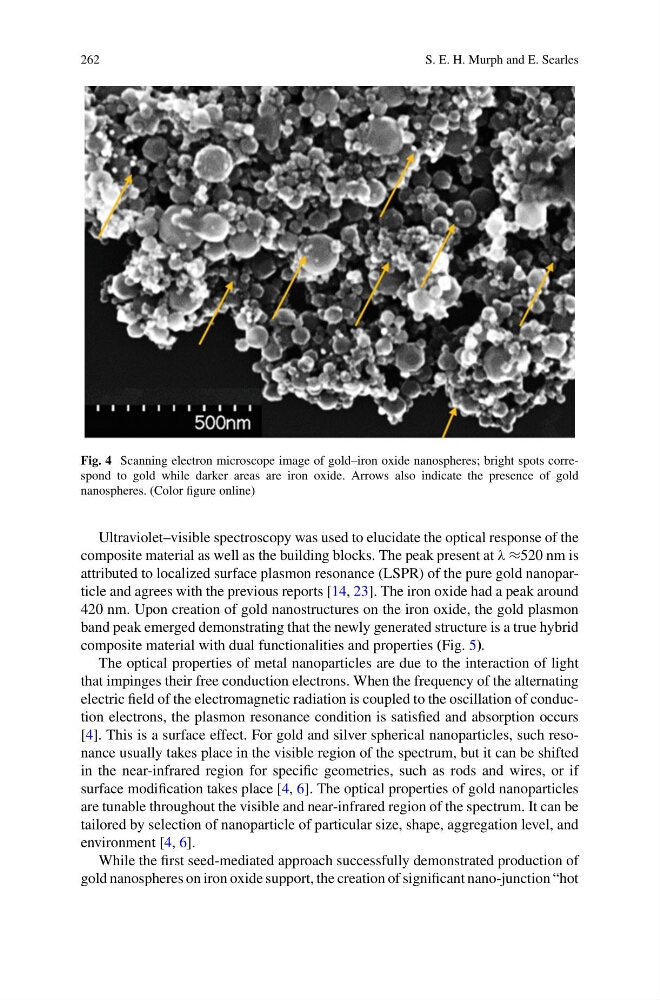
Fig. 4 Scanning electron microscope image of gold–iron oxide nanospheres; bright spots correspond to gold while darker areas are iron oxide. Arrows also indicate the presence of gold
nanospheres. (Color figure online)
Ultraviolet–visible spectroscopy was used to elucidate the optical response of the
composite material as well as the building blocks. The peak present at λ ≈520 nm is
attributed to localized surface plasmon resonance (LSPR) of the pure gold nanoparticle and agrees with the previous reports [14, 23]. The iron oxide had a peak around
420 nm. Upon creation of gold nanostructures on the iron oxide, the gold plasmon
band peak emerged demonstrating that the newly generated structure is a true hybrid
composite material with dual functionalities and properties (Fig. 5).
The optical properties of metal nanoparticles are due to the interaction of light
that impinges their free conduction electrons. When the frequency of the alternating
electric field of the electromagnetic radiation is coupled to the oscillation of conduction electrons, the plasmon resonance condition is satisfied and absorption occurs
[4]. This is a surface effect. For gold and silver spherical nanoparticles, such resonance usually takes place in the visible region of the spectrum, but it can be shifted
in the near-infrared region for specific geometries, such as rods and wires, or if
surface modification takes place [4, 6]. The optical properties of gold nanoparticles
are tunable throughout the visible and near-infrared region of the spectrum. It can be
tailored by selection of nanoparticle of particular size, shape, aggregation level, and
environment [4, 6].
While the first seed-mediated approach successfully demonstrated production of
gold nanospheres on iron oxide support, the creation of significant nano-junction “hot
S. E. H. Murph and E. Searles
Fig. 4 Scanning electron microscope image of gold–iron oxide nanospheres; bright spots correspond to gold while darker areas are iron oxide. Arrows also indicate the presence of gold
nanospheres. (Color figure online)
Ultraviolet–visible spectroscopy was used to elucidate the optical response of the
composite material as well as the building blocks. The peak present at λ ≈520 nm is
attributed to localized surface plasmon resonance (LSPR) of the pure gold nanoparticle and agrees with the previous reports [14, 23]. The iron oxide had a peak around
420 nm. Upon creation of gold nanostructures on the iron oxide, the gold plasmon
band peak emerged demonstrating that the newly generated structure is a true hybrid
composite material with dual functionalities and properties (Fig. 5).
The optical properties of metal nanoparticles are due to the interaction of light
that impinges their free conduction electrons. When the frequency of the alternating
electric field of the electromagnetic radiation is coupled to the oscillation of conduction electrons, the plasmon resonance condition is satisfied and absorption occurs
[4]. This is a surface effect. For gold and silver spherical nanoparticles, such resonance usually takes place in the visible region of the spectrum, but it can be shifted
in the near-infrared region for specific geometries, such as rods and wires, or if
surface modification takes place [4, 6]. The optical properties of gold nanoparticles
are tunable throughout the visible and near-infrared region of the spectrum. It can be
tailored by selection of nanoparticle of particular size, shape, aggregation level, and
environment [4, 6].
While the first seed-mediated approach successfully demonstrated production of
gold nanospheres on iron oxide support, the creation of significant nano-junction “hot