

Iron Oxide–Gold Composite Nanoparticles and Nano-Gap Junctions …
263
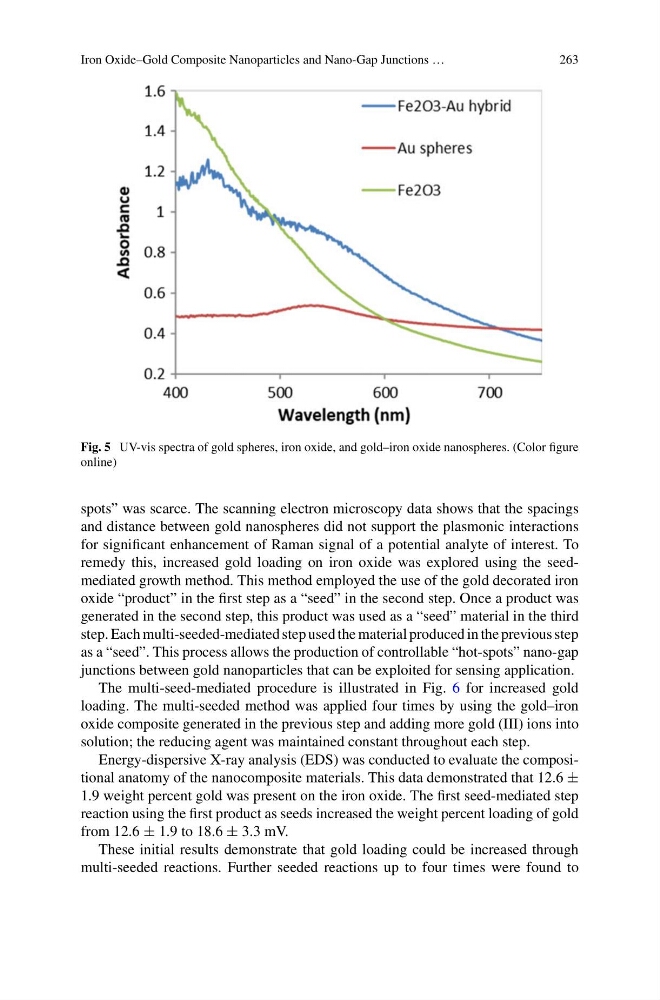
Fig. 5 UV-vis spectra of gold spheres, iron oxide, and gold–iron oxide nanospheres. (Color figure
online)
spots” was scarce. The scanning electron microscopy data shows that the spacings
and distance between gold nanospheres did not support the plasmonic interactions
for significant enhancement of Raman signal of a potential analyte of interest. To
remedy this, increased gold loading on iron oxide was explored using the seedmediated growth method. This method employed the use of the gold decorated iron
oxide “product” in the first step as a “seed” in the second step. Once a product was
generated in the second step, this product was used as a “seed” material in the third
step. Each multi-seeded-mediated step used the material produced in the previous step
as a “seed”. This process allows the production of controllable “hot-spots” nano-gap
junctions between gold nanoparticles that can be exploited for sensing application.
The multi-seed-mediated procedure is illustrated in Fig. 6 for increased gold
loading. The multi-seeded method was applied four times by using the gold–iron
oxide composite generated in the previous step and adding more gold (III) ions into
solution; the reducing agent was maintained constant throughout each step.
Energy-dispersive X-ray analysis (EDS) was conducted to evaluate the compositional anatomy of the nanocomposite materials. This data demonstrated that 12.6 ±
1.9 weight percent gold was present on the iron oxide. The first seed-mediated step
reaction using the first product as seeds increased the weight percent loading of gold
from 12.6 ± 1.9 to 18.6 ± 3.3 mV.
These initial results demonstrate that gold loading could be increased through
multi-seeded reactions. Further seeded reactions up to four times were found to
263
Fig. 5 UV-vis spectra of gold spheres, iron oxide, and gold–iron oxide nanospheres. (Color figure
online)
spots” was scarce. The scanning electron microscopy data shows that the spacings
and distance between gold nanospheres did not support the plasmonic interactions
for significant enhancement of Raman signal of a potential analyte of interest. To
remedy this, increased gold loading on iron oxide was explored using the seedmediated growth method. This method employed the use of the gold decorated iron
oxide “product” in the first step as a “seed” in the second step. Once a product was
generated in the second step, this product was used as a “seed” material in the third
step. Each multi-seeded-mediated step used the material produced in the previous step
as a “seed”. This process allows the production of controllable “hot-spots” nano-gap
junctions between gold nanoparticles that can be exploited for sensing application.
The multi-seed-mediated procedure is illustrated in Fig. 6 for increased gold
loading. The multi-seeded method was applied four times by using the gold–iron
oxide composite generated in the previous step and adding more gold (III) ions into
solution; the reducing agent was maintained constant throughout each step.
Energy-dispersive X-ray analysis (EDS) was conducted to evaluate the compositional anatomy of the nanocomposite materials. This data demonstrated that 12.6 ±
1.9 weight percent gold was present on the iron oxide. The first seed-mediated step
reaction using the first product as seeds increased the weight percent loading of gold
from 12.6 ± 1.9 to 18.6 ± 3.3 mV.
These initial results demonstrate that gold loading could be increased through
multi-seeded reactions. Further seeded reactions up to four times were found to