

Kinetics and Thermodynamics of Metal Cluster Nucleation …
235
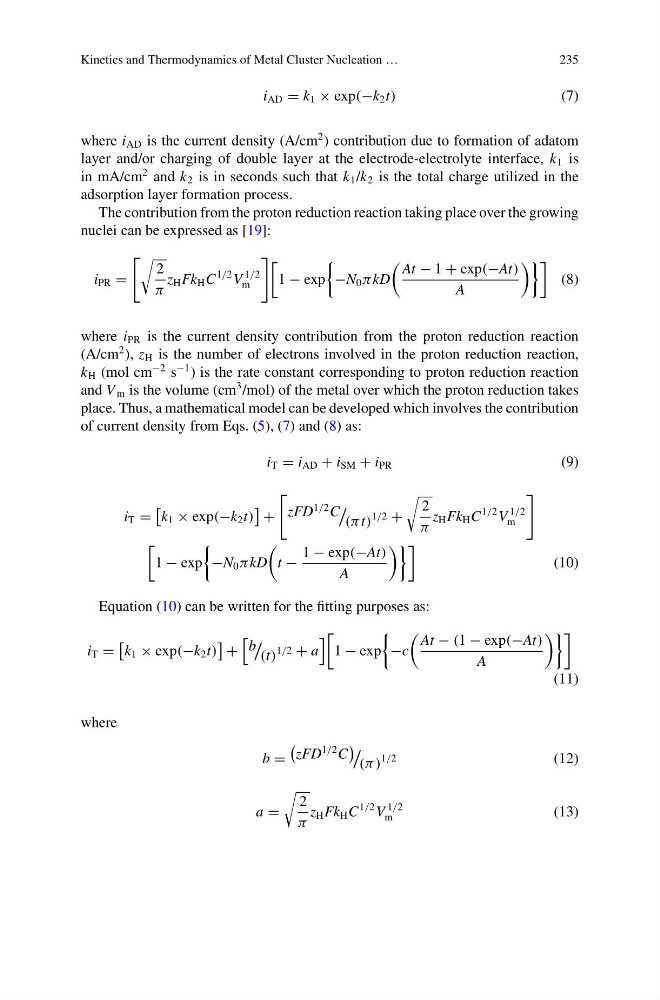
i AD = k 1 × exp(−k 2 t)
(7)
where i AD is the current density (A/cm
2 ) contribution due to formation of adatom
layer and/or charging of double layer at the electrode-electrolyte interface, k 1 is
in mA/cm
2 and k 2 is in seconds such that k 1 /k 2 is the total charge utilized in the
adsorption layer formation process.
The contribution from the proton reduction reaction taking place over the growing
nuclei can be expressed as [19]:
i PR =
2
π
z H Fk H C
1/2 V
1/2
m
1 − exp
−N 0 π kD
At − 1 + exp(−At)
A
(8)
where i PR is the current density contribution from the proton reduction reaction
(A/cm
2 ), z H is the number of electrons involved in the proton reduction reaction,
k H (mol cm
−2 s
−1 ) is the rate constant corresponding to proton reduction reaction
and V m is the volume (cm
3 /mol) of the metal over which the proton reduction takes
place. Thus, a mathematical model can be developed which involves the contribution
of current density from Eqs. (5), (7) and (8) as:
i T = i AD + i SM + i PR
(9)
i T =
k 1 × exp(−k 2 t)
+
zFD
1/2 C
(π t)
1/2 +
2
π
z H Fk H C
1/2 V
1/2
m
1 − exp
−N 0 π kD
t −
1 − exp(−At)
A
(10)
Equation (10) can be written for the fitting purposes as:
i T =
k 1 × exp(−k 2 t)
+
b
(t)
1/2 + a
1 − exp
−c
At − (1 − exp(−At)
A
(11)
where
b =
zFD
1/2 C
(π )
1/2
(12)
a =
2
π
z H Fk H C
1/2 V
1/2
m
(13)
235
i AD = k 1 × exp(−k 2 t)
(7)
where i AD is the current density (A/cm
2 ) contribution due to formation of adatom
layer and/or charging of double layer at the electrode-electrolyte interface, k 1 is
in mA/cm
2 and k 2 is in seconds such that k 1 /k 2 is the total charge utilized in the
adsorption layer formation process.
The contribution from the proton reduction reaction taking place over the growing
nuclei can be expressed as [19]:
i PR =
2
π
z H Fk H C
1/2 V
1/2
m
1 − exp
−N 0 π kD
At − 1 + exp(−At)
A
(8)
where i PR is the current density contribution from the proton reduction reaction
(A/cm
2 ), z H is the number of electrons involved in the proton reduction reaction,
k H (mol cm
−2 s
−1 ) is the rate constant corresponding to proton reduction reaction
and V m is the volume (cm
3 /mol) of the metal over which the proton reduction takes
place. Thus, a mathematical model can be developed which involves the contribution
of current density from Eqs. (5), (7) and (8) as:
i T = i AD + i SM + i PR
(9)
i T =
k 1 × exp(−k 2 t)
+
zFD
1/2 C
(π t)
1/2 +
2
π
z H Fk H C
1/2 V
1/2
m
1 − exp
−N 0 π kD
t −
1 − exp(−At)
A
(10)
Equation (10) can be written for the fitting purposes as:
i T =
k 1 × exp(−k 2 t)
+
b
(t)
1/2 + a
1 − exp
−c
At − (1 − exp(−At)
A
(11)
where
b =
zFD
1/2 C
(π )
1/2
(12)
a =
2
π
z H Fk H C
1/2 V
1/2
m
(13)