

Recent Advances in the Analysis, Measurement, and Properties …
207
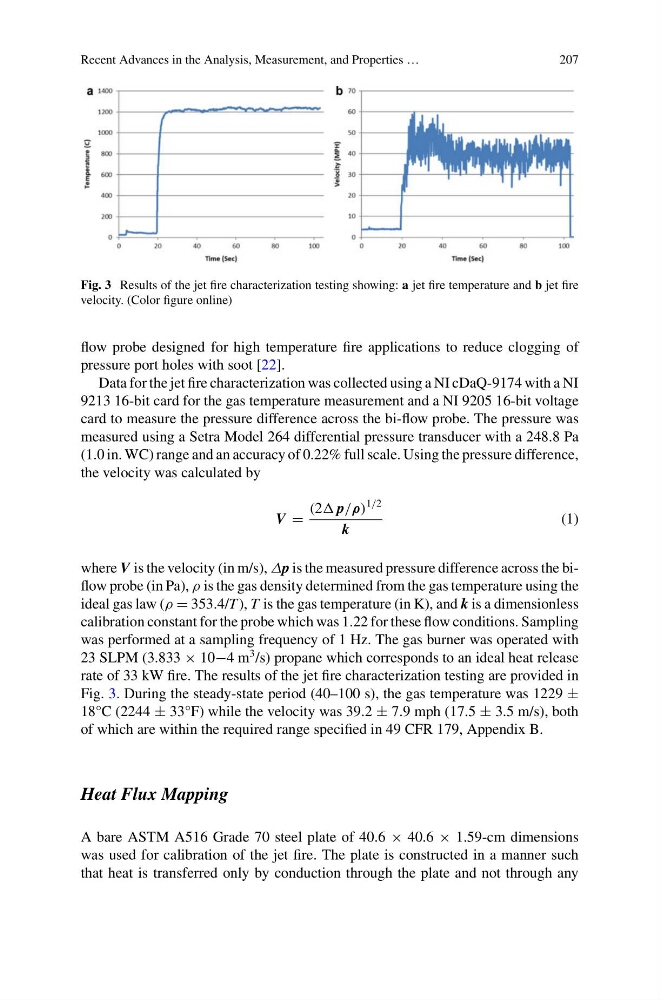
Fig. 3 Results of the jet fire characterization testing showing: a jet fire temperature and b jet fire
velocity. (Color figure online)
flow probe designed for high temperature fire applications to reduce clogging of
pressure port holes with soot [22].
Data for the jet fire characterization was collected using a NI cDaQ-9174 with a NI
9213 16-bit card for the gas temperature measurement and a NI 9205 16-bit voltage
card to measure the pressure difference across the bi-flow probe. The pressure was
measured using a Setra Model 264 differential pressure transducer with a 248.8 Pa
(1.0 in. WC) range and an accuracy of 0.22% full scale. Using the pressure difference,
the velocity was calculated by
V =
(2 p/ρ)
1/2
k
(1)
where V is the velocity (in m/s), Δp is the measured pressure difference across the biflow probe (in Pa), ρ is the gas density determined from the gas temperature using the
ideal gas law (ρ = 353.4/T ), T is the gas temperature (in K), and k is a dimensionless
calibration constant for the probe which was 1.22 for these flow conditions. Sampling
was performed at a sampling frequency of 1 Hz. The gas burner was operated with
23 SLPM (3.833 × 10⁻⁴ m
3 /s) propane which corresponds to an ideal heat release
rate of 33 kW fire. The results of the jet fire characterization testing are provided in
Fig. 3. During the steady-state period (40–100 s), the gas temperature was 1229 ±
18°C (2244 ± 33°F) while the velocity was 39.2 ± 7.9 mph (17.5 ± 3.5 m/s), both
of which are within the required range specified in 49 CFR 179, Appendix B.
Heat Flux Mapping
A bare ASTM A516 Grade 70 steel plate of 40.6 × 40.6 × 1.59-cm dimensions
was used for calibration of the jet fire. The plate is constructed in a manner such
that heat is transferred only by conduction through the plate and not through any
207
Fig. 3 Results of the jet fire characterization testing showing: a jet fire temperature and b jet fire
velocity. (Color figure online)
flow probe designed for high temperature fire applications to reduce clogging of
pressure port holes with soot [22].
Data for the jet fire characterization was collected using a NI cDaQ-9174 with a NI
9213 16-bit card for the gas temperature measurement and a NI 9205 16-bit voltage
card to measure the pressure difference across the bi-flow probe. The pressure was
measured using a Setra Model 264 differential pressure transducer with a 248.8 Pa
(1.0 in. WC) range and an accuracy of 0.22% full scale. Using the pressure difference,
the velocity was calculated by
V =
(2 p/ρ)
1/2
k
(1)
where V is the velocity (in m/s), Δp is the measured pressure difference across the biflow probe (in Pa), ρ is the gas density determined from the gas temperature using the
ideal gas law (ρ = 353.4/T ), T is the gas temperature (in K), and k is a dimensionless
calibration constant for the probe which was 1.22 for these flow conditions. Sampling
was performed at a sampling frequency of 1 Hz. The gas burner was operated with
23 SLPM (3.833 × 10⁻⁴ m
3 /s) propane which corresponds to an ideal heat release
rate of 33 kW fire. The results of the jet fire characterization testing are provided in
Fig. 3. During the steady-state period (40–100 s), the gas temperature was 1229 ±
18°C (2244 ± 33°F) while the velocity was 39.2 ± 7.9 mph (17.5 ± 3.5 m/s), both
of which are within the required range specified in 49 CFR 179, Appendix B.
Heat Flux Mapping
A bare ASTM A516 Grade 70 steel plate of 40.6 × 40.6 × 1.59-cm dimensions
was used for calibration of the jet fire. The plate is constructed in a manner such
that heat is transferred only by conduction through the plate and not through any