

208
A. Rabiei et al.
0.305 m (12.0 in.)
25.4 mm
(1.0 in.)
12.7 mm
(0.5 in.)
x=0
x=127 mm
(5.0 in.)
Heat Flux
Measurement
Locations
(a)
(b)
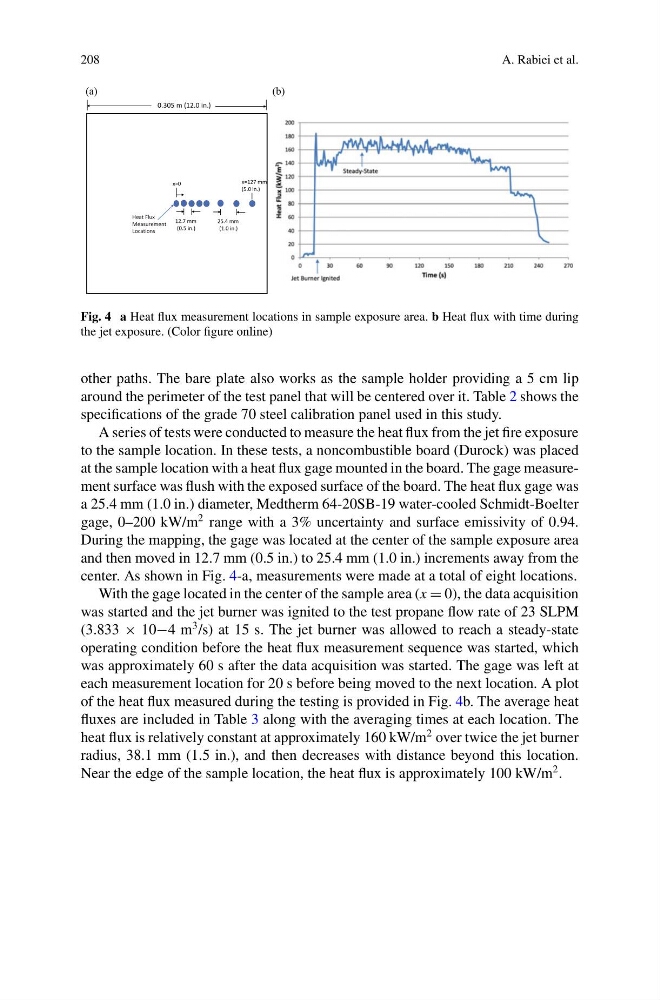
Fig. 4 a Heat flux measurement locations in sample exposure area. b Heat flux with time during
the jet exposure. (Color figure online)
other paths. The bare plate also works as the sample holder providing a 5 cm lip
around the perimeter of the test panel that will be centered over it. Table 2 shows the
specifications of the grade 70 steel calibration panel used in this study.
A series of tests were conducted to measure the heat flux from the jet fire exposure
to the sample location. In these tests, a noncombustible board (Durock) was placed
at the sample location with a heat flux gage mounted in the board. The gage measurement surface was flush with the exposed surface of the board. The heat flux gage was
a 25.4 mm (1.0 in.) diameter, Medtherm 64-20SB-19 water-cooled Schmidt-Boelter
gage, 0–200 kW/m
2 range with a 3% uncertainty and surface emissivity of 0.94.
During the mapping, the gage was located at the center of the sample exposure area
and then moved in 12.7 mm (0.5 in.) to 25.4 mm (1.0 in.) increments away from the
center. As shown in Fig. 4-a, measurements were made at a total of eight locations.
With the gage located in the center of the sample area (x = 0), the data acquisition
was started and the jet burner was ignited to the test propane flow rate of 23 SLPM
(3.833 × 10⁻⁴ m
3 /s) at 15 s. The jet burner was allowed to reach a steady-state
operating condition before the heat flux measurement sequence was started, which
was approximately 60 s after the data acquisition was started. The gage was left at
each measurement location for 20 s before being moved to the next location. A plot
of the heat flux measured during the testing is provided in Fig. 4b. The average heat
fluxes are included in Table 3 along with the averaging times at each location. The
heat flux is relatively constant at approximately 160 kW/m
2 over twice the jet burner
radius, 38.1 mm (1.5 in.), and then decreases with distance beyond this location.
Near the edge of the sample location, the heat flux is approximately 100 kW/m
2 .
A. Rabiei et al.
0.305 m (12.0 in.)
25.4 mm
(1.0 in.)
12.7 mm
(0.5 in.)
x=0
x=127 mm
(5.0 in.)
Heat Flux
Measurement
Locations
(a)
(b)
Fig. 4 a Heat flux measurement locations in sample exposure area. b Heat flux with time during
the jet exposure. (Color figure online)
other paths. The bare plate also works as the sample holder providing a 5 cm lip
around the perimeter of the test panel that will be centered over it. Table 2 shows the
specifications of the grade 70 steel calibration panel used in this study.
A series of tests were conducted to measure the heat flux from the jet fire exposure
to the sample location. In these tests, a noncombustible board (Durock) was placed
at the sample location with a heat flux gage mounted in the board. The gage measurement surface was flush with the exposed surface of the board. The heat flux gage was
a 25.4 mm (1.0 in.) diameter, Medtherm 64-20SB-19 water-cooled Schmidt-Boelter
gage, 0–200 kW/m
2 range with a 3% uncertainty and surface emissivity of 0.94.
During the mapping, the gage was located at the center of the sample exposure area
and then moved in 12.7 mm (0.5 in.) to 25.4 mm (1.0 in.) increments away from the
center. As shown in Fig. 4-a, measurements were made at a total of eight locations.
With the gage located in the center of the sample area (x = 0), the data acquisition
was started and the jet burner was ignited to the test propane flow rate of 23 SLPM
(3.833 × 10⁻⁴ m
3 /s) at 15 s. The jet burner was allowed to reach a steady-state
operating condition before the heat flux measurement sequence was started, which
was approximately 60 s after the data acquisition was started. The gage was left at
each measurement location for 20 s before being moved to the next location. A plot
of the heat flux measured during the testing is provided in Fig. 4b. The average heat
fluxes are included in Table 3 along with the averaging times at each location. The
heat flux is relatively constant at approximately 160 kW/m
2 over twice the jet burner
radius, 38.1 mm (1.5 in.), and then decreases with distance beyond this location.
Near the edge of the sample location, the heat flux is approximately 100 kW/m
2 .