

156
T. Das
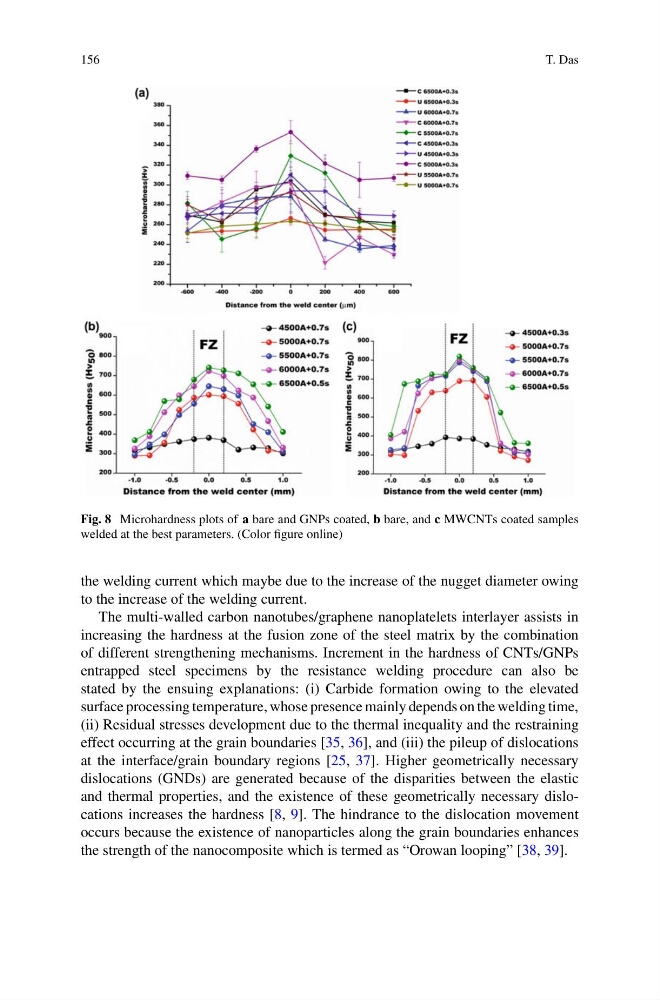
Fig. 8 Microhardness plots of a bare and GNPs coated, b bare, and c MWCNTs coated samples
welded at the best parameters. (Color figure online)
the welding current which maybe due to the increase of the nugget diameter owing
to the increase of the welding current.
The multi-walled carbon nanotubes/graphene nanoplatelets interlayer assists in
increasing the hardness at the fusion zone of the steel matrix by the combination
of different strengthening mechanisms. Increment in the hardness of CNTs/GNPs
entrapped steel specimens by the resistance welding procedure can also be
stated by the ensuing explanations: (i) Carbide formation owing to the elevated
surface processing temperature, whose presence mainly depends on the welding time,
(ii) Residual stresses development due to the thermal inequality and the restraining
effect occurring at the grain boundaries [35, 36], and (iii) the pileup of dislocations
at the interface/grain boundary regions [25, 37]. Higher geometrically necessary
dislocations (GNDs) are generated because of the disparities between the elastic
and thermal properties, and the existence of these geometrically necessary dislocations increases the hardness [8, 9]. The hindrance to the dislocation movement
occurs because the existence of nanoparticles along the grain boundaries enhances
the strength of the nanocomposite which is termed as “Orowan looping” [38, 39].
T. Das
Fig. 8 Microhardness plots of a bare and GNPs coated, b bare, and c MWCNTs coated samples
welded at the best parameters. (Color figure online)
the welding current which maybe due to the increase of the nugget diameter owing
to the increase of the welding current.
The multi-walled carbon nanotubes/graphene nanoplatelets interlayer assists in
increasing the hardness at the fusion zone of the steel matrix by the combination
of different strengthening mechanisms. Increment in the hardness of CNTs/GNPs
entrapped steel specimens by the resistance welding procedure can also be
stated by the ensuing explanations: (i) Carbide formation owing to the elevated
surface processing temperature, whose presence mainly depends on the welding time,
(ii) Residual stresses development due to the thermal inequality and the restraining
effect occurring at the grain boundaries [35, 36], and (iii) the pileup of dislocations
at the interface/grain boundary regions [25, 37]. Higher geometrically necessary
dislocations (GNDs) are generated because of the disparities between the elastic
and thermal properties, and the existence of these geometrically necessary dislocations increases the hardness [8, 9]. The hindrance to the dislocation movement
occurs because the existence of nanoparticles along the grain boundaries enhances
the strength of the nanocomposite which is termed as “Orowan looping” [38, 39].