

A Comparative Study on the Effect of Graphene and Multi-walled …
155
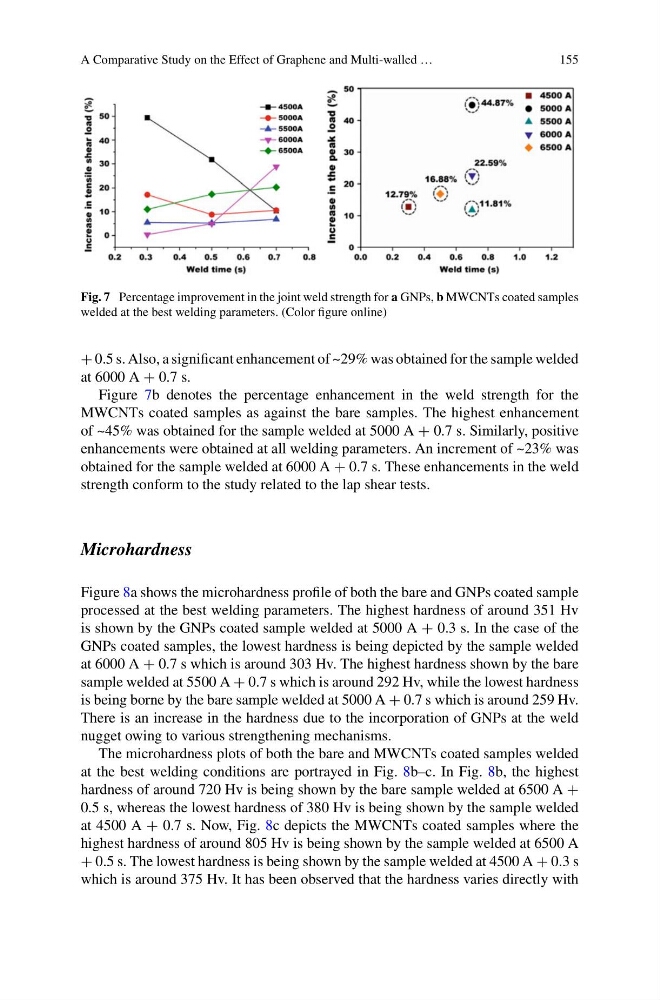
Fig. 7 Percentage improvement in the joint weld strength for a GNPs, b MWCNTs coated samples
welded at the best welding parameters. (Color figure online)
+ 0.5 s. Also, a significant enhancement of ~29% was obtained for the sample welded
at 6000 A + 0.7 s.
Figure 7b denotes the percentage enhancement in the weld strength for the
MWCNTs coated samples as against the bare samples. The highest enhancement
of ~45% was obtained for the sample welded at 5000 A + 0.7 s. Similarly, positive
enhancements were obtained at all welding parameters. An increment of ~23% was
obtained for the sample welded at 6000 A + 0.7 s. These enhancements in the weld
strength conform to the study related to the lap shear tests.
Microhardness
Figure 8a shows the microhardness profile of both the bare and GNPs coated sample
processed at the best welding parameters. The highest hardness of around 351 Hv
is shown by the GNPs coated sample welded at 5000 A + 0.3 s. In the case of the
GNPs coated samples, the lowest hardness is being depicted by the sample welded
at 6000 A + 0.7 s which is around 303 Hv. The highest hardness shown by the bare
sample welded at 5500 A + 0.7 s which is around 292 Hv, while the lowest hardness
is being borne by the bare sample welded at 5000 A + 0.7 s which is around 259 Hv.
There is an increase in the hardness due to the incorporation of GNPs at the weld
nugget owing to various strengthening mechanisms.
The microhardness plots of both the bare and MWCNTs coated samples welded
at the best welding conditions are portrayed in Fig. 8b–c. In Fig. 8b, the highest
hardness of around 720 Hv is being shown by the bare sample welded at 6500 A +
0.5 s, whereas the lowest hardness of 380 Hv is being shown by the sample welded
at 4500 A + 0.7 s. Now, Fig. 8c depicts the MWCNTs coated samples where the
highest hardness of around 805 Hv is being shown by the sample welded at 6500 A
+ 0.5 s. The lowest hardness is being shown by the sample welded at 4500 A + 0.3 s
which is around 375 Hv. It has been observed that the hardness varies directly with
155
Fig. 7 Percentage improvement in the joint weld strength for a GNPs, b MWCNTs coated samples
welded at the best welding parameters. (Color figure online)
+ 0.5 s. Also, a significant enhancement of ~29% was obtained for the sample welded
at 6000 A + 0.7 s.
Figure 7b denotes the percentage enhancement in the weld strength for the
MWCNTs coated samples as against the bare samples. The highest enhancement
of ~45% was obtained for the sample welded at 5000 A + 0.7 s. Similarly, positive
enhancements were obtained at all welding parameters. An increment of ~23% was
obtained for the sample welded at 6000 A + 0.7 s. These enhancements in the weld
strength conform to the study related to the lap shear tests.
Microhardness
Figure 8a shows the microhardness profile of both the bare and GNPs coated sample
processed at the best welding parameters. The highest hardness of around 351 Hv
is shown by the GNPs coated sample welded at 5000 A + 0.3 s. In the case of the
GNPs coated samples, the lowest hardness is being depicted by the sample welded
at 6000 A + 0.7 s which is around 303 Hv. The highest hardness shown by the bare
sample welded at 5500 A + 0.7 s which is around 292 Hv, while the lowest hardness
is being borne by the bare sample welded at 5000 A + 0.7 s which is around 259 Hv.
There is an increase in the hardness due to the incorporation of GNPs at the weld
nugget owing to various strengthening mechanisms.
The microhardness plots of both the bare and MWCNTs coated samples welded
at the best welding conditions are portrayed in Fig. 8b–c. In Fig. 8b, the highest
hardness of around 720 Hv is being shown by the bare sample welded at 6500 A +
0.5 s, whereas the lowest hardness of 380 Hv is being shown by the sample welded
at 4500 A + 0.7 s. Now, Fig. 8c depicts the MWCNTs coated samples where the
highest hardness of around 805 Hv is being shown by the sample welded at 6500 A
+ 0.5 s. The lowest hardness is being shown by the sample welded at 4500 A + 0.3 s
which is around 375 Hv. It has been observed that the hardness varies directly with