

140
R. Goswami et al.
σ = 0.84 Gb/λ
(1)
where λ is the inter-precipitate distance, G is the shear modulus, b is the Burgers
vector. Using G = 45 GPa, b = 0.25 nm, r = 5 nm and λ ≈ 30 nm, the increase
in strength from Eq. 1 is 315.00 MPa. From TEM studies we observe that the
interparticle spacing ranges from 20 to 30 nm.
Thus, the increase in strength due to the Orowan mechanism would mostly account
for the observed increase in strength for the composite as compared to the commercially pure copper. To get the overall idea about bond strength, we obtain elastic
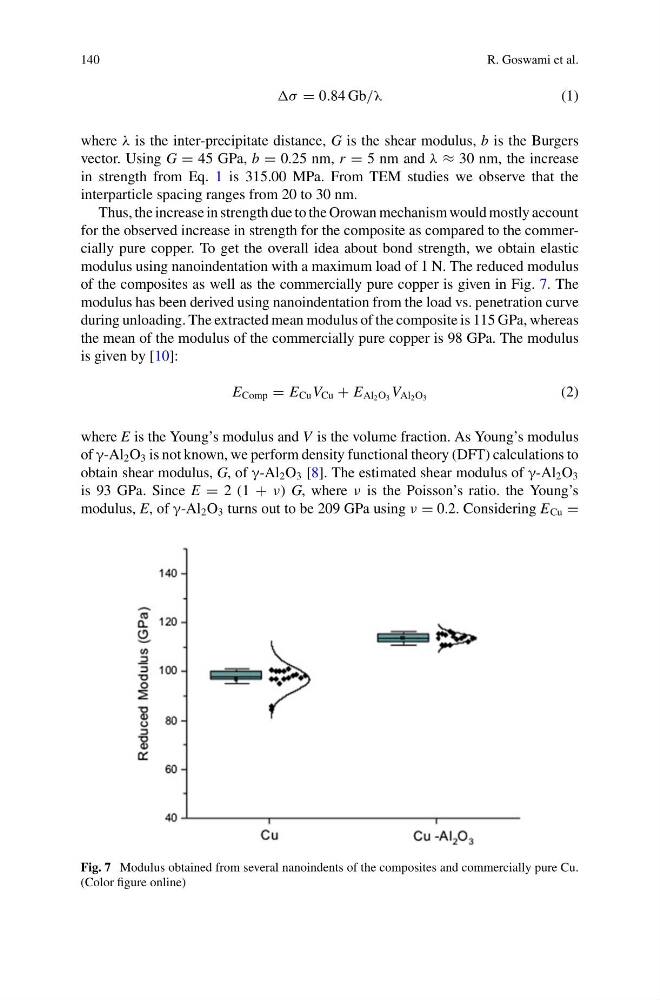
modulus using nanoindentation with a maximum load of 1 N. The reduced modulus
of the composites as well as the commercially pure copper is given in Fig. 7. The
modulus has been derived using nanoindentation from the load vs. penetration curve
during unloading. The extracted mean modulus of the composite is 115 GPa, whereas
the mean of the modulus of the commercially pure copper is 98 GPa. The modulus
is given by [10]:
E Comp = E Cu V Cu + E Al 2 O 3 V Al 2 O 3
(2)
where E is the Young’s modulus and V is the volume fraction. As Young’s modulus
of γ-Al 2 O 3 is not known, we perform density functional theory (DFT) calculations to
obtain shear modulus, G, of γ-Al 2 O 3 [8]. The estimated shear modulus of γ-Al 2 O 3
is 93 GPa. Since E = 2 (1 + ν) G, where ν is the Poisson’s ratio. the Young’s
modulus, E, of γ-Al 2 O 3 turns out to be 209 GPa using ν = 0.2. Considering E Cu =
Fig. 7 Modulus obtained from several nanoindents of the composites and commercially pure Cu.
(Color figure online)
R. Goswami et al.
σ = 0.84 Gb/λ
(1)
where λ is the inter-precipitate distance, G is the shear modulus, b is the Burgers
vector. Using G = 45 GPa, b = 0.25 nm, r = 5 nm and λ ≈ 30 nm, the increase
in strength from Eq. 1 is 315.00 MPa. From TEM studies we observe that the
interparticle spacing ranges from 20 to 30 nm.
Thus, the increase in strength due to the Orowan mechanism would mostly account
for the observed increase in strength for the composite as compared to the commercially pure copper. To get the overall idea about bond strength, we obtain elastic
modulus using nanoindentation with a maximum load of 1 N. The reduced modulus
of the composites as well as the commercially pure copper is given in Fig. 7. The
modulus has been derived using nanoindentation from the load vs. penetration curve
during unloading. The extracted mean modulus of the composite is 115 GPa, whereas
the mean of the modulus of the commercially pure copper is 98 GPa. The modulus
is given by [10]:
E Comp = E Cu V Cu + E Al 2 O 3 V Al 2 O 3
(2)
where E is the Young’s modulus and V is the volume fraction. As Young’s modulus
of γ-Al 2 O 3 is not known, we perform density functional theory (DFT) calculations to
obtain shear modulus, G, of γ-Al 2 O 3 [8]. The estimated shear modulus of γ-Al 2 O 3
is 93 GPa. Since E = 2 (1 + ν) G, where ν is the Poisson’s ratio. the Young’s
modulus, E, of γ-Al 2 O 3 turns out to be 209 GPa using ν = 0.2. Considering E Cu =
Fig. 7 Modulus obtained from several nanoindents of the composites and commercially pure Cu.
(Color figure online)