

Correlation of Fine Scale Microstructure and Mechanical …
137
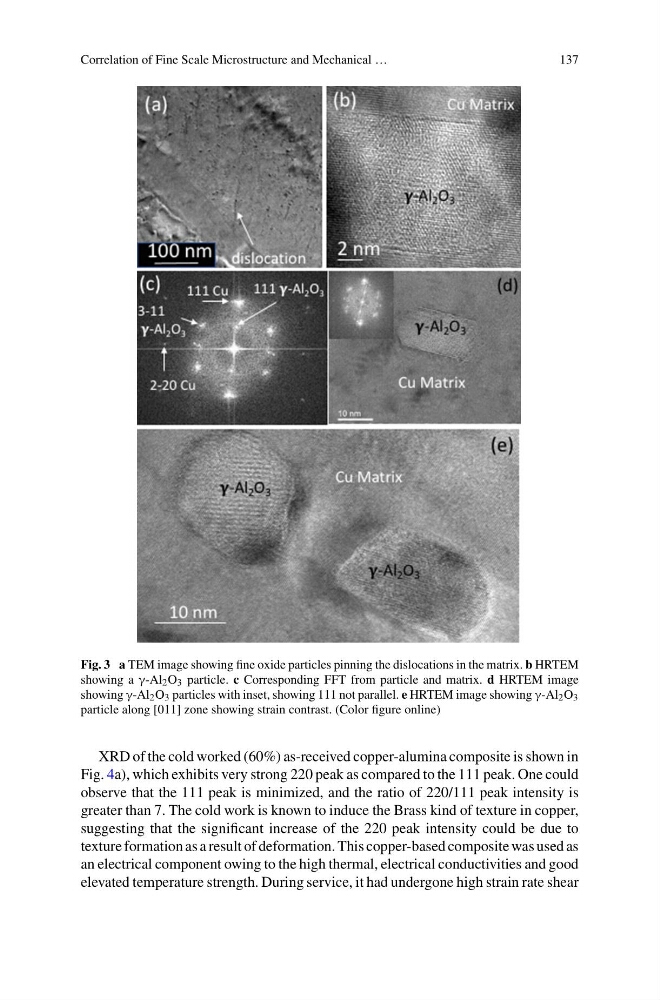
Fig. 3 a TEM image showing fine oxide particles pinning the dislocations in the matrix. b HRTEM
showing a γ-Al 2 O 3 particle. c Corresponding FFT from particle and matrix. d HRTEM image
showing γ-Al 2 O 3 particles with inset, showing 111 not parallel. e HRTEM image showing γ-Al 2 O 3
particle along [011] zone showing strain contrast. (Color figure online)
XRD of the cold worked (60%) as-received copper-alumina composite is shown in
Fig. 4a), which exhibits very strong 220 peak as compared to the 111 peak. One could
observe that the 111 peak is minimized, and the ratio of 220/111 peak intensity is
greater than 7. The cold work is known to induce the Brass kind of texture in copper,
suggesting that the significant increase of the 220 peak intensity could be due to
texture formation as a result of deformation. This copper-based composite was used as
an electrical component owing to the high thermal, electrical conductivities and good
elevated temperature strength. During service, it had undergone high strain rate shear
137
Fig. 3 a TEM image showing fine oxide particles pinning the dislocations in the matrix. b HRTEM
showing a γ-Al 2 O 3 particle. c Corresponding FFT from particle and matrix. d HRTEM image
showing γ-Al 2 O 3 particles with inset, showing 111 not parallel. e HRTEM image showing γ-Al 2 O 3
particle along [011] zone showing strain contrast. (Color figure online)
XRD of the cold worked (60%) as-received copper-alumina composite is shown in
Fig. 4a), which exhibits very strong 220 peak as compared to the 111 peak. One could
observe that the 111 peak is minimized, and the ratio of 220/111 peak intensity is
greater than 7. The cold work is known to induce the Brass kind of texture in copper,
suggesting that the significant increase of the 220 peak intensity could be due to
texture formation as a result of deformation. This copper-based composite was used as
an electrical component owing to the high thermal, electrical conductivities and good
elevated temperature strength. During service, it had undergone high strain rate shear