

136
R. Goswami et al.
in this internal oxidation process, one could expect copper oxide, a small fraction
oxygen dissolved in the matrix and copper–aluminum–oxygen clusters. Such fine
dispersion of oxide particles and clusters increases the strength and could inhibit
recrystallization of the copper matrix at temperatures close to the melting point of
copper. The yield strength of this composite at room temperature is 475 MPa, and
it gradually changes to 300 MPa at elevated temperatures. We have observed that
most of the grain boundaries were free of these oxide particles. The high-resolution
TEM (HRTEM) image (see Fig. 1b), close to the [110] zone, shows microtwins in
the copper matrix as a result of deformation. The fast Fourier transform (FFT) from
this area shows the twin spots (see the inset) and streaks along the 111 direction.
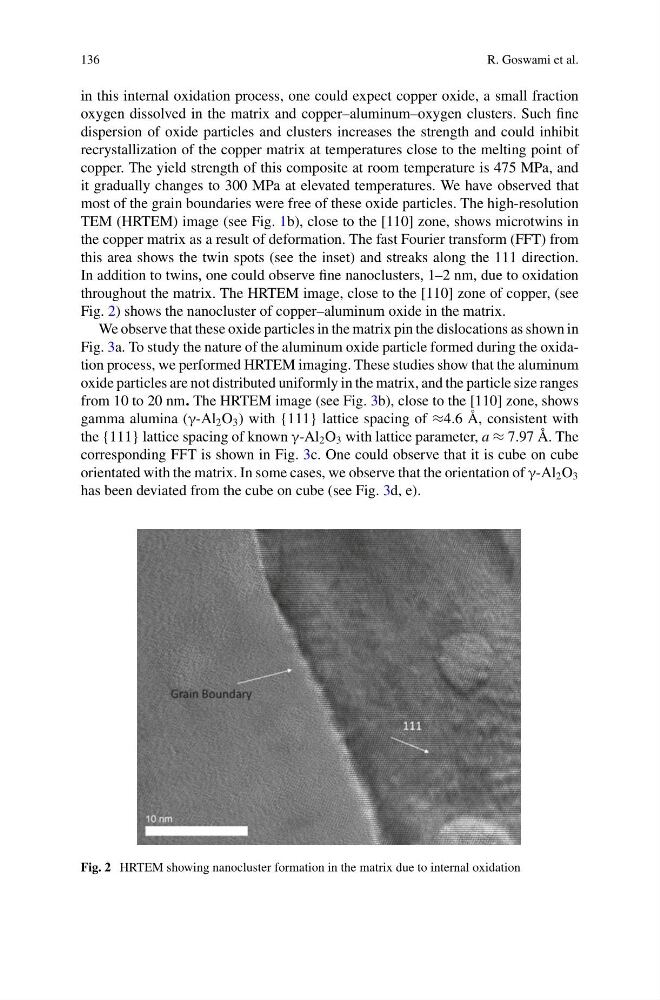
In addition to twins, one could observe fine nanoclusters, 1–2 nm, due to oxidation
throughout the matrix. The HRTEM image, close to the [110] zone of copper, (see
Fig. 2) shows the nanocluster of copper–aluminum oxide in the matrix.
We observe that these oxide particles in the matrix pin the dislocations as shown in
Fig. 3a. To study the nature of the aluminum oxide particle formed during the oxidation process, we performed HRTEM imaging. These studies show that the aluminum
oxide particles are not distributed uniformly in the matrix, and the particle size ranges
from 10 to 20 nm. The HRTEM image (see Fig. 3b), close to the [110] zone, shows
gamma alumina (γ-Al 2 O 3 ) with {111} lattice spacing of ≈4.6 Å, consistent with
the {111} lattice spacing of known γ-Al 2 O 3 with lattice parameter, a ≈ 7.97 Å. The
corresponding FFT is shown in Fig. 3c. One could observe that it is cube on cube
orientated with the matrix. In some cases, we observe that the orientation of γ-Al 2 O 3
has been deviated from the cube on cube (see Fig. 3d, e).
Fig. 2 HRTEM showing nanocluster formation in the matrix due to internal oxidation
R. Goswami et al.
in this internal oxidation process, one could expect copper oxide, a small fraction
oxygen dissolved in the matrix and copper–aluminum–oxygen clusters. Such fine
dispersion of oxide particles and clusters increases the strength and could inhibit
recrystallization of the copper matrix at temperatures close to the melting point of
copper. The yield strength of this composite at room temperature is 475 MPa, and
it gradually changes to 300 MPa at elevated temperatures. We have observed that
most of the grain boundaries were free of these oxide particles. The high-resolution
TEM (HRTEM) image (see Fig. 1b), close to the [110] zone, shows microtwins in
the copper matrix as a result of deformation. The fast Fourier transform (FFT) from
this area shows the twin spots (see the inset) and streaks along the 111 direction.
In addition to twins, one could observe fine nanoclusters, 1–2 nm, due to oxidation
throughout the matrix. The HRTEM image, close to the [110] zone of copper, (see
Fig. 2) shows the nanocluster of copper–aluminum oxide in the matrix.
We observe that these oxide particles in the matrix pin the dislocations as shown in
Fig. 3a. To study the nature of the aluminum oxide particle formed during the oxidation process, we performed HRTEM imaging. These studies show that the aluminum
oxide particles are not distributed uniformly in the matrix, and the particle size ranges
from 10 to 20 nm. The HRTEM image (see Fig. 3b), close to the [110] zone, shows
gamma alumina (γ-Al 2 O 3 ) with {111} lattice spacing of ≈4.6 Å, consistent with
the {111} lattice spacing of known γ-Al 2 O 3 with lattice parameter, a ≈ 7.97 Å. The
corresponding FFT is shown in Fig. 3c. One could observe that it is cube on cube
orientated with the matrix. In some cases, we observe that the orientation of γ-Al 2 O 3
has been deviated from the cube on cube (see Fig. 3d, e).
Fig. 2 HRTEM showing nanocluster formation in the matrix due to internal oxidation