

94
4 Four-Dimensional Superfield Supersymmetry
C = −
¯
sinh(is
¯
)
A =
1
[cosh(is
¯
) − 1].
(4.173)
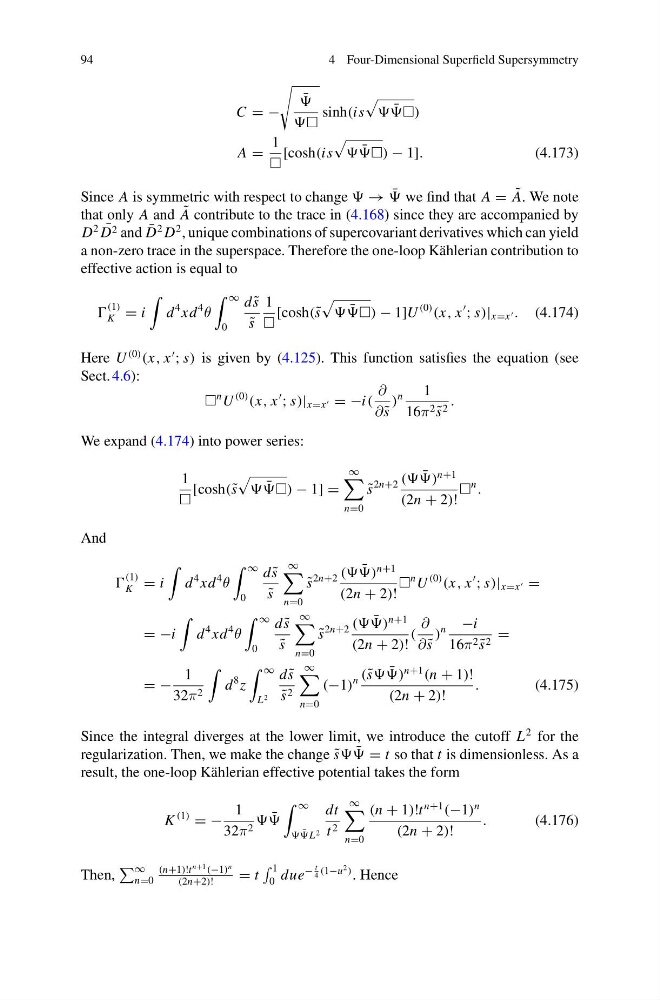
Since A is symmetric with respect to change → ¯
we find that A = ˜
A. We note
that only A and ˜
A contribute to the trace in (4.168) since they are accompanied by
D
2 ¯
D 2 and ¯
D
2 D
2 , unique combinations of supercovariant derivatives which can yield
a non-zero trace in the superspace. Therefore the one-loop Kählerian contribution to
effective action is equal to
(1)
K = i
d
4 xd
4
θ
∞
0
d ˜
s
˜
s
1
[cosh(˜ s
¯
) − 1]U
(0)
(x, x
; s)| x=x . (4.174)
Here U
(0)
(x, x
; s) is given by (4.125). This function satisfies the equation (see
Sect. 4.6):
n U
(0)
(x, x
; s)| x=x = −i(
∂
∂ ˜
s
)
n
1
16π 2 ˜
s 2 .
We expand (4.174) into power series:
1
[cosh(˜ s
¯
) − 1] =
∞
n=0
˜
s
2n+2 (( ¯
)
n+1
(2n + 2)!
n
.
And
(1)
K = i
d
4 xd
4
θ
∞
0
d ˜
s
˜
s
∞
n=0
˜
s
2n+2 (( ¯
)
n+1
(2n + 2)!
n U
(0)
(x, x
; s)| x=x =
= −i
d
4 xd
4
θ
∞
0
d ˜
s
˜
s
∞
n=0
˜
s
2n+2 (( ¯
)
n+1
(2n + 2)!
(
∂
∂ ˜
s
)
n
−i
16π 2 ˜
s 2 =
= −
1
32π 2
d
8 z
∞
L 2
d ˜
s
˜
s 2
∞
n=0
(−1)
n (˜ s ¯
)
n+1
(n + 1)!
(2n + 2)!
.
(4.175)
Since the integral diverges at the lower limit, we introduce the cutoff L
2 for the
regularization. Then, we make the change ˜
s ¯
= t so that t is dimensionless. As a
result, the one-loop Kählerian effective potential takes the form
K
(1)
= −
1
32π 2 ¯
∞
¯
L 2
dt
t 2
∞
n=0
(n + 1)!t
n+1
(−1)
n
(2n + 2)!
.
(4.176)
Then,
∞
n=0
(n+1)!t
n+1 (−1)
n
(2n+2)!
= t
1
0 due
−
t
4 (1−u
2 ) . Hence
4 Four-Dimensional Superfield Supersymmetry
C = −
¯
sinh(is
¯
)
A =
1
[cosh(is
¯
) − 1].
(4.173)
Since A is symmetric with respect to change → ¯
we find that A = ˜
A. We note
that only A and ˜
A contribute to the trace in (4.168) since they are accompanied by
D
2 ¯
D 2 and ¯
D
2 D
2 , unique combinations of supercovariant derivatives which can yield
a non-zero trace in the superspace. Therefore the one-loop Kählerian contribution to
effective action is equal to
(1)
K = i
d
4 xd
4
θ
∞
0
d ˜
s
˜
s
1
[cosh(˜ s
¯
) − 1]U
(0)
(x, x
; s)| x=x . (4.174)
Here U
(0)
(x, x
; s) is given by (4.125). This function satisfies the equation (see
Sect. 4.6):
n U
(0)
(x, x
; s)| x=x = −i(
∂
∂ ˜
s
)
n
1
16π 2 ˜
s 2 .
We expand (4.174) into power series:
1
[cosh(˜ s
¯
) − 1] =
∞
n=0
˜
s
2n+2 (( ¯
)
n+1
(2n + 2)!
n
.
And
(1)
K = i
d
4 xd
4
θ
∞
0
d ˜
s
˜
s
∞
n=0
˜
s
2n+2 (( ¯
)
n+1
(2n + 2)!
n U
(0)
(x, x
; s)| x=x =
= −i
d
4 xd
4
θ
∞
0
d ˜
s
˜
s
∞
n=0
˜
s
2n+2 (( ¯
)
n+1
(2n + 2)!
(
∂
∂ ˜
s
)
n
−i
16π 2 ˜
s 2 =
= −
1
32π 2
d
8 z
∞
L 2
d ˜
s
˜
s 2
∞
n=0
(−1)
n (˜ s ¯
)
n+1
(n + 1)!
(2n + 2)!
.
(4.175)
Since the integral diverges at the lower limit, we introduce the cutoff L
2 for the
regularization. Then, we make the change ˜
s ¯
= t so that t is dimensionless. As a
result, the one-loop Kählerian effective potential takes the form
K
(1)
= −
1
32π 2 ¯
∞
¯
L 2
dt
t 2
∞
n=0
(n + 1)!t
n+1
(−1)
n
(2n + 2)!
.
(4.176)
Then,
∞
n=0
(n+1)!t
n+1 (−1)
n
(2n+2)!
= t
1
0 due
−
t
4 (1−u
2 ) . Hence